After eons of tabloid scrutiny, the Duke of Sussex is fighting back and he’s brought receipts
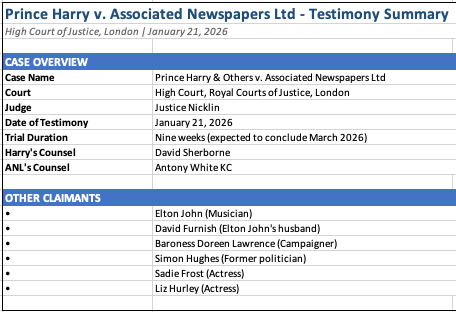
The scene outside London’s Royal Courts of Justice on January 21st had all the makings of a blockbuster premiere: rain-soaked reporters lined up behind barriers, camera flashes cutting through the grey morning, and a black Range Rover pulling up to deliver the main attraction.
Prince Harry, Duke of Sussex, had arrived for his day in court.
But this wasn’t entertainment. This was war a legal battle years in the making against the media empire Harry blames for destroying his peace, poisoning his relationships, and turning his wife’s life into what he emotionally described as “an absolute misery.”
The Players
On one side: Harry and six other high-profile claimants including music legend Elton John, his husband David Furnish, civil rights campaigner Baroness Doreen Lawrence, and actresses Sadie Frost and Liz Hurley.
On the other: Associated Newspapers Limited, publisher of the Daily Mail and Mail on Sunday are titans of British tabloid journalism with a combined readership in the millions.
The referee: Justice Nicklin, presiding over what’s expected to be a nine-week trial that could reshape the landscape of British media.
What Harry Says They Did
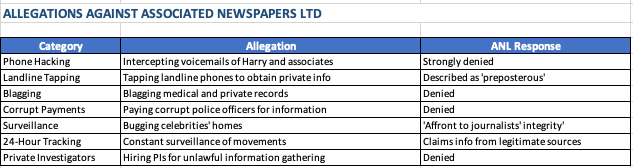
The allegations read like a spy thriller. According to the claimants, ANL journalists and their agents:
- Hacked into voicemails to intercept private messages
- Tapped landline telephones
- Obtained confidential medical records through deception
- Paid off corrupt police officers
- Deployed private investigators for round-the-clock surveillance
- Potentially bugged homes
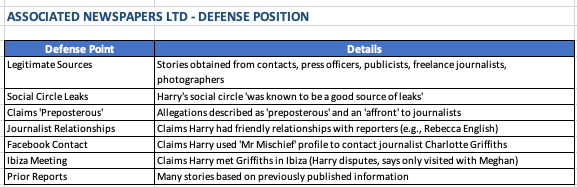
ANL says it’s all nonsense—”preposterous” accusations that insult their journalists’ integrity. They claim every story came from legitimate sources: friends in Harry’s circle, press officers, publicists, and previously published reports.
So who’s telling the truth? That’s what the next two months will determine.
The Testimony: Tense, Personal, and at Times Tearful
Harry spent hours in the witness box, parrying questions from ANL’s barrister Antony White KC while occasionally clashing with him over characterizations of his past.
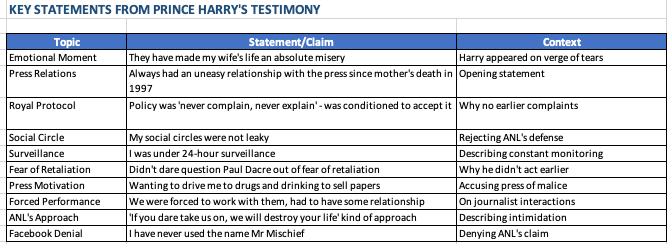
The atmosphere was electric. When White suggested Harry’s social circle had been feeding stories to journalists, the Duke shot back firmly: “My social circles were not leaky.”
When White claimed Harry had contacted a Mail on Sunday journalist using a Facebook profile called “Mr Mischief,” Harry didn’t hesitate: “I have never used the name Mr Mischief.”
And when White suggested Harry had once met journalist Charlotte Griffiths in Ibiza, the Duke’s response was pointed: “I don’t believe I have ever been to Ibiza other than with my now wife.”
The Breaking Point
But it was near the end of his testimony that Harry’s composure finally cracked.
Speaking about how ANL’s treatment of him has escalated since he began legal action, his voice wavered. He appeared on the verge of tears.
“They continue to come after me,” he said. “They have made my wife’s life an absolute misery, my lord.”
It was the kind of raw, unscripted moment that transcends legal proceedings—a glimpse of the human cost behind the headlines.
Born Into Suspicion
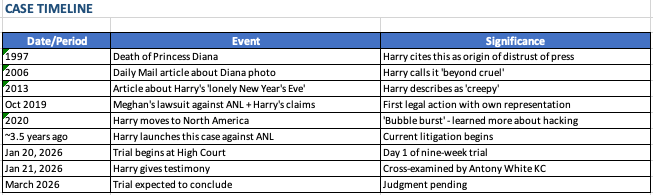
To understand Harry’s fight, you have to go back to 1997. He was 12 when his mother, Princess Diana, died in a Paris car crash while being pursued by paparazzi. The trauma shaped everything that followed.
“I have always had an uneasy relationship with the press,” Harry stated. But as a royal, he had no choice but to accept it. The palace mantra was “never complain, never explain.”
So he didn’t complain. He watched as articles appeared with details that seemed impossible for journalists to know. He suspected friends and bodyguards of leaking. He cut people out of his life. Relationships crumbled under the weight of paranoia.
“It feels creepy, like you’re constantly being watched, and you can’t trust anyone around you,” he told the court.
Now, he believes the real source wasn’t betrayal by those close to him—it was unlawful surveillance.
The Fear Factor
One of the most revealing aspects of Harry’s testimony was his explanation for why he never challenged the press earlier.
He specifically named Paul Dacre, the Daily Mail’s legendary editor-in-chief, describing ANL’s approach as uniquely intimidating.
“By going on the offensive, rather than the defensive, they had me so convinced that I didn’t even think twice about it,” Harry said. “Nor did I dare question Paul Dacre out of fear of retaliation.”
He described their unspoken message: “If you dare take us on, we will destroy your life.”
For years, that threat worked. Harry stayed silent.
What Changed
Two things shifted the calculus.
First, in late 2016, Harry’s relationship with Meghan Markle went public. The coverage that followed—which Harry described as “vicious” and at times “racist”—made silence impossible.
Second, in 2020, Harry and Meghan stepped back from royal duties and moved to North America. For the first time, Harry had his own legal team, independent of the palace.
“It is not an exaggeration to say that the bubble burst in terms of what I knew in 2020,” he said.
Free from institutional constraints, he finally felt able to fight.
The Defense Strategy
ANL’s legal team is working to establish that Harry was more chummy with journalists than he admits, and that his inner circle was the real source of leaked information.
They’ve pointed to alleged phone calls where Harry thanked reporter Rebecca English. They’ve raised the “Mr Mischief” Facebook claim. They’ve suggested journalist Charlotte Griffiths moved in Harry’s social circles.
Harry has disputed or denied each point, maintaining that any cooperation with journalists was “forced” by his royal role.
“We were forced to work with them, we had to have some kind of relationship with them,” he said. “I am not friends with any of these journalists, and never have been.”
Why This Matters Beyond Harry
Strip away the royal drama, and this case raises fundamental questions about press accountability in Britain.
If Harry and his co-claimants prove their allegations, it would mean one of the country’s most powerful media organizations systematically broke the law while publicly denying it—including in sworn testimony at the Leveson Inquiry.
Harry framed the stakes in his written statement:
“If the defendant… can evade justice without there being a trial of my claims, then what does that say about the industry as a whole and the consequences for our great country?”
It’s a question that extends far beyond one prince’s grievances. It’s about whether powerful institutions can be held accountable when they allegedly abuse that power.
The Long Road Ahead
The trial will continue through March. Paul Dacre is expected to testify. More revelations will likely emerge.
For now, Harry has said his piece. He’s made clear he’s not backing down, regardless of the cost.
“I am determined to hold Associated accountable, for everyone’s sake,” he stated. “I am committed to pursuing this claim because I believe it is in the public’s interest.”
The court will ultimately decide whether his claims have merit. But whatever the verdict, Harry’s testimony has already achieved something: it’s put the practices of Britain’s tabloid press back on trial in the court of public opinion.
And this time, the Duke of Sussex is the one asking the questions.
The trial of Prince Harry & Others v. Associated Newspapers Ltd continues at the High Court in London. A verdict is expected later this year.
 celebchai.com