Let’s talk about institutional crisis management and the language of careful distance.
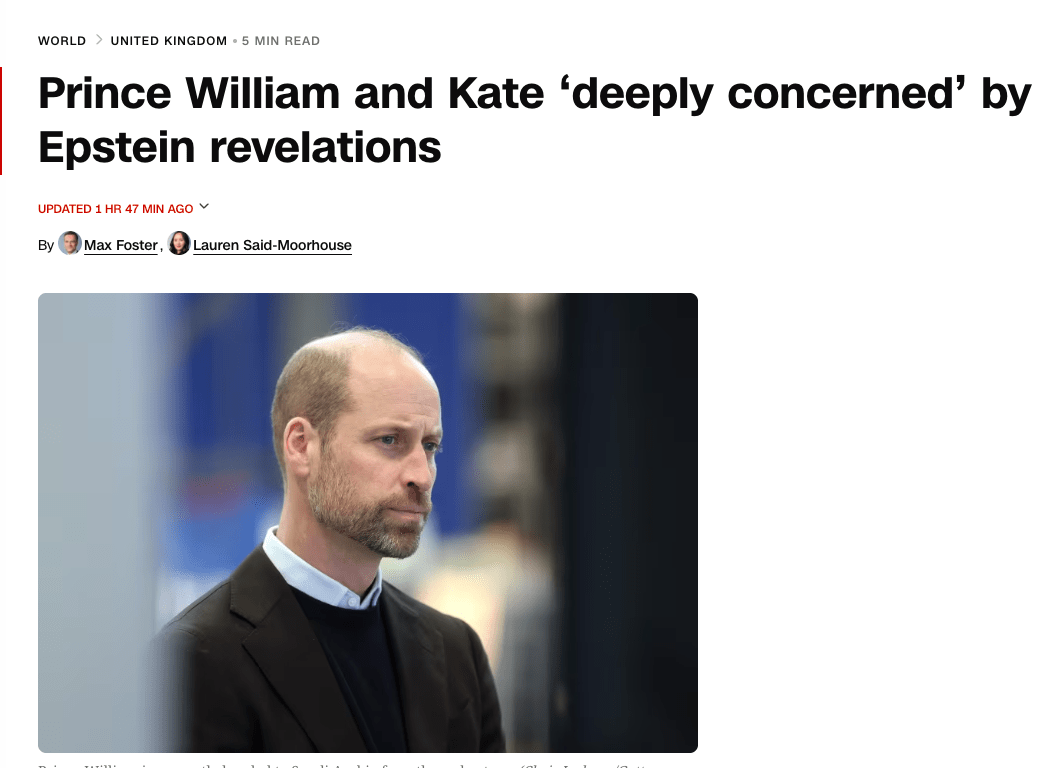
CNN reported that Prince William and Kate expressed being “deeply concerned” about continuing Jeffrey Epstein revelations involving Andrew Mountbatten-Windsor—the former Prince Andrew, who was stripped of his titles in October after years of scandal related to his ties to the convicted sex offender.
The statement came just hours before William’s departure for a diplomatic trip to Saudi Arabia, a timing that’s anything but coincidental. And the language—oh, the language—reveals everything about how institutions handle crises when they actually threaten the system versus when they need to manufacture threats to people they’ve decided to exclude.
The Language of Strategic Distance
Notice what William and Kate’s spokesperson said: “The Prince and Princess have been deeply concerned by the continuing revelations. Their thoughts remain focused on the victims.”
This is textbook institutional crisis communication:
“Deeply concerned” – Expresses appropriate gravity without accepting institutional responsibility
“Continuing revelations” – Frames this as an ongoing external problem, not something the institution enabled or protected
“Thoughts… focused on the victims” – Performative empathy that costs nothing and commits to nothing
Contrast this with how Sussex “crises” are covered. When Harry and Meghan have different professional projects, anonymous sources tell RadarOnline they’re living “separate lives” and the marriage is “nowhere near as perfect as she likes to make it seem.”
When Andrew Mountbatten-Windsor settled a sexual abuse lawsuit (without admitting wrongdoing but acknowledging the plaintiff’s “suffering as a victim of sex trafficking”), the institution’s response was… delayed titles removal and “deep concern.”
The Timeline of Institutional Protection
Let’s map this out:
- 2019: The infamous BBC Newsnight interview where Andrew claimed he couldn’t sweat and was at Pizza Express
- 2022: Andrew settled Virginia Giuffre’s lawsuit, paying an undisclosed sum
- October 2025: King Charles finally stripped Andrew of titles and Royal Lodge
- February 2026: New DOJ document release, renewed scrutiny
- February 2026: William and Kate express “deep concern” just before a diplomatic trip
That’s years of institutional protection before action. Years of Andrew maintaining HRH status, royal residence, security detail, family appearances.
Compare to Sussex timeline:
- 2020: Harry and Meghan leave working royal roles
- Immediate: Stripped of HRH usage, security, patronages
- Ongoing: Constant anonymous briefings about their marriage, motives, character
The institution moves with glacial slowness when protecting one of its own from documented scandal. It moves with lightning speed when excising members who challenged the system.
The “Andrew Mountbatten-Windsor” Rebrand
CNN’s consistent use of “Andrew Mountbatten-Windsor” rather than “Prince Andrew” is fascinating. It’s the linguistic equivalent of a non-person, the institution’s attempt to memory-hole someone who became too toxic while avoiding direct accountability for the years they protected him.
But here’s the thing: the institution didn’t act until it had no choice. Not after the Newsnight interview disaster. Not after the lawsuit. Only after King Charles ascended and needed to project “modernization”—and even then, Andrew kept Royal Lodge for years before finally being evicted.
The language shift to “Mountbatten-Windsor” creates distance, but it can’t erase the documented years of institutional protection. It can’t erase the fact that Andrew attended family events, appeared in official photos, maintained his royal status long after his Epstein connections were public knowledge.
Victims as Rhetorical Device
“Their thoughts remain focused on the victims.”
This line does important institutional work: it signals appropriate concern without accepting any responsibility for how the institution’s protection of Andrew potentially compounded victims’ trauma.
The Palace didn’t focus on victims when they were strategizing Andrew’s PR rehabilitation. They didn’t focus on victims when they allowed him to maintain royal status years after the allegations became public. They didn’t focus on victims when the institution’s resources were deployed to manage his reputation.
They focused on victims when it became politically necessary to distance themselves from someone who’d become a liability.
This isn’t to say the concern isn’t genuine—but the timing and deployment of that concern serves institutional interests first.
The Saudi Arabia Distraction Strategy
William’s spokesperson made this statement just hours before his departure for Saudi Arabia—a trip that’s already diplomatically fraught given MBS’s documented involvement in Jamal Khashoggi’s murder.
The timing achieves several things:
- Gets ahead of inevitable questions about Andrew during the trip
- Demonstrates “leadership” by William as heir
- Allows focus shift to the diplomatic mission
- Creates news cycle separation between Andrew scandal and William’s trip coverage
It’s clean, professional crisis management. The institution knows how to handle this when it wants to.
The Institutional Accountability Gap
Here’s what’s striking: the Palace statement confirms William and Kate “supported” King Charles’s decision to remove Andrew’s titles last year. As heir, William “would have been consulted” at the time.
So the institutional decision-making process around Andrew involved:
- King Charles (head of institution)
- Prince William (heir, consulted on major decisions)
- Palace communications teams
- Legal advisors
- Presumably other senior royals
This was a deliberate, coordinated institutional response to protect the Crown by excising a liability.
Now contrast with Sussex coverage, where:
- Anonymous “sources” claim knowledge of their private life
- “Insiders” report marital problems
- “Royal experts” with no palace access provide commentary
- Tabloids construct crisis narratives contradicted by public evidence
One system involves documented institutional decision-making with official statements. The other involves anonymous speculation with no accountability.
What This Reveals About Power
The Andrew situation demonstrates what institutional crisis management looks like when the institution actually faces threat:
- Delayed action until absolutely necessary
- Careful language that expresses concern without accepting responsibility
- Strategic timing of statements
- Coordinated messaging across palace sources
- Victim-focused rhetoric that costs nothing
- Eventual excision of the liability
The Sussex coverage demonstrates what institutional crisis manufacturing looks like when the institution wants to discredit someone:
- Immediate action (stripping HRH, security, patronages)
- Anonymous briefings creating narrative of dysfunction
- Constant media feeding with “insider” speculation
- No official statements maintaining deniability
- Sustained campaign even after departure
One is real crisis management. The other is weaponized PR.
The Comparison They Don’t Want You Making
The Palace would prefer you not notice that:
Andrew Mountbatten-Windsor:
- Settled sexual abuse lawsuit
- Documented ties to convicted sex offender
- Catastrophic PR interview
- Maintained royal status for years after scandal
- Finally stripped of titles in 2025
- Palace expresses “deep concern” in 2026
Harry and Meghan:
- Left working royal roles voluntarily
- Cited mental health and media intrusion
- No legal settlements for misconduct
- Immediately stripped of HRH usage and security
- Subject to sustained anonymous briefing campaign
- Palace maintains official silence while tabloids run wild
The institution protected Andrew for years despite documented scandal. The institution excised Harry and Meghan immediately despite no documented misconduct.
The difference? Andrew’s scandal was external—he was a victim of his own choices. Harry and Meghan’s “crime” was challenging the institution itself.
The Bottom Line
When the institution faces real crisis—documented scandal, legal settlements, reputational damage—it knows exactly how to respond: careful language, strategic timing, delayed action until absolutely necessary, eventual excision when protection becomes impossible.
When the institution wants to discredit someone who threatened the system, it deploys a completely different playbook: anonymous briefings, sustained media campaigns, manufactured crises, immediate action.
William and Kate’s “deep concern” about Epstein revelations is appropriate and possibly genuine. But it comes after years of institutional protection for Andrew, delivered with carefully crafted language that expresses sympathy for victims while accepting no responsibility for the institution’s role in shielding their abuser’s royal family member.
Meanwhile, Harry brings Meghan chocolate in their home office, and RadarOnline publishes “separate lives” crisis narratives based on anonymous sources two days later.
One situation involves actual scandal managed with institutional precision. The other involves manufactured scandal amplified with institutional complicity.
The Palace knows how to handle crisis when it wants to. The question is who gets protected and who gets destroyed, and why.
 celebchai.com