Analysis of the Lawsuit vs. Video Articles: Who Is Right?
Key Points from the Lawsuit
Blake Lively alleges:
- On-Set Harassment & Misconduct
- Justin Baldoni & Jamey Heath allegedly engaged in sexually inappropriate behavior, disregarding industry protocols for intimate scenes, and making unwanted comments.
- Baldoni allegedly pressured Lively into gratuitous nudity, including in scenes that were not originally scripted for it.
- Unwanted physical contact during scenes and inappropriate sexual remarks about Lively and other cast members.
- Wayfarer’s Failure to Investigate & Protect Employees
- Lively and other cast members filed HR complaints, but no formal investigations were conducted.
- Despite raising concerns, Baldoni & Heath continued their behavior, and Wayfarer allegedly covered it up.
- Retaliation & Social Media Manipulation
- After the film’s release, Lively was allegedly targeted in a deliberate PR smear campaign.
- Baldoni and his team hired crisis PR specialists to plant negative stories about Lively, blaming her for production troubles and framing her as “controlling” and a “mean girl.”
- Social media bots and influencers were allegedly paid to amplify attacks on Lively and shift blame away from Baldoni.
- Financial & Emotional Damage
- Lively’s businesses suffered backlash (haircare brand Blake Brown, Betty Buzz, Betty Booze).
- She and her family faced mental health struggles due to the attacks.
- Public sentiment shifted dramatically against Lively right after the film’s premiere, which she argues was orchestrated.
Key Takeaways from the 4 Video Articles
The three video articles (which I’ll refer to as Article A, B, C, and D) attempt to present different aspects of the controversy.
1. Article A – Focus on “Feud” and “Diva Behavior”
- The primary narrative in this article claims that Lively was difficult to work with, that she took over the production, and that Baldoni was sidelined.
- It frames Baldoni as a victim of Lively’s alleged control over final edits and the promotional campaign.
- Contradictions:
- The lawsuit shows that Lively had to negotiate protections through a legal contract, meaning she didn’t arbitrarily take control.
- The article ignores the HR complaints and misconduct claims, shifting focus away from Baldoni’s alleged behavior.
- The timeline suggests retaliation started only after Lively refused to promote Baldoni’s cut of the film—a key sign of PR strategy.
2. Article B – Narrative of “Marketing Failure & Image Issues”
- This article claims Lively mismanaged the marketing by making the film “too soft” and focusing on fashion instead of the domestic violence themes.
- It echoes Baldoni’s PR shift (from a lighthearted romance to a serious domestic violence discussion) as a “smart move.”
- Contradictions:
- The marketing plan was pre-approved and followed by the whole cast, including Baldoni, until he suddenly changed direction post-premiere.
- Baldoni’s PR pivot aligns with the retaliation timeline, making it suspiciously convenient.
- The idea that Lively was “harming” the film’s marketing is irrelevant to the harassment claims and a distraction from her allegations.
3. Article C – “Lively’s Reputation & Social Media Backlash”
- This article highlights how social media turned against Lively, portraying her as a “mean girl” and overly controlling.
- It cherry-picks old interviews, awkward moments, and rehashes past unrelated controversies to suggest that Lively has a history of “problematic behavior.”
- Contradictions:
- The lawsuit explicitly details how Baldoni’s crisis PR firm orchestrated this backlash.
- The timing of the smear campaign (right after the premiere) suggests an intentional strategy rather than an organic backlash.
- No direct evidence is presented that Lively mistreated anyone on set—only anonymous claims and speculative Twitter threads.
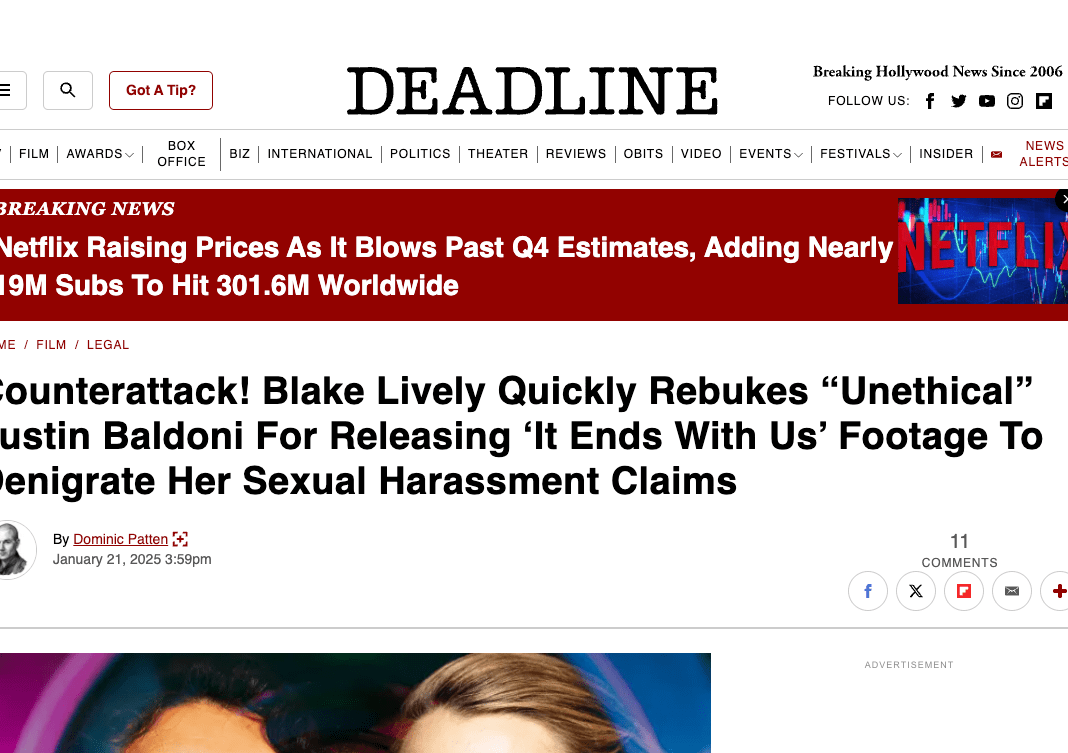
Blake Lively’s legal team has condemned the release of It Ends with Us behind-the-scenes footage by Justin Baldoni’s attorneys, calling it part of a “harassment and retaliatory campaign.” The video, obtained by TMZ, shows Lively and Baldoni joking about his nose and her spray tan while filming a dialogue-free scene. However, Lively’s lawyers argue that the footage corroborates her claims of an unsafe work environment and unwanted advances by Baldoni.
In her December 20 lawsuit, Lively accused Baldoni of “disturbing” on-set behavior, including an incident during a slow dance scene where he allegedly dragged his lips down her neck and made inappropriate remarks. Baldoni denied these claims and responded with lawsuits against The New York Times and Lively, Ryan Reynolds, and their publicist, accusing them of defamation and extortion.
Baldoni’s legal team alleges that Lively insulted his nose and joked about plastic surgery during filming. Lively’s attorneys counter that the newly released footage actually proves her discomfort, showing her repeatedly leaning away while Baldoni improvised intimate gestures without consent or an intimacy coordinator present.
Lively’s lawyers called the footage release a media stunt aimed at misleading the public and reaffirmed their commitment to proving Baldoni’s misconduct in court, under oath. Meanwhile, Baldoni’s team has announced plans to launch a website sharing all correspondence and videos to “quash” Lively’s claims.
Comparing the Two Sides
| Key Issue | Lawsuit Evidence (Lively’s Claims) | Video Articles (Baldoni’s Narrative) | Who Seems More Credible? |
|---|---|---|---|
| On-set Misconduct | Multiple HR complaints, detailed incidents, pattern of behavior | Barely mentioned or ignored | Lively – The articles don’t dispute key misconduct allegations |
| Marketing Plan | Agreed upon by all parties, Baldoni suddenly changed approach | Blames Lively for making it too “light” | Lively – Baldoni’s shift aligns with retaliation timeline |
| Retaliation PR Plan | Screenshots, crisis PR hire, “social manipulation” discussions | Ignored or downplayed | Lively – Texts prove Baldoni’s team was planting negative stories |
| Social Media Backlash | Sudden shift, bot activity, planned attacks | “Public turned on Lively because she’s difficult” | Lively – Lawsuit provides strong proof of coordinated attacks |
| Financial & Emotional Harm | Business losses, mental health effects, targeted harassment | Not addressed | Lively – Direct cause-and-effect shown in lawsuit |
Final Conclusion: Lively’s Case is Stronger
- The articles appear to be part of the exact crisis PR strategy that Lively’s lawsuit describes.
- They ignore the most damning allegations against Baldoni.
- They frame the story around Lively’s “difficult personality” rather than addressing the core legal claims.
- The timing of negative coverage aligns suspiciously well with what the lawsuit describes as a planned social media takedown.
- The lawsuit has substantial evidence:
- Internal messages show Baldoni’s team planning a “social combat” campaign.
- Contracts, emails, and meeting records confirm the HR complaints were ignored.
- PR firms were literally hired to push the “Lively is a bully” narrative.
Who Is Right?
➡ Based on the lawsuit’s concrete evidence, Lively’s claims hold more weight.
➡ The video articles appear to be misleading distractions, omitting key facts, and possibly part of the PR retaliation strategy.
Biggest Red Flags Against Baldoni
- Crisis PR firms were actively planning to “destroy” Lively’s reputation.
- He and his team never denied the misconduct allegations at the January 4, 2024, meeting.
- His sudden shift in marketing approach aligned perfectly with his retaliation strategy.
- Social media manipulation tactics described in the lawsuit match exactly what happened online.
Final Thoughts
- If Lively can prove in court that Baldoni & Wayfarer orchestrated this campaign, she has a strong case for defamation and retaliation.
- The video articles cannot be trusted as neutral reporting because they fit too neatly into Baldoni’s crisis PR playbook.
- Baldoni’s entire public brand (feminist, ally, “Man Enough”) would be at risk if these allegations prove true.
- That gives him strong motive to suppress the story and attack Lively’s credibility.
Next Steps
- If this case goes to trial, expect more leaked emails and messages proving coordinated attacks.
- PR firms like TAG might distance themselves from Baldoni if pressure mounts.
- If Lively wins, this could set a precedent for how Hollywood retaliatory smear campaigns are handled legally.
 celebchai.com