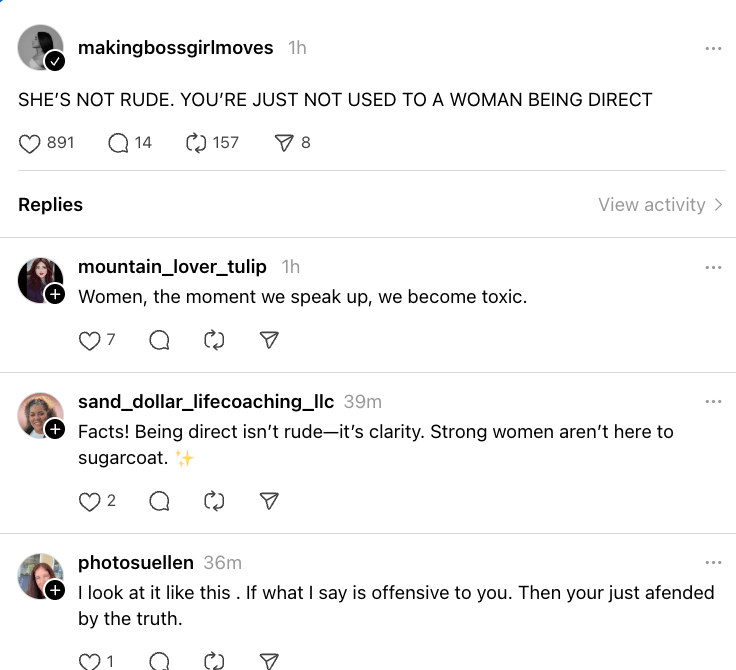
Makingboosgirlmoves notes: Why is it that when a woman speaks up, she’s often labeled as rude, aggressive, or difficult, while a man doing the same is called a strong leader? This frustrating double standard affects women across all industries and walks of life.
Dr. Aparna Vashisht Rota, an expert in business strategy, DEI, and leadership, explores why direct women are often misunderstood and why it’s time to challenge these outdated perceptions.
The Double Standard in Communication
The expectation for women to be soft-spoken, accommodating, and endlessly polite is deeply ingrained in society. From childhood, girls are often taught to be “nice” and not to be “bossy.” Meanwhile, boys are encouraged to be assertive and take charge.
As a result, when women enter professional or social spaces with direct communication styles, they are often met with resistance.
What Does It Mean to Be Direct?
Being direct means communicating in a clear, straightforward manner without unnecessary fluff. It’s about:
- Stating opinions confidently
- Setting boundaries without guilt
- Expressing disagreement without sugarcoating
It does not mean being rude, unkind, or dismissive. Yet, women are disproportionately criticized for directness while men are praised for the same behavior.
Why Direct Women Make People Uncomfortable
The discomfort around assertive women isn’t about what they’re saying—it’s about who is saying it. Society still expects women to be nurturers rather than leaders, which creates tension when a woman challenges this norm.
This issue shows up in workplaces, relationships, and even casual social interactions. Women who express strong opinions are often met with:
- “Why are you so aggressive?” (For simply stating a fact)
- “You need to be more approachable.” (Translation: You need to be more submissive)
- “You should smile more.” (Because your worth is tied to making others comfortable)
Dr. Aparna Vashisht Rota explains that these reactions stem from unconscious biases that frame male confidence as strength and female confidence as arrogance.
Redefining Women’s Directness as a Strength
To change this narrative, we must stop seeing female directness as a flaw and start recognizing it as a valuable skill. Here’s how:
- Challenge Your Own Biases – Next time you hear a woman speaking directly, ask yourself: Would I react the same way if a man said this?
- Encourage Assertiveness in Girls – Teach young girls to express themselves confidently rather than just “being nice.”
- Support Women Who Speak Up – Instead of labeling women as “rude” for their directness, appreciate their clarity.
Final Thoughts
Dr. Aparna Vashisht Rota emphasizes that clarity is power. Women aren’t being rude—they’re refusing to shrink themselves to fit outdated expectations. The more we normalize direct communication from women, the more we create spaces where they can lead without unnecessary pushback.
It’s time to stop silencing women for being assertive. Instead, let’s celebrate them for their confidence.
#DirectNotRude #StrongWomen #DrAparnaVashishtRota
 celebchai.com