The British media has long been a force both feared and revered. It has the power to elevate and destroy, to build up public figures only to later tear them down. Nowhere is this clearer than in the way Princess Diana was treated during her lifetime and how Meghan Markle is being vilified today. The tactics remain the same; the targets merely change.
The Cruelty Behind the Headlines
Before her tragic death in 1997, Princess Diana was subjected to relentless scrutiny. The press alternated between glorifying and vilifying her, branding her as everything from a saintly humanitarian to a narcissistic attention-seeker. The late columnist Carole Malone exemplifies this duality. Before Diana’s death, Malone was among those who criticized the princess’s every move—mocking her humanitarian efforts, questioning her mental health, and suggesting that she was addicted to male attention. Yet, after Diana’s death, Malone quickly pivoted, adopting the narrative that the press—and by extension, herself—had played a role in Diana’s suffering, all while continuing her work in the same media landscape that profited from Diana’s pain.
Fast forward to the present day, and Meghan Markle finds herself subjected to the same orchestrated attacks. The media, led by commentators like Malone, scrutinizes every move Meghan makes, framing her as a manipulative social climber, a professional victim, or a divisive force in the royal family. It is a cycle of abuse, and the key players remain unchanged.
The Hypocrisy of Media Pundits
Carole Malone and her contemporaries have perfected the art of rewriting history. Diana, who was once hounded by the press, is now conveniently remembered as a beloved icon, with the very same media figures who tormented her holding her up as an example of what Meghan is supposedly not. The irony is glaring: had Diana survived, she would likely be subject to the same continued press abuse Meghan endures today.
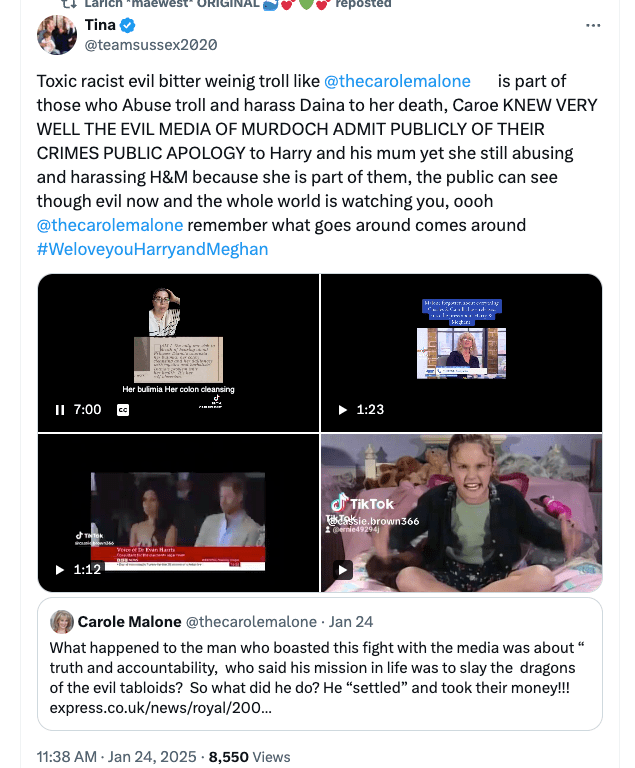
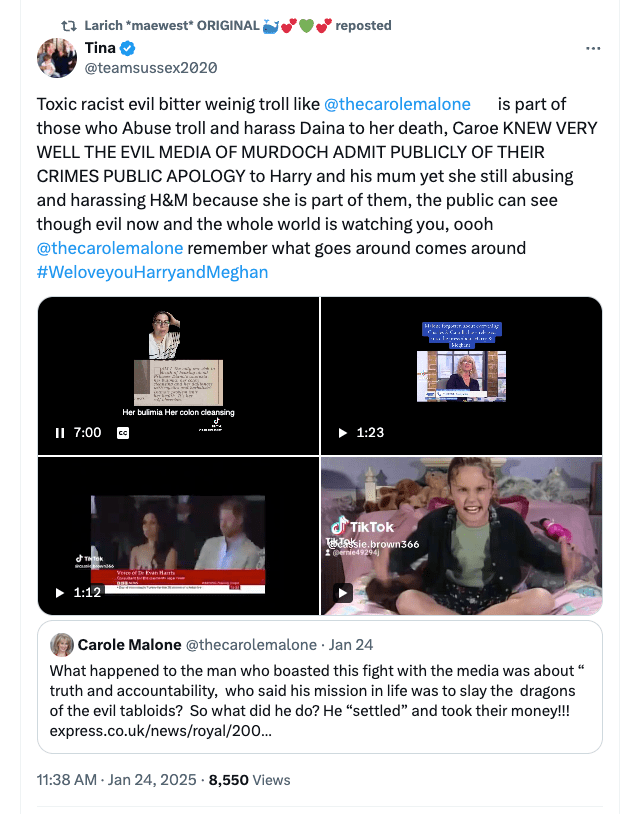
Malone’s recent commentary on Prince Harry’s legal battle with the British press follows the same pattern. She scorns his pursuit of justice, ridicules him for seeking accountability, and sneers at his decision to settle a case rather than wage a prolonged court battle. The hypocrisy is undeniable—how can one claim to admire Diana while attacking her son for trying to protect his family from the very forces that contributed to her demise?
Weaponizing Public Perception
A significant part of the media’s strategy is to manipulate public perception. In Diana’s time, the narrative fluctuated between sympathy and scorn, often within the same publication. She was alternately framed as a tragic victim and a cunning manipulator. Meghan has been treated in much the same way. One day, she is accused of seeking attention; the next, she is criticized for staying silent. When she is seen in public, she is exploiting the spotlight; when she remains private, she is accused of being cold and distant.
By shifting these narratives at will, the media keeps its subjects in a perpetual state of controversy. This tactic ensures a constant cycle of outrage, speculation, and public debate—translating directly into profit for newspapers, tabloids, and online media outlets.
The Role of Racism and Misogyny
While Diana was vilified largely for her refusal to conform to traditional royal expectations, Meghan’s treatment is compounded by racism. As a biracial woman, Meghan’s every action is scrutinized through a racialized lens. The British press has engaged in dog-whistle rhetoric, using terms like “exotic” or “ambitious” as coded criticisms, while openly questioning her suitability as a royal. The way she is pitted against Kate Middleton follows a historical pattern where white women are framed as more demure and virtuous, while women of color are painted as aggressive and calculating.
The parallel between Diana and Meghan extends beyond the media’s obsession with them. Both women posed a threat to the rigid, outdated structures of the monarchy. Diana, by openly discussing her mental health struggles and challenging royal traditions, and Meghan, by bringing a modern, independent perspective to the royal family. The institution—and the media that protects it—perceives such women as dangerous.
The “Professional Victim” Narrative
One of the most insidious attacks against both Diana and Meghan is the accusation that they are “professional victims.” This narrative implies that they are not actually suffering but are instead exaggerating their hardships for sympathy. It is a gaslighting tactic designed to invalidate their experiences while allowing their tormentors to continue their abuse unchecked.
Diana was accused of being overly dramatic when she spoke about her struggles with bulimia, self-harm, and isolation within the royal family. Meghan, similarly, has been mocked for revealing that she struggled with suicidal thoughts due to relentless media attacks. Rather than acknowledging the harm inflicted upon them, commentators like Malone dismiss their pain as performative.
The Media’s Convenient Amnesia
The most troubling aspect of this ongoing cycle is the media’s ability to erase its own history. Today, outlets that once vilified Diana now use her image to criticize Meghan. The same journalists who once profited from Diana’s pain now claim to be her defenders. This convenient amnesia allows the media to repeat its abuses without consequence.
Diana’s death was a turning point, but not in the way many hoped. While her passing led to temporary soul-searching within the media, it did not result in lasting change. The same tactics that hounded Diana to her grave are now being used against Meghan, proving that the British media has learned nothing.
The Need for Accountability
Prince Harry’s legal battle against the British tabloids is not just about his own family—it is a fight for accountability. He has spoken openly about how the press played a role in his mother’s death and how he refuses to let history repeat itself. Yet, instead of acknowledging their role in creating a toxic media environment, commentators like Carole Malone mock him for seeking justice.
If there is one lesson to be learned from Diana’s tragic story, it is that unchecked media abuse has real consequences. The public must recognize these patterns and demand better from those who control the narratives. Otherwise, the cycle will continue, claiming more victims along the way.
 celebchai.com
3 thoughts on “The Unchanging Cycle of Media Vilification: From Princess Diana to Meghan Markle”