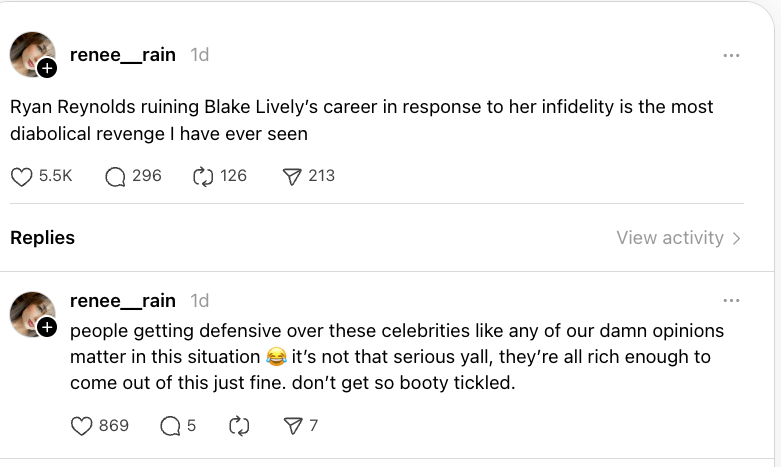
1. The Role of Social Media in Spreading Rumors
- TikTok as a News Source: One user (@smoky.mountain.soul) mentions not having TikTok anymore and being out of the loop, highlighting how platforms like TikTok have become primary sources of information (and misinformation) for many people. This reflects a broader trend where social media platforms are increasingly replacing traditional news outlets for breaking stories, especially in the realm of celebrity gossip.
- Viral Speculation: The thread shows how rumors can gain traction quickly, even without credible sources. Once a theory or allegation is posted, it can spread rapidly, with users adding their own interpretations or assumptions.
2. The Psychology of Celebrity Gossip
- Moral Judgment: Many comments reflect a tendency to pass moral judgment on celebrities, often based on limited or unverified information. For example, users call Ryan Reynolds an “overrated douchebag” or accuse Blake Lively of being “problematic.” This reflects a broader human tendency to project moral narratives onto public figures.
- Schadenfreude: Some users seem to take pleasure in the perceived downfall of these celebrities, as seen in comments like “It’s about time he gets blacklisted.” This aligns with the concept of schadenfreude—finding joy in others’ misfortunes, especially those who are seen as privileged or powerful.
- Identification and Defense: On the flip side, some users defend the celebrities, suggesting that the rumors are exaggerated or false. This reflects how people often identify with celebrities and feel compelled to protect their image.
3. The Power of Anonymity
- Bold Claims Without Accountability: Many users make bold allegations (e.g., Blake Lively bullying co-stars, Ryan Reynolds orchestrating lawsuits) without providing evidence. The anonymity of social media allows people to share such claims without fear of repercussions, contributing to the spread of unverified information.
- Echo Chambers: The thread also shows how like-minded individuals can reinforce each other’s opinions, creating an echo chamber. For example, users who believe Ryan Reynolds is “the problem” upvote and agree with each other, while those who disagree are dismissed or ignored.
4. The Blurred Line Between Fact and Fiction
- Lack of Evidence: Despite the intense speculation, there’s no concrete evidence or credible sources cited in the thread. This highlights how easily rumors can be presented as facts in online discussions.
- Confirmation Bias: Users seem to interpret the situation in ways that align with their preexisting beliefs. For example, those who already dislike Ryan Reynolds are quick to blame him, while fans of Blake Lively defend her actions.
5. The Impact on Public Perception
- Career Implications: Several users speculate about the potential damage to the careers of those involved. For example, one user suggests that the drama could “ruin all of their careers,” while another claims Blake Lively is “ruining her own career.” This reflects how public perception, fueled by gossip, can have real-world consequences for celebrities.
- Distraction from Real Issues: One user (@jmar3309) criticizes the focus on celebrity gossip, calling it a “distraction” from more important global issues. This raises an important point about the role of celebrity drama in diverting attention from substantive topics.
6. The Role of Fandom and Tribalism
- Team Blake vs. Team Ryan: The thread reveals a divide between those who side with Blake Lively and those who side with Ryan Reynolds. This tribalism is common in celebrity gossip, where fans often take sides in conflicts involving their favorite stars.
- Comparisons to Other Couples: Users frequently compare Ryan and Blake to other celebrity couples (e.g., John Krasinski and Emily Blunt, Tom Holland and Zendaya), suggesting that these comparisons serve as a way to evaluate the health or morality of the relationships.
7. The Absurdity of Online Discourse
- Humorous and Random Comments: Some users inject humor or randomness into the conversation, such as “Why r u dancing” or “Hogy?” (which means “How?” in Hungarian). These comments highlight the chaotic and often unserious nature of online discussions.
- Over-the-Top Reactions: The thread is filled with exaggerated reactions, such as “WHAT DID I MISSS” and “Wait what did I miss?!?!?!” This reflects how social media amplifies emotions and encourages hyperbolic responses.
8. The Broader Cultural Context
- Celebrity Worship and Critique: The thread exemplifies the dual nature of celebrity culture, where public figures are simultaneously idolized and scrutinized. Celebrities like Ryan Reynolds and Blake Lively are held to impossibly high standards, and any perceived misstep can lead to intense criticism.
- The Role of Tabloids and Gossip Blogs: While not explicitly mentioned, the rumors discussed in the thread likely originated from tabloids or gossip blogs, which thrive on sensationalism and often prioritize clicks over accuracy.
Conclusion
This thread is a microcosm of how celebrity gossip functions in the digital age. It highlights the power of social media to amplify rumors, the psychological dynamics that drive engagement with gossip, and the blurred line between fact and fiction. While entertaining, such discussions often lack substance and can contribute to the spread of misinformation. As consumers of online content, it’s important to approach celebrity gossip with a critical eye and recognize its limitations as a source of truth.
 celebchai.com