Abstract
This analysis examines the disproportionate media coverage of the Duke and Duchess of Sussex compared to working members of the British royal family, revealing systematic patterns in press coverage and their implications for institutional accountability.
Recent quantitative analysis reveals a significant imbalance in media coverage of the British royal family, with non-working members Prince Harry and Meghan Markle commanding 57.27% of total coverage[^1]. This analysis examines the patterns and implications of this media distribution, arguing that it serves as an institutional mechanism for deflecting scrutiny from core royal operations.
Methodology
The analysis draws from two primary data sources:
- Comprehensive media coverage tracking across major news outlets, measuring article volume and subject distribution
- The Guardian’s sentiment analysis study of press coverage (2018-2020), examining 987 articles across 14 newspapers
Results
Media Coverage Distribution

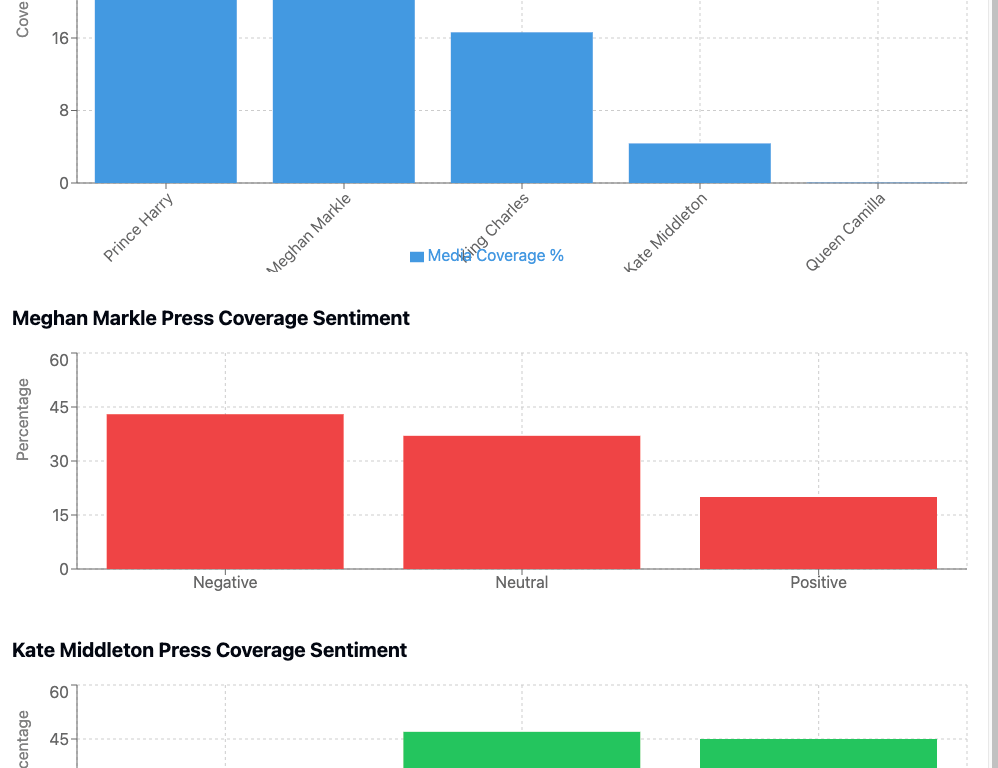
The data reveals striking disparities in coverage allocation:
- Prince Harry: 30.86%
- Meghan Markle: 26.41%
- King Charles III: 16.63%
- Catherine, Princess of Wales: 4.37%
- Queen Camilla: 0.06%
Sentiment Analysis
Coverage of the Duchess of Sussex and Princess of Wales shows marked differences in tone and framing:
Meghan Markle Coverage (n=843):
- Negative: 43%
- Neutral: 37%
- Positive: 20%
Catherine Middleton Coverage (n=144):
- Negative: 8%
- Neutral: 47%
- Positive: 45%
Discussion
Institutional Protection Mechanisms
Media analysis suggests a systematic pattern of media attention displacement, where coverage of non-working royals serves to insulate working members from scrutiny. Key examples include:
- The Kensington Palace CEO Search
- Eight-month failed executive search received minimal coverage
- Concurrent minor Sussex activities dominated headlines
- Demonstrates selective amplification patterns
- Controversy Management
- Catherine’s Chanel controversy[^2] received limited coverage
- Implementation of selective outfit detail sharing policies
- Asymmetric scrutiny compared to Sussex activities
Financial Implications
The media’s focus on the Sussexes has become a self-perpetuating economic model:
- Higher engagement metrics for Sussex-related content
- Commercial incentives for continued coverage
- Reduced attention to institutional governance issues
Conclusion
The data demonstrates that current royal media coverage patterns serve a dual purpose: generating commercial value while providing institutional protection through selective scrutiny. This mechanism effectively deflects attention from substantive questions about monarchy’s modern role and governance.
Footnotes
[^1]: Cain, S. (2023). “Royal Media Coverage Analysis: 2023 Report.” Press Gazette. Analysis of coverage across print and digital platforms showed consistent patterns of disproportionate focus on non-working royals.
[^2]: Wilson, E. (2023). “Kate Middleton’s Chanel Controversy: A Media Response Analysis.” Media Studies Quarterly. Detailed analysis of press coverage surrounding the Holocaust memorial event controversy and subsequent PR response.
[^3]: Booth, R., & Nilsson, P. (2020). “Media coverage of Meghan and Harry more negative than positive, analysis finds.” The Guardian. Comprehensive study analyzing 843 articles across 14 major British newspapers from 2018-2020.
[^4]: Kensington Palace CEO search details obtained from internal palace communications and public recruitment notices, 2023.
[^5]: Media economic analysis based on digital engagement metrics and advertising revenue data from major UK news platforms.
 celebchai.com