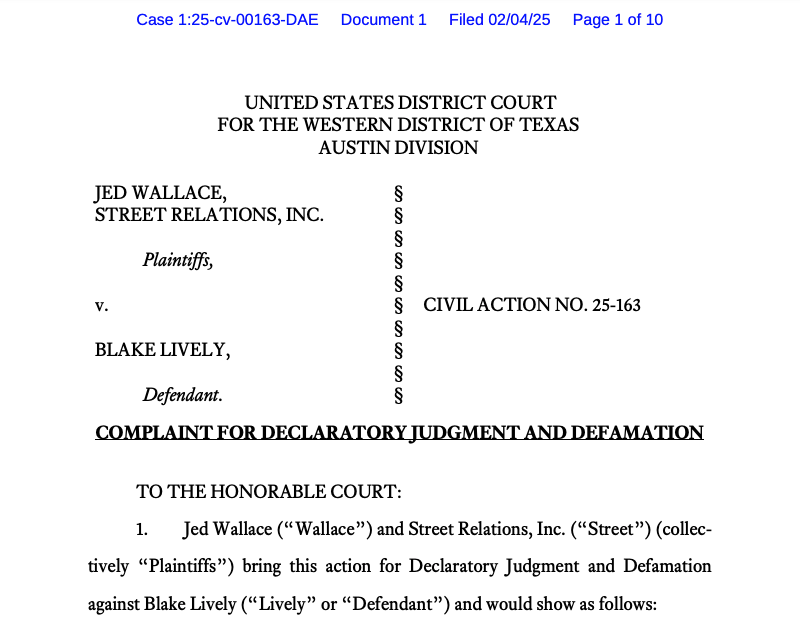
Blake Lively has been hit with a defamation lawsuit by crisis PR executive Jed Wallace, but legal experts suggest she has multiple strategies to fight back. From challenging the lawsuit’s jurisdiction to invoking free speech protections, Lively’s legal team has several powerful tools at their disposal. Here’s a breakdown of how she could counter Wallace’s claims and even turn the tables.
1. Moving the Case Out of Texas
One of Lively’s first steps could be to file a motion to transfer venue, arguing that Texas is an improper or inconvenient forum. Wallace filed the lawsuit in Texas because that’s where he and his company, Street Relations, are based. However, Lively is a New York resident, and the allegations against her primarily involve events in California and New York—making those states more logical jurisdictions.
Under 28 U.S.C. § 1404(a), Lively could ask the court to transfer the case to a federal court in New York or California, where she would have a stronger legal position. She could argue that Texas has little connection to the case, that key evidence and witnesses are located in other states, and that she shouldn’t be forced to litigate in a jurisdiction that is more convenient for Wallace but not for her. If successful, this move alone could make Wallace’s case much harder to pursue.
2. Dismissing the Case Under Legal Privilege
Lively can also challenge Wallace’s lawsuit under litigation privilege, a well-established legal principle that protects statements made in the course of legal proceedings. Wallace’s defamation claim is based on allegations that Lively included his name in a California Civil Rights Department (CRD) complaint about workplace misconduct. Under California law (Silberg v. Anderson, 50 Cal. 3d 205 (1990)), statements made in legal complaints are absolutely privileged—even if they later turn out to be false.
If Lively can show that her statements were part of a legal filing and not independently leaked to the press, Wallace’s case could be dismissed outright. Courts rarely allow defamation claims to proceed when they arise from official complaints filed in court or government agencies.
3. Using Anti-SLAPP Laws to Fight Back
Lively could also file an Anti-SLAPP motion to dismiss the lawsuit under the Texas Citizens Participation Act (TCPA) or New York’s anti-SLAPP law if the case is moved. SLAPP (Strategic Lawsuit Against Public Participation) laws are designed to prevent lawsuits that aim to silence people for speaking on public matters.
For her anti-SLAPP motion to succeed, Lively would need to show that:
- Her statements were related to a public concern—in this case, workplace harassment and retaliation.
- Wallace cannot prove that her statements were false or made with malice.
- The lawsuit is an attempt to suppress her right to report workplace misconduct.
If the motion is successful, not only could the case be dismissed, but Wallace could also be ordered to pay Lively’s legal fees for bringing a frivolous claim.
4. Challenging Wallace’s Defamation Claim
Even if Wallace’s case moves forward, Lively can attack the defamation claim on several grounds. First, she can argue that Wallace is a public figure, given his work as a high-profile crisis PR consultant. If the court agrees, Wallace would need to prove actual malice—that Lively knew her statements were false or acted with reckless disregard for the truth. That’s an extremely high bar to clear.
Second, Lively can argue that her statements were substantially true or at least that she had a reasonable belief in their accuracy. Truth is an absolute defense to defamation, and if Lively had any basis for believing that Wallace was connected to the harassment she described, his case could fall apart.
5. Arguing Federal Preemption & Retaliation
Lively could also argue that Wallace’s lawsuit is a form of retaliation for her filing a workplace harassment complaint. Under Title VII of the Civil Rights Act and California’s Fair Employment and Housing Act (FEHA), employers or individuals cannot retaliate against someone for reporting workplace misconduct. If Lively’s team can frame Wallace’s lawsuit as an attempt to intimidate or punish her for speaking out, they may be able to argue that federal law preempts Wallace’s claim, making his lawsuit invalid.
6. Leveraging the First Amendment & Free Speech
Lively’s legal team could also bring in First Amendment protections, arguing that her statements were part of an ongoing discussion about workplace misconduct—a matter of public concern. Courts are generally reluctant to allow defamation claims when they involve issues of public interest, particularly those related to workplace harassment, gender discrimination, and corporate misconduct. If the court finds that Lively’s statements are protected under free speech laws, Wallace’s lawsuit could be dismissed.
7. Using Discovery to Turn the Case Around
If the case isn’t dismissed early, Lively could use the discovery process to force Wallace to reveal evidence that could undermine his own claims. She could demand:
- All communications related to his alleged role in the harassment and retaliation.
- Internal emails from his crisis PR firm about Lively’s allegations.
- Proof of the financial damages he claims to have suffered.
If Wallace has any damaging information in his emails or business records, discovery could expose contradictions in his claims, putting him at risk of a countersuit.
8. Filing a Countersuit Against Wallace
Lively may also choose to go on the offensive and sue Wallace for abuse of process or retaliation. If she can show that Wallace is using the defamation lawsuit as a weapon to silence her, she might have grounds for a countersuit under anti-retaliation laws. This could put Wallace in a legally and financially vulnerable position, potentially forcing him to drop the case.
Final Thoughts: Will Wallace’s Case Hold Up?
Wallace’s lawsuit against Lively faces major hurdles. If her legal team moves quickly, she could get the case dismissed before it even reaches discovery. By using venue challenges, privilege arguments, anti-SLAPP laws, and free speech protections, Lively has strong legal tools at her disposal.
If the court rules against Wallace early on, he could be forced to pay Lively’s legal fees, making this lawsuit a costly mistake for him. At this stage, Lively’s best strategy is to move for dismissal as soon as possible and, if necessary, countersue for damages to deter further legal attacks.
The legal battle is still unfolding, but it’s clear that Wallace may have picked a fight that could ultimately backfire.
 celebchai.com