
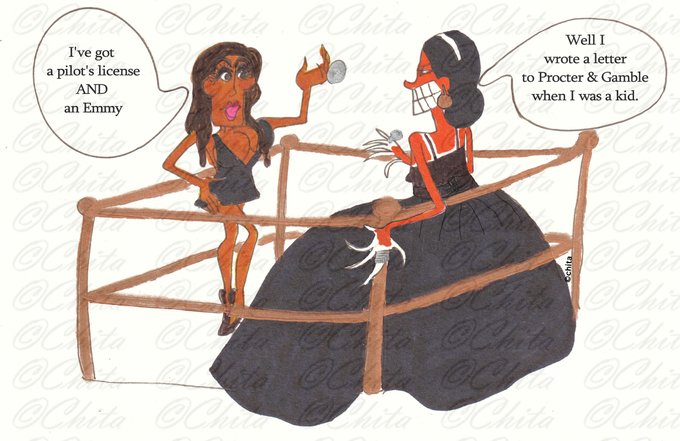
Lauren Sánchez and Meghan Markle have both led impressive careers, yet they continue to be overshadowed by narratives that reduce them to their relationships. A recent viral cartoon depicts them in a boxing ring, with Sánchez listing her achievements—an Emmy and a pilot’s license—only to be met with an underwhelming response from Meghan, who boasts about writing a letter to Procter & Gamble as a child. The illustration is a striking example of how accomplished women are often trivialized in the public eye.
The online discourse surrounding Sánchez, including a viral image from Donald Trump’s inauguration, exposes how women in high-profile relationships are scrutinized in ways men rarely are. The same is true for Meghan Markle, whose transition from a successful actress to a global humanitarian and duchess has been met with relentless criticism. Both women have built careers that stand on their own, yet the media continues to frame them through a narrow lens that disregards their achievements.
Lauren Sánchez: More Than a Billionaire’s Fiancée
Sánchez was a respected journalist long before she became engaged to Jeff Bezos. She is an Emmy-winning anchor who worked on major news platforms like Good Day LA and Fox 11. She has also been a frequent guest host on The View. Her career in media was built on credibility and experience, not association with a billionaire.
She later transitioned into aviation, becoming a licensed helicopter pilot and founding Black Ops Aviation, the first female-owned aerial film and production company. Through this venture, she has worked on major Hollywood productions, breaking barriers in an industry where women are still underrepresented.
In addition to her business endeavors, Sánchez has been involved in philanthropy, working on initiatives that address climate change and disaster relief. She plays a significant role in the Bezos Earth Fund, helping shape global sustainability projects. Her career is not just about media or aviation; it reflects a commitment to innovation and social impact.
Meghan Markle: A Woman Defined by More Than Royalty
Meghan Markle’s journey is equally noteworthy. Before she became the Duchess of Sussex, she had a successful career as an actress, best known for her role in Suits. However, she was also a humanitarian long before marrying into the British royal family.
Her advocacy began at an early age when, at just 11 years old, she wrote a letter to Procter & Gamble challenging the sexist language in one of their advertisements. This moment, which the cartoon mocks, was not just a childhood anecdote but an early sign of her lifelong commitment to social justice.
As a royal, she championed causes related to gender equality, education, and mental health. Despite facing relentless media scrutiny, she has continued her advocacy through the Archewell Foundation, working on global issues ranging from women’s rights to climate change. Like Sánchez, her achievements stand independently of her marriage, yet the public discourse often reduces her to being just Prince Harry’s wife.
The Cartoon: A Clear Example of Misogynistic Reductionism
The cartoon presents Sánchez and Markle as competing figures, pitting their achievements against each other as if only one can be taken seriously. This not only trivializes their individual careers but also perpetuates the idea that women must constantly prove their worth.
By portraying Sánchez’s Emmy and pilot’s license as unimpressive and juxtaposing it with Meghan’s childhood activism, the cartoon reinforces the notion that women’s successes are only valid if they fit into a specific narrative. It ignores Sánchez’s entrepreneurial ventures and philanthropy while reducing Meghan’s decades of advocacy to a single childhood letter.
This type of humor often targets women who achieve success while being in high-profile relationships. The message is clear: their accomplishments are not their own but are either a product of their partners or are simply dismissed as unimportant.
The Inauguration Controversy: The Unfair Scrutiny of Women
Sánchez has also been at the center of another viral moment. A widely circulated image from Donald Trump’s inauguration appeared to show Mark Zuckerberg staring at her, sparking an online debate about power dynamics and objectification. Rather than discussing why she was subjected to this attention, much of the online discourse shifted to blaming her for wearing a revealing outfit.
This is a clear example of how women in elite spaces face criticism no matter what they do. While Zuckerberg became the subject of memes, Sánchez faced scrutiny over her appearance. This reflects a broader societal issue where women are held to impossible standards—expected to be stylish but not too fashionable, successful but not too ambitious, and confident but not too assertive.
The Hypocrisy of Public Judgment
Male billionaires and business leaders are rarely scrutinized for their social interactions, awkward moments, or fashion choices. Yet, women in similar circles face relentless judgment for everything from their clothing to their body language.
Mark Zuckerberg’s awkward moment at the inauguration was turned into a joke, but Sánchez was the one whose character was put on trial. Similarly, Meghan Markle is frequently criticized for being “too outspoken” or “too ambitious,” traits that are often praised in men. These double standards persist because society still struggles with the idea of women holding power and influence independently of the men they are associated with.
Conclusion: More Than Just a Punchline
Both Lauren Sánchez and Meghan Markle are successful women who have built careers based on skill, intelligence, and determination. The media’s tendency to reduce them to their relationships or pit them against one another is a reflection of the outdated perception that women must constantly prove their worth.
The viral cartoon and the inauguration controversy are just two examples of how society dismisses accomplished women. Rather than treating them as mere extensions of their partners, it is time to recognize their achievements for what they are—significant, independent, and worthy of respect.
 celebchai.com