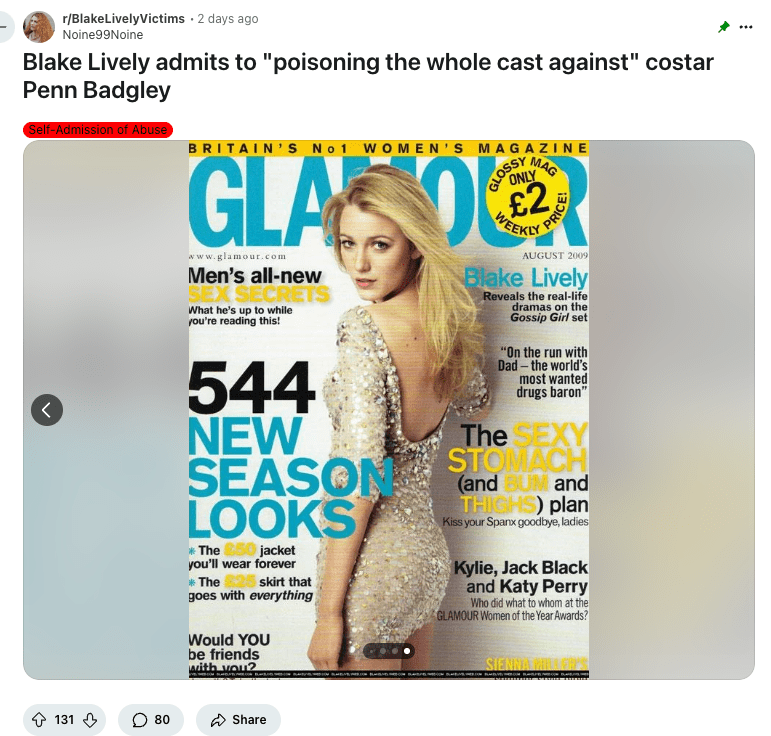
The resurgence of an old Blake Lively interview has reignited controversy over her past behavior, with some online voices calling for her downfall. However, a closer look at the situation reveals an unsettling double standard: while a 2009 quote is being used to frame Lively as a manipulative “mean girl,” Justin Baldoni’s legal troubles and accusations of misconduct are receiving far less scrutiny.
The Resurfaced Blake Lively Interview
An interview from Glamour UK in 2009 has been making the rounds on social media, with headlines claiming that Blake Lively “poisoned” the Gossip Girl cast against Penn Badgley when he was first hired. Lively admitted that she was initially unhappy with Badgley’s casting and influenced her co-stars against him, but quickly realized she was wrong.
“At first I was so upset that they hired him. I actually poisoned the whole cast against him,” Lively said in the interview. “But then they noticed that he wasn’t a jerk and was actually a really nice, charming person. Almost immediately I realized that too, but it took me about a week to admit it.”
Lively and Badgley later dated from 2007 to 2010, and by all accounts, their relationship was amicable. Penn later stated that Blake saved him. Yet, over a decade later, this quote is being reframed as evidence of Lively’s alleged history of bullying and manipulation.
The Narrative Shift: From Gossip Girl to Legal Battles
The timing of this resurfaced interview is no coincidence. It comes amid Lively’s legal battle with Justin Baldoni, whom she accused of sexual harassment on the set of It Ends With Us. In December 2024, Lively alleged that Baldoni engaged in “invasive, unwelcome, unprofessional and sexually inappropriate behavior”, including entering her trailer unannounced and improvising physical intimacy without prior discussion.
Baldoni denied the allegations and countersued Lively and her husband, Ryan Reynolds, for $400 million in damages, claiming they attempted to “steal” the film from him. His legal team has since published a website claiming to have “receipts” proving Lively’s allegations are false.
Meanwhile, it was also revealed that Baldoni paid $175,000 to seal a past lawsuit—a fact that has gone largely unnoticed amid the backlash against Lively.
The Hypocrisy of Selective Outrage
Social media has a tendency to amplify certain narratives while ignoring others. In Lively’s case, the focus has shifted from her accusations against Baldoni to a decades-old mistake that she admitted and corrected. The same level of scrutiny is not being applied to Baldoni, despite his ongoing legal issues and efforts to control the media narrative surrounding his case.
This isn’t just about Lively—it’s about how Hollywood and the media dictate which scandals deserve attention. While an old interview is being used to discredit Lively, Baldoni’s sealed lawsuit and harassment accusations are largely absent from the conversation.
The Bigger Picture
The way these stories are being framed reveals a broader pattern in media coverage:
- Blake Lively is being vilified for a mistake she admitted over a decade ago, while Baldoni’s actual legal case is being downplayed.
- An old, out-of-context quote is being used to push a narrative of Lively as a toxic figure, distracting from the far more serious accusations against Baldoni.
- The power of media gatekeeping—which stories get amplified and which ones get buried—determines public perception, often to the benefit of those with greater industry influence.
If Lively should be held accountable for past behavior, then Baldoni should be held accountable for present allegations—yet the energy surrounding each story is vastly different.
What Comes Next?
Lively’s lawsuit against Baldoni is set for trial in March 2026, meaning more revelations will likely come to light. However, unless the public shifts its focus to actual legal battles rather than resurfaced gossip, the media landscape will continue to manipulate narratives in favor of those with more industry power.
The real question is: why is a 2009 non-issue more newsworthy than a 2025 lawsuit?
 celebchai.com