Jan 30, 2025
ORDER: The above-captioned cases involve common questions of law and fact. For convenience, expedition, and judicial economy, and noting that no party has objected despite the opportunity to do so, the Court exercises its discretion to consolidate these cases into a single action. See Federal Rule of Civil Procedure 42(a)(2). The Clerk of Court is directed to consolidate all cases listed above under case number 24-cv-10049, and to close all other cases. Counsel are directed to make filings only under case number 24-cv-10049. SO ORDERED. (Signed by Judge Lewis J. Liman on 1/30/2025) Filed In Associated Cases: 1:24-cv-10049-LJL, 1:25-cv-00449-LJL (ks) (Entered: 01/30/2025)
Understanding the Case Consolidation: Blake Lively v. Wayfarer Studios & Wayfarer Studios v. Blake Lively
What happened?
Initially, there were two separate lawsuits:
- Blake Lively sued Wayfarer Studios, Justin Baldoni, and others in Case No. 1:24-cv-10049-LJL, alleging sexual harassment, retaliation, defamation, and breach of contract related to the filming of It Ends With Us.
- Wayfarer Studios, Baldoni, and others countersued Lively, Ryan Reynolds, Leslie Sloane, and Vision PR, Inc. in Case No. 1:25-cv-00449-LJL, claiming defamation, extortion, and interference with the film’s production and marketing.
What did the court decide?
- On January 30, 2025, Judge Lewis J. Liman ruled that both cases involved common facts and legal issues.
- The court consolidated both lawsuits into a single case under Case No. 1:24-cv-10049-LJL.
- This means that instead of two separate trials, all claims and counterclaims will be handled together in a single legal proceeding.
What does this mean in simple terms?
- Blake Lively sued Baldoni and Wayfarer for harassment and retaliation.
- Baldoni and Wayfarer sued Lively back, claiming she lied to damage them.
- The court combined both cases into one, so everything will be decided in a single trial instead of two separate ones.
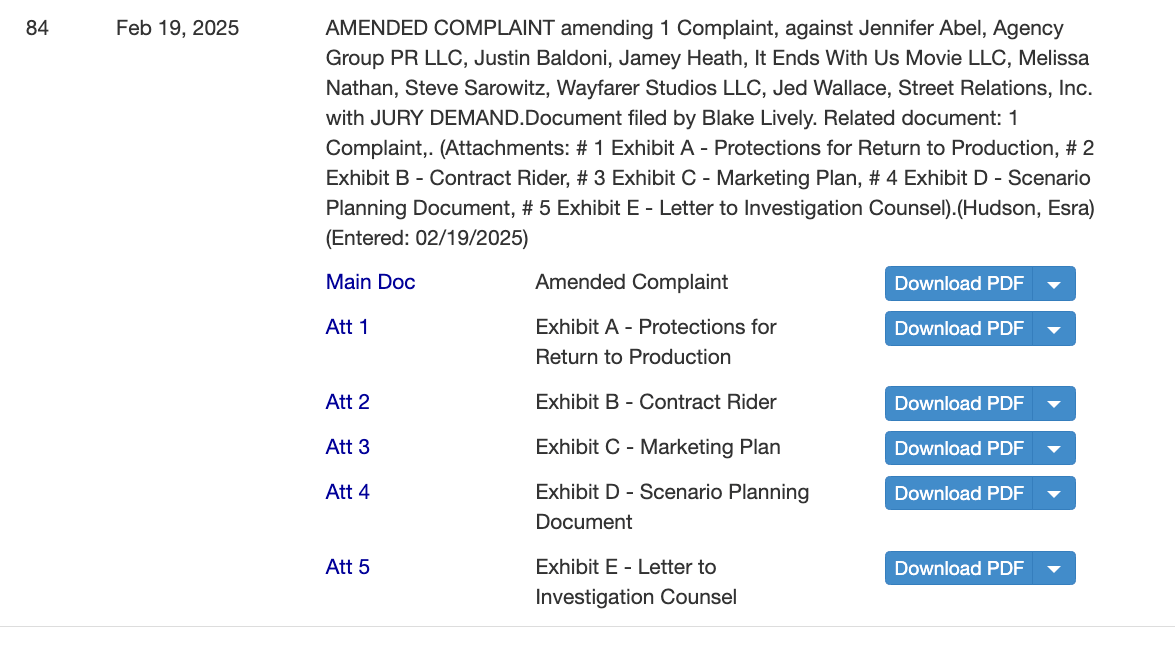
This means both sides will present their cases at the same time, and the judge will determine who is telling the truth. Blake Filed an Amended Complaint today.
Links:
https://www.courtlistener.com/docket/69510553/lively-v-wayfarer-studios-llc/
Amended Complaint: https://storage.courtlistener.com/recap/gov.uscourts.nysd.634304/gov.uscourts.nysd.634304.84.0.pdf
Exhibit A:
Exhibit B:
Exhibit C:
Exhibit D:
Exhibit E:
1. Introduction and Lawsuit Background
Blake Lively, the lead actress in It Ends With Us, has filed a lawsuit against Wayfarer Studios LLC, Justin Baldoni, Jamey Heath, Steve Sarowitz, and others, alleging sexual harassment, retaliation, breach of contract, false light, and defamation. The case, filed in the United States District Court for the Southern District of New York, centers on Lively’s claims that Baldoni and Wayfarer Studios fostered a toxic work environment and later launched a smear campaign against her when she spoke out.
The lawsuit argues that Baldoni, who portrays himself as a feminist advocate, engaged in inappropriate behavior on set, discussed personal sexual experiences, pressured Lively into uncomfortable situations, and retaliated when she attempted to establish workplace protections. The complaint also includes allegations of a coordinated public relations effort to discredit Lively and shift blame onto her.
2. Key Allegations in the Complaint
Sexual Harassment and On-Set Misconduct
Lively alleges that Baldoni exhibited a pattern of inappropriate behavior during the production of It Ends With Us. The claims include:
- Unsolicited conversations about pornography addiction and personal sexual experiences.
- Pressuring Lively into intimate scenes without prior discussion or proper choreography.
- Making degrading comments about women, including female cast members.
- Forcing an improvised birthing scene that was chaotic and violated agreed-upon boundaries.
The lawsuit details that Lively was not the only one who experienced such behavior. Other female cast members reportedly raised concerns but were ignored.
Failure to Investigate Complaints
Despite multiple HR complaints, Wayfarer Studios and Sony, the film’s distributor, allegedly failed to conduct a meaningful investigation into the allegations. Lively cites messages exchanged with Sony executives expressing distress over the toxic environment.
Exhibit A in the lawsuit reveals an agreement negotiated in November 2023, titled “Protections for Return to Production”, outlining terms to ensure a safe set. These included:
- Requiring an intimacy coordinator.
- Banning impromptu intimate scene improvisation.
- Preventing unwanted physical contact or inappropriate sexual discussions on set.
However, the lawsuit alleges that Baldoni and his team did not fully comply with these terms.
Retaliation and Smear Campaign
Lively’s complaint asserts that after she voiced concerns, Baldoni and Wayfarer launched a retaliation campaign. Key elements of this alleged retaliation include:
- An orchestrated PR effort to paint Lively as a “bully” and a “difficult actress.”
- The use of crisis PR firms to spread misleading narratives online.
- The deployment of social media manipulation tactics, including astroturfing—covertly seeding false information to appear as public opinion.
Exhibit D, the Scenario Planning Document, outlines a crisis management strategy discussing methods to protect Baldoni’s reputation and preemptively discredit Lively.
Messages between PR strategists show discussions about “burying” Lively and planting media stories that would undermine her credibility. Lively’s legal team argues this demonstrates a concerted effort to silence and discredit her.
3. Legal Response and the Subpoena That Could Shift the Case
Lively’s legal team has issued a broad subpoena against 14 individuals and companies, including Baldoni, Wayfarer executives, and crisis PR firms. The subpoena demands:
- Call logs and data records from major telecom providers.
- Location tracking data spanning two and a half years.
- Correspondence related to Lively’s allegations.
Baldoni’s legal team has called the subpoena overbroad and an invasion of privacy, arguing that it is being used to generate media attention rather than serve legitimate legal interests. However, Lively’s team contends that the requested records could expose how the PR campaign against her was coordinated.
4. Leaked HR Complaints and Other Corroborating Evidence
Leaked HR complaints reveal that Lively was not the only woman on set who reported misconduct.
- A May 29, 2023 complaint alleged inappropriate comments from Baldoni to a female cast member.
- Another actress reported discomfort with Baldoni’s comments about her body, leading to avoidance behavior from him.
- Jenny Slate, another cast member, allegedly experienced inappropriate physical contact when Baldoni adjusted her posture on set.
Exhibit E includes a letter from Lively’s attorneys rejecting Wayfarer’s belated attempt to conduct an investigation. The letter argues that an investigation nearly two years after the original complaints does not meet legal requirements for promptness and appears to be a legal maneuver rather than a genuine attempt at accountability.
5. The Marketing Pivot and Its Role in the PR Strategy
Leading up to the film’s release, Baldoni allegedly shifted the film’s marketing strategy to frame himself as a champion of domestic violence awareness, distancing himself from the harassment allegations.
Exhibit C, the Marketing Plan, directs cast members to avoid discussing the film as a domestic violence story and instead focus on empowerment and resilience.
Text messages in the lawsuit indicate that this shift was a calculated effort to protect Baldoni’s image in the face of the harassment allegations.
6. Potential Implications and Next Steps
With the amended complaint filed and the subpoena pending, the lawsuit is approaching a critical juncture.
- If the subpoenaed records reveal a coordinated smear campaign, it could substantiate Lively’s claims of defamation and retaliation.
- If the leaked HR complaints are authenticated, it could strengthen the argument that Wayfarer ignored a pattern of misconduct.
- Wayfarer’s attempts to downplay or block the investigation may raise additional legal concerns regarding corporate accountability.
7. Conclusion
This lawsuit is more than just a legal dispute between Lively and Baldoni—it has the potential to expose systemic failures in Hollywood regarding workplace protections and PR-driven retaliation campaigns.
As the legal battle unfolds, Wayfarer and Baldoni will likely continue to deny the allegations, while Lively’s team pushes to bring the evidence into the public record. The outcome of this case could influence how harassment allegations are handled in the entertainment industry moving forward.1. Introduction and Lawsuit Background
Blake Lively, the lead actress in It Ends With Us, has filed a lawsuit against Wayfarer Studios LLC, Justin Baldoni, Jamey Heath, Steve Sarowitz, and others, alleging sexual harassment, retaliation, breach of contract, false light, and defamation. The case, filed in the United States District Court for the Southern District of New York, centers on Lively’s claims that Baldoni and Wayfarer Studios fostered a toxic work environment and later launched a smear campaign against her when she spoke out.
The lawsuit argues that Baldoni, who portrays himself as a feminist advocate, engaged in inappropriate behavior on set, discussed personal sexual experiences, pressured Lively into uncomfortable situations, and retaliated when she attempted to establish workplace protections. The complaint also includes allegations of a coordinated public relations effort to discredit Lively and shift blame onto her.
2. Key Allegations in the Complaint
Sexual Harassment and On-Set Misconduct
Lively alleges that Baldoni exhibited a pattern of inappropriate behavior during the production of It Ends With Us. The claims include:
- Unsolicited conversations about pornography addiction and personal sexual experiences.
- Pressuring Lively into intimate scenes without prior discussion or proper choreography.
- Making degrading comments about women, including female cast members.
- Forcing an improvised birthing scene that was chaotic and violated agreed-upon boundaries.
The lawsuit details that Lively was not the only one who experienced such behavior. Other female cast members reportedly raised concerns but were ignored.
Failure to Investigate Complaints
Despite multiple HR complaints, Wayfarer Studios and Sony, the film’s distributor, allegedly failed to conduct a meaningful investigation into the allegations. Lively cites messages exchanged with Sony executives expressing distress over the toxic environment.
Exhibit A in the lawsuit reveals an agreement negotiated in November 2023, titled “Protections for Return to Production”, outlining terms to ensure a safe set. These included:
- Requiring an intimacy coordinator.
- Banning impromptu intimate scene improvisation.
- Preventing unwanted physical contact or inappropriate sexual discussions on set.
However, the lawsuit alleges that Baldoni and his team did not fully comply with these terms.
Retaliation and Smear Campaign
Lively’s complaint asserts that after she voiced concerns, Baldoni and Wayfarer launched a retaliation campaign. Key elements of this alleged retaliation include:
- An orchestrated PR effort to paint Lively as a “bully” and a “difficult actress.”
- The use of crisis PR firms to spread misleading narratives online.
- The deployment of social media manipulation tactics, including astroturfing—covertly seeding false information to appear as public opinion.
Exhibit D, the Scenario Planning Document, outlines a crisis management strategy discussing methods to protect Baldoni’s reputation and preemptively discredit Lively.
Messages between PR strategists show discussions about “burying” Lively and planting media stories that would undermine her credibility. Lively’s legal team argues this demonstrates a concerted effort to silence and discredit her.
3. Legal Response and the Subpoena That Could Shift the Case
Lively’s legal team has issued a broad subpoena against 14 individuals and companies, including Baldoni, Wayfarer executives, and crisis PR firms. The subpoena demands:
- Call logs and data records from major telecom providers.
- Location tracking data spanning two and a half years.
- Correspondence related to Lively’s allegations.
Baldoni’s legal team has called the subpoena overbroad and an invasion of privacy, arguing that it is being used to generate media attention rather than serve legitimate legal interests. However, Lively’s team contends that the requested records could expose how the PR campaign against her was coordinated.
4. Leaked HR Complaints and Other Corroborating Evidence
Leaked HR complaints reveal that Lively was not the only woman on set who reported misconduct.
- A May 29, 2023 complaint alleged inappropriate comments from Baldoni to a female cast member.
- Another actress reported discomfort with Baldoni’s comments about her body, leading to avoidance behavior from him.
- Jenny Slate, another cast member, allegedly experienced inappropriate physical contact when Baldoni adjusted her posture on set.
Exhibit E includes a letter from Lively’s attorneys rejecting Wayfarer’s belated attempt to conduct an investigation. The letter argues that an investigation nearly two years after the original complaints does not meet legal requirements for promptness and appears to be a legal maneuver rather than a genuine attempt at accountability.
5. The Marketing Pivot and Its Role in the PR Strategy
Leading up to the film’s release, Baldoni allegedly shifted the film’s marketing strategy to frame himself as a champion of domestic violence awareness, distancing himself from the harassment allegations.
Exhibit C, the Marketing Plan, directs cast members to avoid discussing the film as a domestic violence story and instead focus on empowerment and resilience.
Text messages in the lawsuit indicate that this shift was a calculated effort to protect Baldoni’s image in the face of the harassment allegations.
6. Potential Implications and Next Steps
With the amended complaint filed and the subpoena pending, the lawsuit is approaching a critical juncture.
- If the subpoenaed records reveal a coordinated smear campaign, it could substantiate Lively’s claims of defamation and retaliation.
- If the leaked HR complaints are authenticated, it could strengthen the argument that Wayfarer ignored a pattern of misconduct.
- Wayfarer’s attempts to downplay or block the investigation may raise additional legal concerns regarding corporate accountability.
7. Conclusion
This lawsuit is more than just a legal dispute between Lively and Baldoni—it has the potential to expose systemic failures in Hollywood regarding workplace protections and PR-driven retaliation campaigns.
As the legal battle unfolds, Wayfarer and Baldoni will likely continue to deny the allegations, while Lively’s team pushes to bring the evidence into the public record. The outcome of this case could influence how harassment allegations are handled in the entertainment industry moving forward.
 celebchai.com