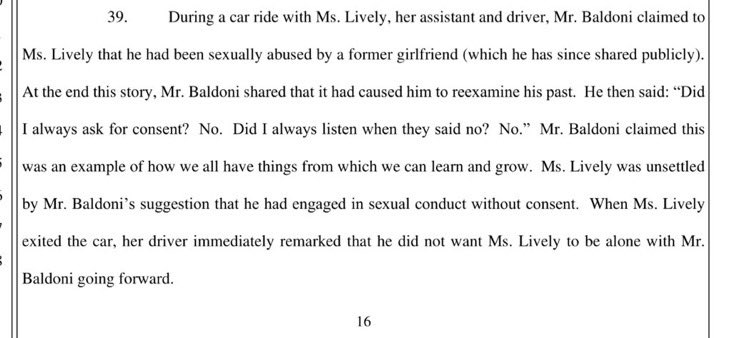
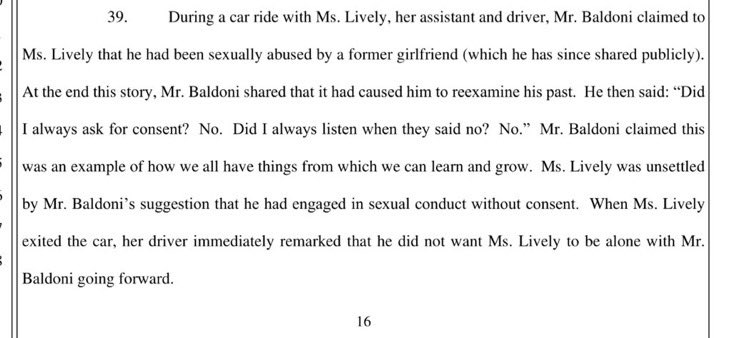
39. During a car ride with Ms. Lively, her assistant and driver, Mr. Baldoni claimed to Ms. Lively that he had been sexually abused by a former girlfriend (which he has since shared publicly). At the end of this story, Mr. Baldoni shared that it had caused him to reexamine his past. He then said: “Did I always ask for consent? No. Did I always listen when they said no? No.” Mr. Baldoni claimed this was an example of how we all have things from which we can learn and grow. Ms. Lively was unsettled by Mr. Baldoni’s suggestion that he had engaged in sexual conduct without consent. When Ms. Lively exited the car, her driver immediately remarked that he did not want Ms. Lively to be alone with Mr. Baldoni going forward.
Justin Baldoni, an actor and filmmaker known for his advocacy on masculinity and gender dynamics, has recently faced a wave of scrutiny regarding his past admissions about consent and the influence of pornography on his perception of women. The controversy has sparked a debate about whether men should be allowed to acknowledge past missteps as part of their growth, or whether such admissions permanently stain their reputation.
Baldoni’s Admission: A Moment of Honesty or a Confession?
At the heart of the debate is a resurfaced quote from Baldoni in which he acknowledged that, as a young man, he had crossed boundaries and failed to fully grasp the concept of consent. His words:
“Did I always ask for consent? No. Did I always listen when they said no? No.”
This statement, paired with his reflection on the impact of pornography on his early understanding of women, ignited controversy. Many took his words as an admission of past inappropriate behavior, while others viewed it as a brave acknowledgment of societal conditioning and the need for growth.
Social media reactions varied widely. Some praised Baldoni for confronting a difficult truth that many men experience but refuse to admit. Others, however, were unforgiving, arguing that past actions—regardless of their context or how much someone has grown—should not be excused. One viral tweet read:
“Past assault is still assault.”
Another user expressed concern that Baldoni appeared to be blaming pornography for his behavior rather than taking full accountability:
“What disturbs me about this is that he appears to be blaming pornography for an aspect of his own personality.”
Blake Lively’s Name in the Debate: A False Comparison?
As Baldoni faced backlash, some attempted to divert attention by bringing Blake Lively into the conversation. In particular, references were made to an old interview where she allegedly admitted to having a history of trying to “steal people’s movies” before being hired for It Ends With Us.
One user countered the Baldoni criticism by pointing out the perceived double standard:
“He’s talking about his teens and early twenties! He’s 41 now, people grow up and mature. Meanwhile, Blake was openly admitting to having a history of trying to steal people’s movies just MONTHS before she was hired for IEWU.”
However, others rejected this comparison outright, arguing that professional ambition and unethical career moves are nowhere near comparable to issues of consent.
“A woman could steal a million movies and it would still not be comparable to RAPE, what the f** is wrong with you?”* one Twitter user wrote in response.
Another user succinctly put it:
“Other women have come forward as well. Who gives a s** if Blake was mean and stole anything. That doesn’t mean he had the right to sexually harass and abuse her.”*
The Debate on Redemption and Accountability
One of the core issues in the discourse surrounding Baldoni is whether someone can openly admit to past mistakes and still be accepted in the public sphere. Many believe that people should be allowed to grow, learn, and change, especially when their past actions were influenced by harmful societal norms.
However, others feel that an admission without tangible accountability—such as apologizing to any individuals harmed or using one’s platform for meaningful change—is hollow. A sentiment echoed online was:
“He’s literally admitting to crossing boundaries and seeing women as objects, and this is not going viral? Yet when people took Blake’s past interview out of context, it was covered by all the media outlets and influencers.”
This double standard between men and women in the entertainment industry is something that many critics have pointed out: men often receive more leeway to confess past indiscretions under the guise of personal growth, whereas women’s actions—especially those deemed “unlikable”—tend to be magnified and punished indefinitely.
Final Thoughts: Growth or Consequence?
The discourse surrounding Baldoni raises broader questions about society’s approach to accountability and redemption. Should people, particularly men in positions of influence, be allowed to admit past failings without immediate cancellation? Or should public figures face lasting scrutiny for problematic behaviors, even if they occurred decades ago?
While Baldoni’s admission has received mixed reactions, it is clear that conversations about masculinity, consent, and personal growth are far from over.
Key Takeaways:
- Justin Baldoni admitted to past issues with consent, sparking debate over accountability and growth.
- Some defended him, arguing that people evolve, while others found his statement disturbing.
- Blake Lively’s past comments about “stealing movies” were brought into the discussion, but many rejected the comparison.
- The discourse reflects wider issues of media double standards and whether past wrongdoings can ever be fully forgiven.
Where do we draw the line between personal growth and past accountability? The conversation continues.
 celebchai.com