Divided Kingdom: Analyzing Public Discourse on Meghan Markle

Introduction
A seemingly innocuous event—Meghan Markle wearing a Northwestern University sweatshirt—ignited a firestorm of comments on social media, revealing deep divisions in public perception of the Duchess of Sussex. This incident serves as a microcosm of the larger discourse surrounding Meghan, the royal family, and the intersection of race, gender, and celebrity in contemporary society.
By examining the comments, patterns emerge that illuminate why discussions about Meghan Markle frequently become polarized and emotionally charged. This analysis explores the complex web of reactions, the underlying narratives they reveal, and what this tells us about broader societal attitudes.
The Inciting Incident
The controversy began when Meghan Markle was photographed wearing a Northwestern University sweatshirt—her alma mater. Critics suggested this was another instance of Meghan “copying” Princess Diana, who had once been photographed wearing a similar-looking sweatshirt. This criticism prompted numerous defenders to point out that Meghan was simply wearing apparel from her own university, a common practice among American college graduates.
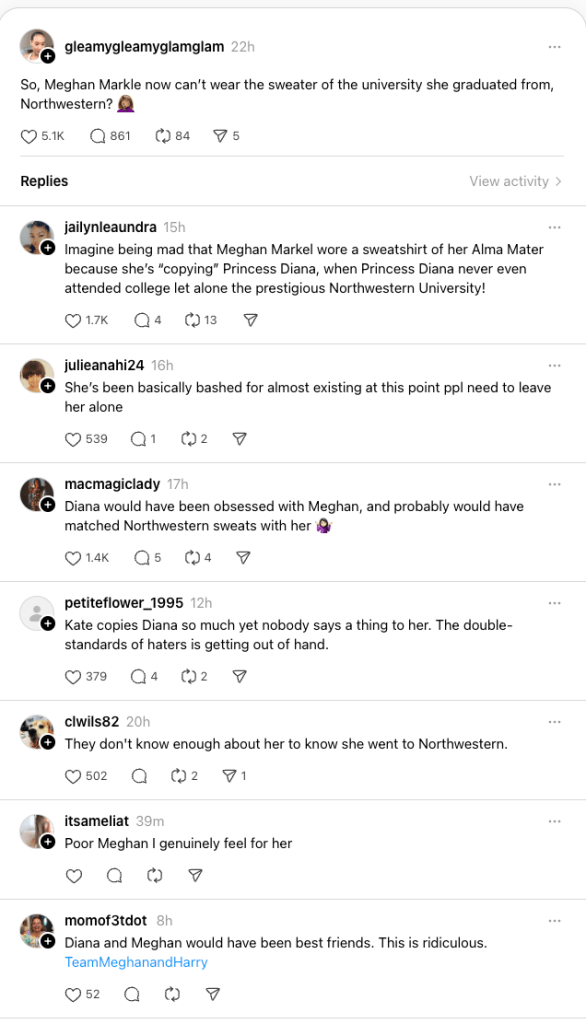
The original post posed the question: “So, Meghan Markle now can’t wear the sweater of the university she graduated from, Northwestern? 🤦🏽♀️”
Major Themes in the Comment Section
1. Accusations of Racial Bias
One of the most prevalent themes in the comments was the assertion that criticism of Meghan Markle is fundamentally rooted in racial bias. Many commenters directly addressed this perspective:
- knowsybee: “If she was white they would have said her meeting Harry was fate, but she’s a brown woman so she was plotting 🤨”
- badmikeyt: “You could’ve just said Catherine is White while Meghan is NOT.”
- cssrmolly: “The white woman pays homage. The mixed race woman cosplays. Gotcha.”
- combs2311: “These white women hating on her are completely unhinged”
- lola_skinandscents: “Racism, so freaking illogical.”
These comments reflect a belief that a double standard exists in how Kate Middleton and Meghan Markle are judged for similar behaviors. They suggest that actions viewed positively when performed by Kate are interpreted negatively when performed by Meghan, with race being the differentiating factor.
2. Denial of Racial Motivation
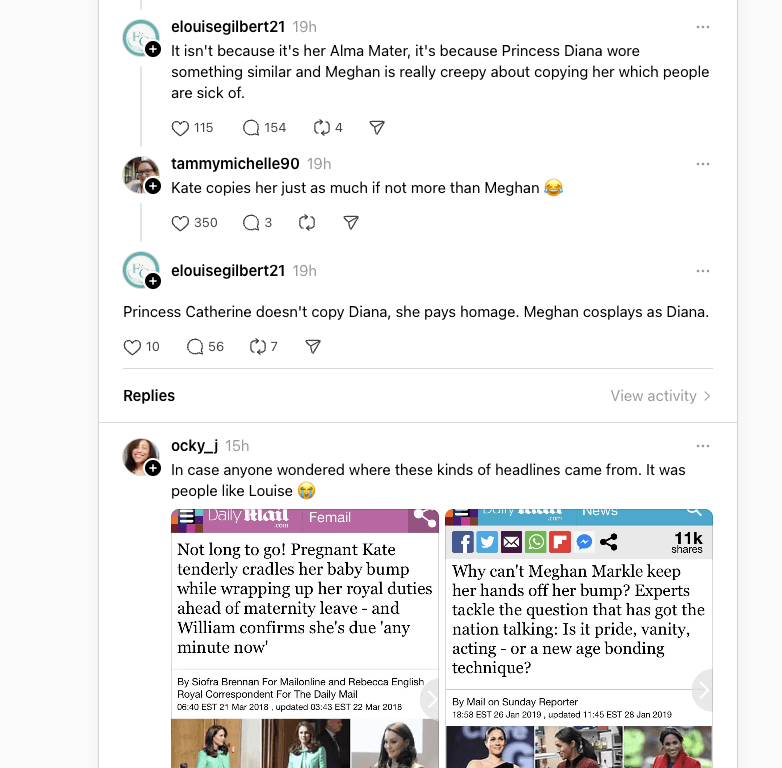
Conversely, critics of Meghan, particularly user elouisegilbert21, vehemently denied racial motivation:
- elouisegilbert21: “I don’t care about her race.”
- elouisegilbert21: “I haven’t noticed a single person’s race. I respond only with the attitude I’m met with.”
- elouisegilbert21: “I would never say something like that because I only say things that are true.”
This user insisted that her criticism was based on Meghan’s behavior rather than her race, drawing a distinction between Kate “paying homage” to Diana versus Meghan “cosplaying” Diana. When pressed to explain this distinction, the responses became increasingly defensive without clarifying the objective difference between these characterizations.
3. Perceived Relentless Criticism
Many commenters expressed frustration with what they view as constant, petty criticism of Meghan:
- the.pen.killed.the.poet: “That woman can’t breathe without those people having something to say about it 😒”
- inger_ghl: “They literally won’t let this woman live. It’s so relentless and exhausting.”
- thxkbyexoxo: “Oh, good GOD!! I swear to my time, how she manages to make it through the day with so much hate directed at her for literally everything she does boggles my mind. A sweatshirt. 🤦🏽♀️🤦🏽♀️”
- _ravenroberts: “They get mad if she breathes at this point it’s so ridiculous”
- ama_d_chique: “Gosh people are just pure evil. They can’t let this women live in peace. She is not bothering nobody. She is making jam and smiling what is their to hate about.”
These comments suggest a perception that Meghan is subjected to a level of scrutiny and criticism that goes beyond normal celebrity coverage, focusing on even the most mundane aspects of her life.
4. Cultural Differences in Understanding
Some commenters highlighted cultural differences between the US and UK that might contribute to misunderstandings:
- AndDontCallMePammie: “I think a lot comes down to culture. I’m Canadian and lived and worked in a major U.S. city for a decade. I thought our cultures were very similar, but they’re not!”
- alliemcb1: “It may be because we don’t really do that here in the UK. We don’t have sweaters etc and call them alma maters. We don’t tend to understand the culture around it.”
- roxydoodle_andfriends: “For real?? Well that’s the dumbest thing I’ve read so far today! Do they not realize all Americans rep their alma maters? 🤦🏼♀️”
These observations suggest that some of the criticism may stem from cultural differences in how Americans and Britons view university affiliations and expressions of school pride.
5. Media Criticism and Tabloid Culture
Several commenters pointed to the role of media, particularly British tabloids, in perpetuating negativity toward Meghan:
- pycts: “It’s honestly embarrassing that the British press is so freaking obsessed with trashing the poor woman. I know part of it is fueled by Piers and his wife.”
- ladybelleolive: “The way this woman is dragged by legacy media and hated by misogynists. I want her to win so badly.”
- dani_j2010: “The people hating on her seem very miserable and disappointed with their own mediocrity. Meanwhile I’m also in California fully understanding why Meghan chose here over the UK — because people have lives here that don’t revolve around bashing her.”
These comments reflect an understanding of the British tabloid press as particularly aggressive toward Meghan, suggesting that media narratives play a significant role in shaping public perception.
6. Counterfactual Arguments About Diana
Interestingly, many commenters speculated about how Princess Diana would have related to Meghan if she were alive:
- macmagiclady: “Diana would have been obsessed with Meghan, and probably would have matched Northwestern sweats with her 🤷🏻♀️”
- momof3tdot: “Diana and Meghan would have been best friends. This is ridiculous.”
- sheshedsheshed: “Delusional thinking Diana would simp for the monarchy. They didn’t deserve her and neither do you.”
These comments represent an attempt to co-opt Diana’s legacy and presumed values to support either side of the debate, despite the impossibility of knowing what Diana’s actual opinions would have been.
7. Double Standards in Royal Coverage
Many comments specifically addressed perceived double standards in how different royals are judged:
- petiteflower_1995: “Kate copies Diana so much yet nobody says a thing to her. The double-standards of haters is getting out of hand.”
- gemma_penney: “Kate copies Diana and Meghan all the time and no one cares.”
- beasredblanket: “But if perfect Kate wore something similar, she’d be praised for it! Such double standards.”
- nickdollmack: “Katie Keen Missington and Pimp Mama Carole literally scour the archives for Diana’s looks and then go and source similar pieces – I mean don’t know about you but cosplaying your husband’s dead mother constantly seems a little off..”
These comments suggest frustration with inconsistent standards of evaluation applied to different members of the royal family, particularly between Kate and Meghan.
8. Connection to Jason Knauf Interview
Some comments explicitly connected the Northwestern sweatshirt controversy to the recent Jason Knauf interview discussed in previous documents:
- inger_ghl: “It’s no conincindce that her BIL’s ex aid is in the tabloids talking about her and the regurgitated lies about bullying. He got his 30 pieces of silver and he’s still going.”
This suggests that some supporters of Meghan see various criticisms as part of a coordinated effort to undermine her reputation, connecting seemingly separate events into a larger narrative of persecution.
Analysis of Commenter Dynamics
Echo Chambers and Validation
The comments section demonstrates how social media can function as an echo chamber, with users seeking validation for their existing views. Supporters of Meghan rallied around defending her, while critics doubled down on their perspectives. Few commenters showed signs of considering alternative viewpoints or engaging in good-faith dialogue.
Parasocial Relationships
Many comments reveal strong parasocial relationships with both Meghan and other royals. Users speak about these public figures with a sense of personal knowledge and investment:
- dudewithblackdolls: “I love Princess Meghan 💕🫶🏾”
- ladybelleolive: “I will watch and cheer on everything she does. The way this woman is dragged by legacy media and hated by misogynists. I want her to win so badly.”
- unbeknownst2me_: “This thread is so refreshing. I absolutely adore Meghan.”
These comments demonstrate how public figures become proxies for broader values and identities, with support or criticism often reflecting personal alignment with what these figures are perceived to represent.
Projection and Assumption
Throughout the comments, users project assumptions onto both Meghan and her critics:
- Critics assume Meghan is deliberately copying Diana despite potential alternative explanations
- Defenders assume critics are racially motivated even when other factors might be at play
- Both sides make assumptions about other users’ motivations and backgrounds
This pattern of projection reveals how discussions about public figures often tell us more about the commenters than about the subjects themselves.
Broader Societal Implications
Intersection of Race, Gender, and Power
The comments about Meghan wearing a Northwestern sweatshirt may seem trivial on the surface, but they reveal deeper tensions around race, gender, and power within British society and the monarchy. Many defenders of Meghan see her treatment as emblematic of how women of color are often subjected to heightened scrutiny and criticism, particularly when they enter predominantly white spaces of privilege.
Media Literacy and Critical Thinking
The polarized nature of these comments highlights challenges in media literacy and critical thinking. Few commenters demonstrated nuanced understanding or willingness to consider multiple perspectives. Instead, most defaulted to binary positions influenced by existing biases and narratives.
Cultural Differences and Misunderstanding
The sweatshirt controversy also highlights genuine cultural differences between American and British traditions. What might be a normal expression of alumni pride in an American context could be interpreted differently through a British lens, where such displays are less common.
Conclusion
What began as criticism of Meghan Markle wearing a Northwestern sweatshirt evolved into a microcosm of larger debates about race, media, and the monarchy. The comments reveal deeply entrenched positions that go far beyond the specific incident in question.
These social media reactions demonstrate how minor events involving public figures can become proxy battles for broader social tensions. The intensity of reaction to something as mundane as a university sweatshirt suggests that these comments are less about Meghan’s wardrobe choices and more about what she represents to different segments of society.
For supporters, defending Meghan against criticism becomes an act of standing against perceived racism and media bias. For critics, finding fault with Meghan’s choices becomes a way of defending traditional institutions and values they perceive as under threat.
The Northwestern sweatshirt incident illustrates how, in today’s polarized media landscape, even the most innocuous actions can become battlegrounds for competing worldviews, with little room for nuance or mutual understanding. This phenomenon extends far beyond Meghan Markle, affecting discourse on numerous public figures and social issues, and highlighting the challenges of constructive dialogue in a digital age dominated by hot takes and tribal affiliations.
 celebchai.com