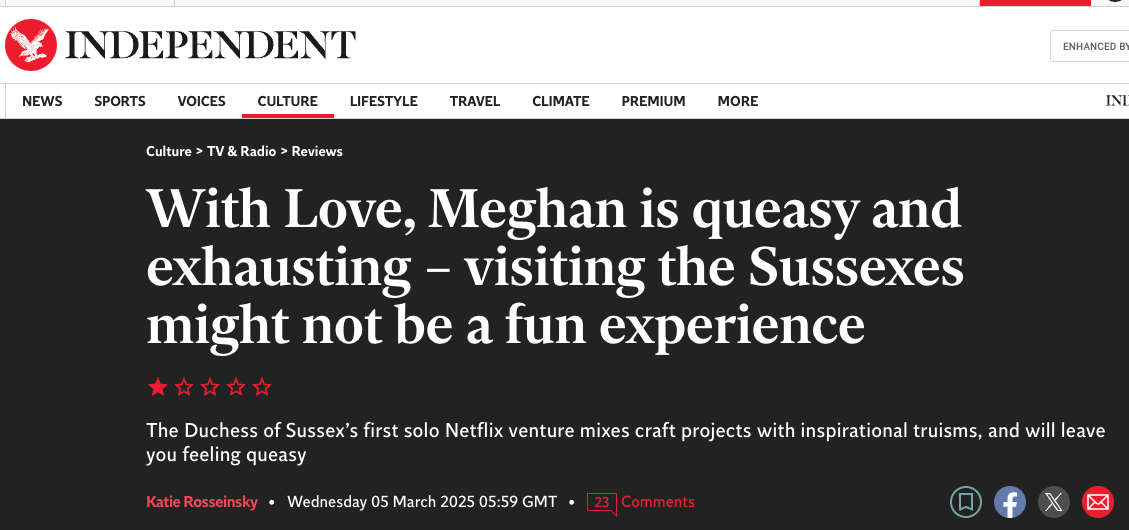
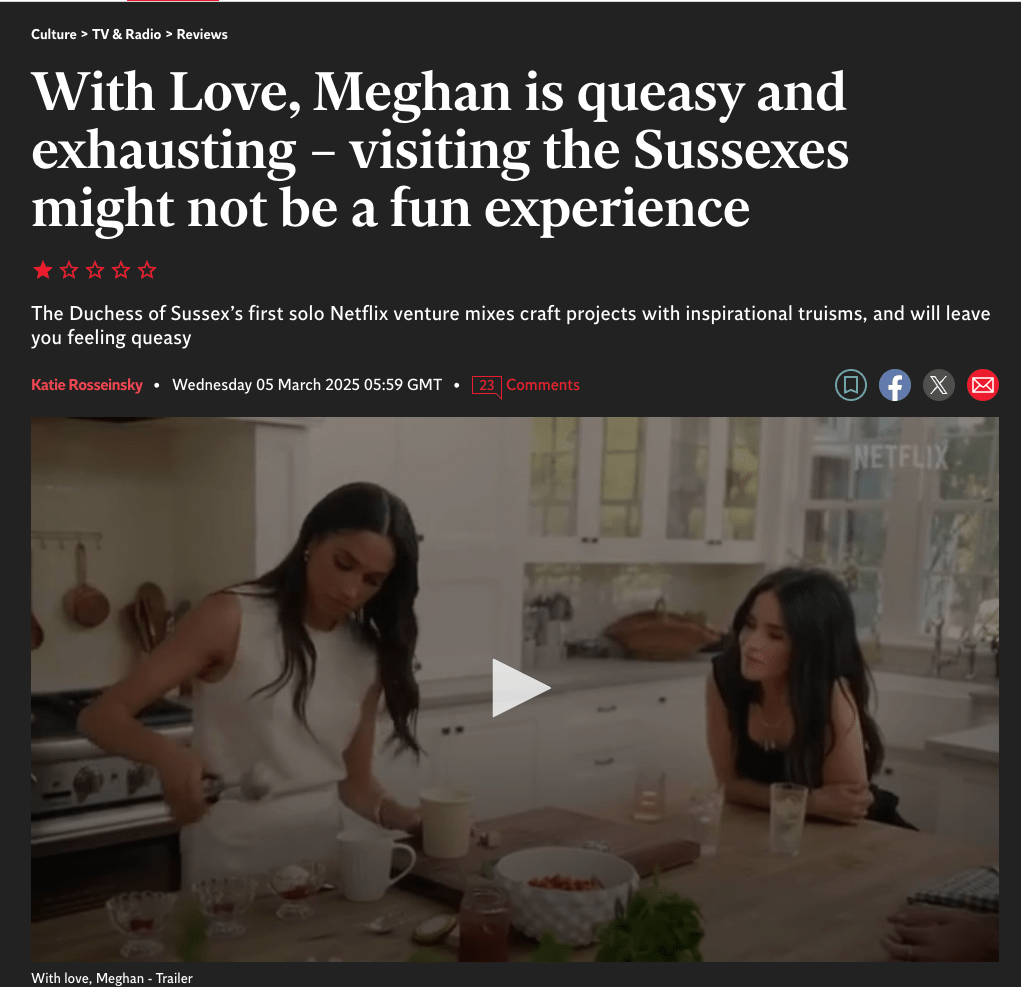
If you’ve read Katie Rosseinsky’s piece in The Independent, you’d think a casual visit to Meghan Markle’s Montecito home would feel like running a marathon. Rosseinsky paints the duchess’s Netflix show, With Love, Meghan, as an endless whirlwind of craft projects, elaborate cooking, and forced domestic bliss—so exhausting that any unsuspecting guest would need to lie down for a week. But is this portrayal fair, or does it gloss over the series’ real appeal and global success?
Below, we dive into the main criticisms of Rosseinsky’s review and explore why it might be missing the bigger picture.
1. Ignoring the Show’s Actual Popularity
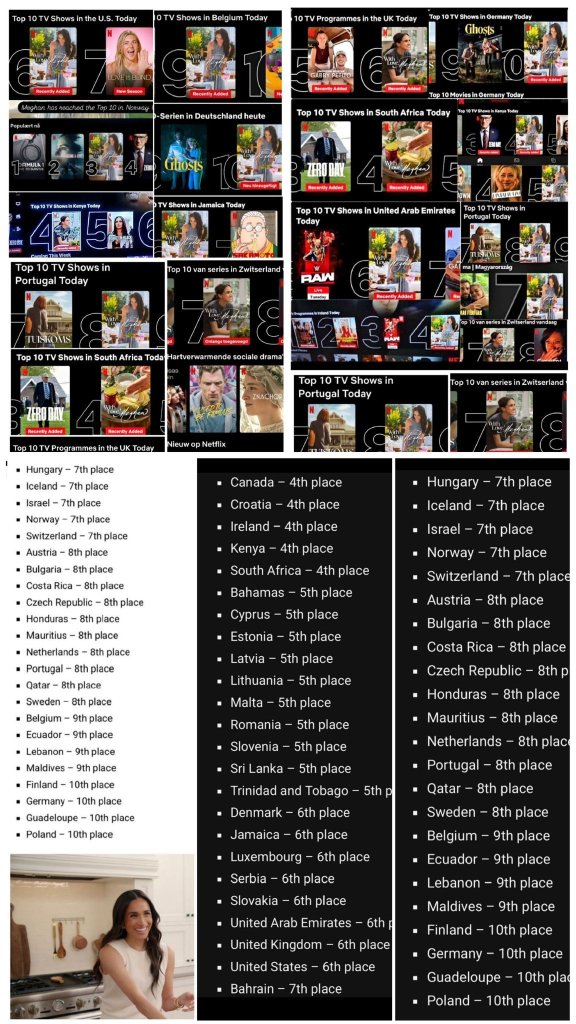
Rosseinsky’s critique focuses on how “queasy” and “exhausting” the show feels—yet she never acknowledges that With Love, Meghan is performing well internationally. From multiple countries ranking the show in their Top 10, it’s clear that a sizable audience is tuning in. If viewers across the globe are finding value—be it in the cooking tips, the aspirational aesthetics, or simply the star power—then it’s worth questioning whether the review is too dismissive. One critic’s personal annoyance doesn’t necessarily reflect the broader audience’s reaction.
2. Overemphasis on Personal Irritations
The review spends much of its word count dissecting Meghan’s “gift-wrapped snacks” and “crafty tasks,” almost as if the writer expected a gritty documentary rather than a breezy lifestyle program. The entire premise of With Love, Meghan is to showcase Meghan’s approach to hosting and everyday celebrations—an ethos reminiscent of Martha Stewart, Joanna Gaines, or any number of lifestyle personalities. By hyper-focusing on how “exhausting” or “queasy” it all is, Rosseinsky risks missing the fact that plenty of viewers actually enjoy (and seek out) precisely this kind of curated, feel-good content.
3. Undervaluing the Show’s Intended Tone
It’s important to remember that With Love, Meghan is meant to be a warm, upbeat glimpse into the duchess’s life, not an exposé on royal family politics. Rosseinsky seems disappointed that the series isn’t serving up sensational gossip. But the show was never billed as a behind-the-scenes tell-all—Meghan already covered that territory in other projects. Criticizing a lifestyle show for not delivering the drama of Harry & Meghan is like faulting a baking show for not exploring climate change. They’re fundamentally different genres.
4. Missing the Aspirational Market
Rosseinsky questions whether viewers have the time or resources to replicate Meghan’s lifestyle—yet overlooks that aspiration is the core selling point of many successful lifestyle programs. From Barefoot Contessa to Queer Eye, the charm lies in seeing how the “other half” lives and picking up bits of inspiration along the way. That’s not “queasy”; it’s a well-established form of entertainment. Indeed, many fans of the show might relish the fantasy of elegantly arranged edible flowers or a guest room stocked with personal touches, even if they’ll never recreate it 100 percent at home.
5. Dismissing Meghan’s Personality-Driven Appeal
Star-driven lifestyle programming is a massive market. Think: Oprah’s home tours, Gwyneth Paltrow’s Goop empire, or Chip and Joanna Gaines’s Magnolia brand. Each thrives because the personalities behind them offer a unique blend of relatability and celebrity. Rosseinsky’s piece largely glosses over Meghan’s global fan base—people who admire her style, her philanthropic interests, or simply her persona. The show’s success likely hinges on that star power, and the numbers suggest it’s working.
6. Failing to See the Bigger Cultural Context
Finally, the review’s heavy emphasis on cynicism overlooks why a warm, wholesome show might resonate right now. In an era of stressful news cycles, viewers often seek out content that feels comforting and lighthearted. Sure, With Love, Meghan might be “Pinterest meets posh Blue Peter,” but that’s precisely the vibe many watchers crave for a quick mental escape. Rosseinsky’s critique would be stronger if it acknowledged that there’s room in the cultural landscape for a bit of well-meaning domestic escapism.
In Conclusion
Katie Rosseinsky is free to find With Love, Meghan nauseating or tedious, and there’s room for constructive critique in any lifestyle show. However, her review overlooks a critical fact: a significant global audience is tuning in—and clearly finding something to enjoy. By zeroing in on personal irritation, ignoring the show’s proven popularity, and dismissing the aspirational market, the critique feels unbalanced. After all, if millions of people are watching (and re-watching) Meghan fill cellophane bags with peanut butter pretzels and arrange fresh blooms, perhaps it’s not quite as “queasy” an experience as the reviewer would have us believe.
 celebchai.com
One thought on “A Take on Katie Rosseinsky’s Review of With Love, Meghan”