Sloane v. Baldoni.
Sloane filed a Motion to Dismiss at Dkt. 86 and 87.
Sloane filed a reply Dkt. 126.
This document is a legal filing titled “Vision PR, Inc. and Leslie Sloane’s Reply Memorandum of Law in Further Support of Their Motion to Dismiss the Amended Complaint, For Attorneys’ Fees and Costs, and to Strike Exhibit A” filed on March 13, 2025, in the U.S. District Court for the Southern District of New York.
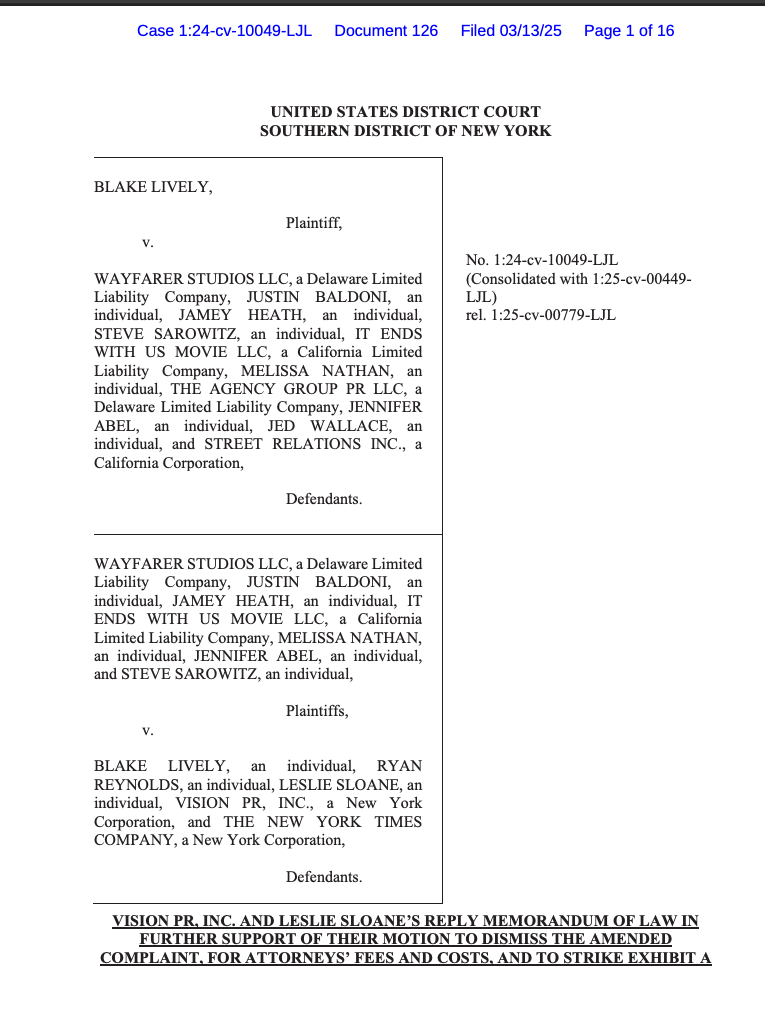
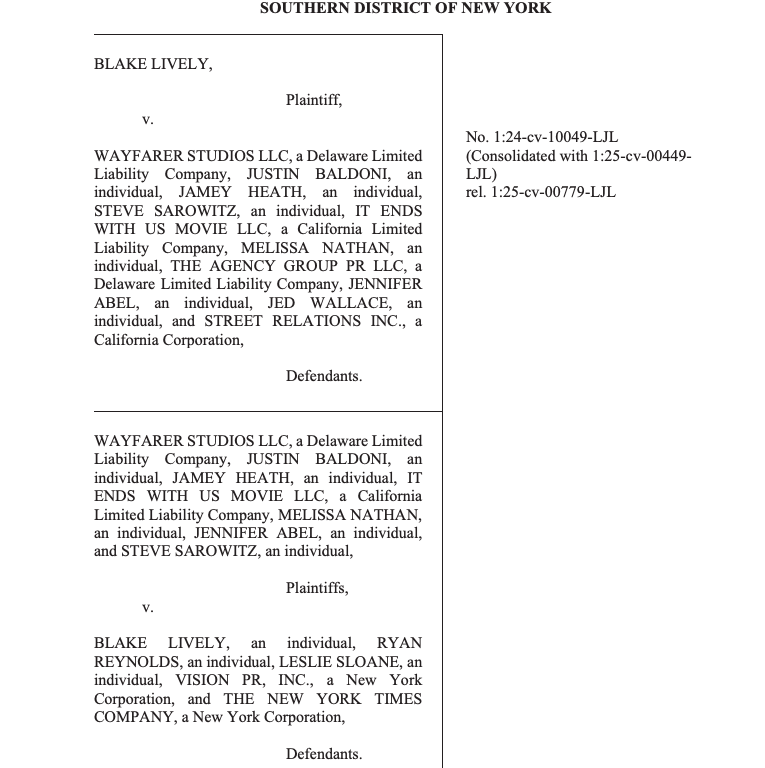
The case involves litigation between Blake Lively (as plaintiff) against Wayfarer Studios LLC, Justin Baldoni, and others, as well as a countersuit by Wayfarer Studios and others against Lively, Ryan Reynolds, Leslie Sloane, Vision PR, and The New York Times Company.
In this reply brief, Leslie Sloane and Vision PR (the “Sloane Parties”) argue for dismissal of claims against them on several grounds:
- The Amended Complaint contains impermissible “group pleading” that fails to specify which plaintiffs are asserting which claims against which defendants.
- The civil extortion claim fails because New York doesn’t recognize such a claim, and even under California law, the basic elements aren’t properly alleged.
- The defamation claim fails because:
- Sloane’s statements don’t concern six of the seven Wayfarer Parties
- The statements are inactionable opinions or substantially true
- The allegations regarding “sexual assault” statements are inadequately pleaded
- The plaintiffs fail to allege actual malice
- The plaintiffs fail to allege special damages
- The false light claim fails because New York doesn’t recognize such a claim, and even under California law, it’s duplicative of the defamation claim.
The Sloane Parties also request attorneys’ fees and costs under New York’s anti-SLAPP law and ask the court to strike Exhibit A to the Amended Complaint. They argue that the Wayfarer Parties’ repeated requests for leave to amend are improper because they’ve already had two opportunities to submit an actionable complaint and have failed to attach a proposed amended pleading.
The Sloane Parties (Leslie Sloane and Vision PR) point out that the Wayfarer Parties (Baldoni, Wayfarer Studios, etc.) repeatedly request permission to amend their complaint rather than defending their current pleading. The document states that the Wayfarer Parties have already been given two opportunities to submit an actionable complaint and have failed both times.
In footnote 13 on page 10, the Sloane Parties argue that the Wayfarer Parties’ requests for leave to amend are procedurally improper because they only make a “bare request to amend a pleading” in their brief without actually attaching a proposed amended complaint. They cite legal precedent (Brown Media Corp. v. K & L Gates, LLP and Krulewich v. Covidien, LP) indicating that such requests without an attached proposed amended pleading are improper under Rule 15 of the Federal Rules of Civil Procedure.
The Sloane Parties also note that the Wayfarer Parties admit they “intend to move for leave to amend” to fix the group pleading issues (page 2) and vaguely assert they have “obtained additional information” but expect the Court to “take their word for it” without providing specifics. The Sloane Parties argue that “no amendment or ‘additional information’ could cure the defects in the Amended Complaint.”
 celebchai.com
One thought on “Blake Lively v. Baldoni: Key Motion Fully Briefed”