



1. Strength of the Wayfarer Parties’ Defamation Claims Against Sloane
Wayfarer and Baldoni’s team claim that Sloane played a key role in defaming them by:
- Allegedly feeding reporters false information about sexual misconduct by Wayfarer executives.
- Helping craft and spread a false narrative about harassment and retaliation.
- Conspiring with Blake Lively’s team to discredit Wayfarer through the media.
However, Wayfarer faces key weaknesses in their defamation case against Sloane:
- Lack of Specific Statements: The complaint does not attribute specific defamatory statements to Sloane herself. Instead, it alleges she was behind a “whisper campaign.” Courts generally require direct evidence (e.g., emails, recorded statements, or testimony) linking a defendant to the publication of defamatory material.
- Group Pleading Issue: The lawsuit names multiple plaintiffs but does not clarify which specific statements harmed which individuals. Courts often reject “group defamation” complaints that fail to specify who was defamed and how.
- Actual Malice Standard: Since Baldoni is a public figure, Wayfarer must prove Sloane knew the statements were false or acted with reckless disregard for the truth. If Sloane believed Lively’s allegations were true, it is unlikely Wayfarer can prove actual malice.
- Truth as a Defense: If Lively’s allegations about harassment have any factual basis, then statements about Wayfarer’s misconduct may not be defamatory.
- Opinion vs. Fact: Some of the alleged defamatory statements (e.g., calling Wayfarer’s executives “retaliatory” or “selfish”) may be protected opinions rather than actionable falsehoods.
Likelihood of Success for Wayfarer’s Defamation Claim Against Sloane?
Weak. Courts are unlikely to let the claim survive without clearer allegations. Even if it survives dismissal, Wayfarer must still prove actual malice, which is a high burden.
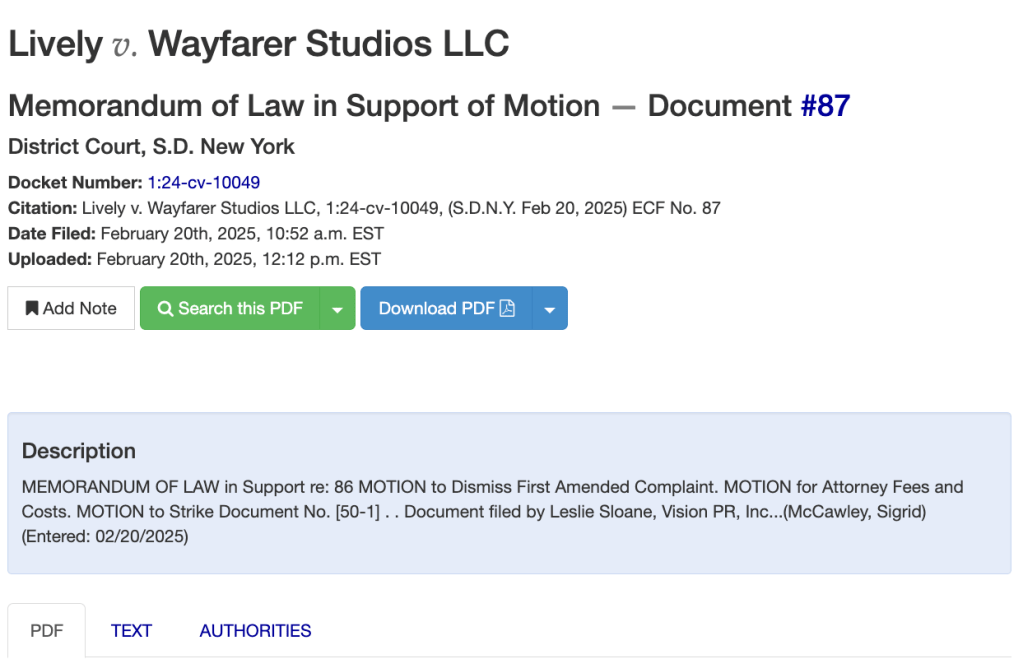
2. Validity of Sloane’s Motion to Dismiss
Sloane’s legal team argues that:
- The complaint is vague and fails to identify specific defamatory statements.
- Some claims (like false light invasion of privacy) should be dismissed because New York law does not recognize them.
- The civil extortion claim is legally defective—it does not allege that Sloane sought money or property, a required element.
- The defamation claim does not sufficiently allege actual malice (a requirement since Baldoni is a public figure).
- The case should be dismissed under New York’s anti-SLAPP law, which penalizes lawsuits that attempt to silence speech on public issues.
Key Strengths of Sloane’s Motion to Dismiss:
Group Pleading Argument is Strong – Wayfarer’s vague allegations against multiple parties might not satisfy federal pleading standards. Courts often dismiss complaints that fail to attribute specific actions to each defendant.
False Light and Extortion Claims Likely to be Dismissed – If New York law applies, false light and civil extortion do not exist as valid claims.
Anti-SLAPP Defense Could Work – If the judge finds Wayfarer’s lawsuit was designed to punish free speech, Sloane could win dismissal and attorneys’ fees.
Potential Weaknesses in Sloane’s Motion:
Defamation Claim Might Survive (Barely) – Courts rarely dismiss defamation claims at this stage unless they are clearly frivolous. Even though Wayfarer’s case is weak, a judge might allow it to proceed to discovery.
Choice of Law Battle – If the court decides California law applies, Wayfarer’s false light and extortion claims could survive.
Likelihood of Sloane’s Motion Succeeding?
High chance of partial dismissal – Expect false light and civil extortion to be dismissed.
Defamation claim might be narrowed but could survive.
Anti-SLAPP ruling could favor Sloane, forcing Wayfarer to prove malice early.
3. Legal Precedents Cited
- Group Defamation Cases (Appalachian Enterprises) – Strengthen Sloane’s argument that Wayfarer’s vague allegations are not specific enough to survive dismissal.
- New York Times v. Sullivan (Actual Malice Standard) – Raises the bar for Wayfarer, as they must prove Sloane acted with knowledge of falsity.
- New York’s Anti-SLAPP Law – If the judge applies it, Wayfarer’s defamation claims could be dismissed for lack of merit.
4. Procedural Advantages
Sloane’s Advantages:
- New York law favors dismissal of weak defamation claims – especially those brought by public figures.
- Anti-SLAPP protection means Wayfarer could be forced to pay attorneys’ fees.
- Weak allegations make dismissal more likely—Wayfarer has no direct quotes from Sloane.
Wayfarer’s Weaknesses:
- Their claims are poorly structured (group pleading issue).
- They may have filed too quickly, without solid evidence tying Sloane to defamation.
- If they lose the motion, they could owe Sloane attorneys’ fees under anti-SLAPP.
Final Prediction
- False Light and Civil Extortion – Dismissed (New York law doesn’t recognize them).
- Defamation Claim – Might survive, but only if Wayfarer fixes their complaint. Otherwise, the court could dismiss it with leave to amend.
- Sloane’s Motion to Dismiss – Mostly granted, at least in part.
- Wayfarer’s lawsuit weakens – If dismissed, they must file an amended complaint with specific allegations against Sloane.
Who Wins This Motion?
Leslie Sloane.
She is likely to win dismissal of at least some claims and possibly force Wayfarer to revise their complaint.
 celebchai.com
One thought on “Outcome of Sloane’s Motion to Dismiss”