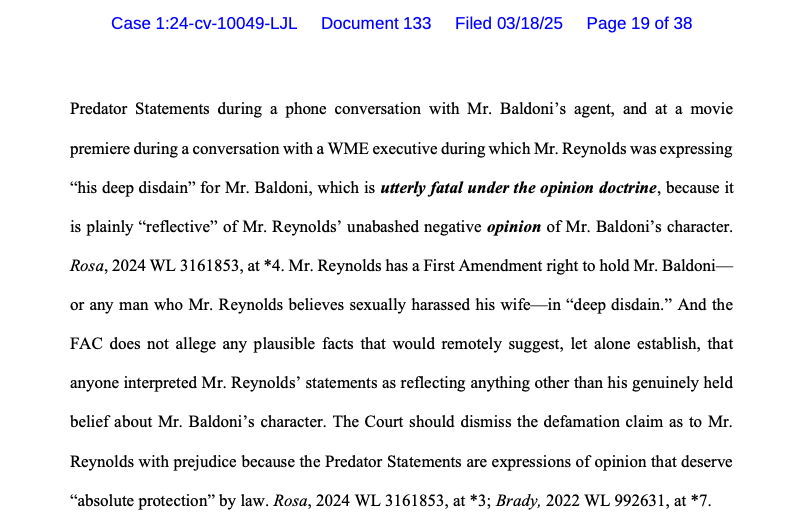
The Hollywood Reporter brought up an excellent point on opinion and belief.
Ryan Reynolds is fighting back against Justin Baldoni’s defamation lawsuit, arguing that his statements about Baldoni being a “sexual predator” are protected under the First Amendment because they reflect his genuinely held beliefs. In a legal battle that has entangled Reynolds, his wife Blake Lively, and It Ends With Us director Baldoni, the dispute raises critical questions about free speech, defamation laws, and Hollywood power struggles.
The Legal Threshold for Defamation
For a public figure like Baldoni to succeed in a defamation case, he must prove that Reynolds knowingly made false statements or acted with reckless disregard for the truth. In his motion to dismiss, Reynolds asserts that he cannot be found guilty of defamation because he sincerely believes Baldoni engaged in predatory behavior. His legal team argues that opinions—even harsh ones—are constitutionally protected.
Reynolds’ lawyer, Michael Gottlieb, stated in the filing that Baldoni’s lawsuit “does not allege any plausible facts that would remotely suggest, let alone establish, that anyone interpreted Mr. Reynolds’ statements as reflecting anything other than his genuinely held belief about Mr. Baldoni’s character.”
The Allegations Against Reynolds
Baldoni sued Reynolds, alleging that the Deadpool star attempted to destroy his career by calling him a “sexual predator” in conversations with WME, a top Hollywood talent agency. The lawsuit claims Reynolds pressured WME executives to sever ties with Baldoni, which, if true, could amount to tortious interference. However, Reynolds’ legal team argues that Baldoni’s claims lack crucial details, such as the specifics of the alleged conversations, making it impossible to determine whether they fall within the statute of limitations.
Additionally, Baldoni’s lawsuit alleges that Reynolds engaged in extortion and contract interference. Reynolds’ lawyers countered that Baldoni failed to specify how Reynolds allegedly extorted him, what contract was breached, or who suffered financial losses. The complaint, they argue, is riddled with vague assertions rather than concrete legal claims.
The Role of Blake Lively in the Dispute
This lawsuit is part of a larger legal battle between Baldoni and Lively, who accused him of sexual harassment on the set of It Ends With Us. Baldoni countersued her, alleging that Lively and Reynolds orchestrated a smear campaign against him. The controversy escalated when The New York Times published an article about Lively’s allegations, prompting Baldoni to sue the newspaper as well.
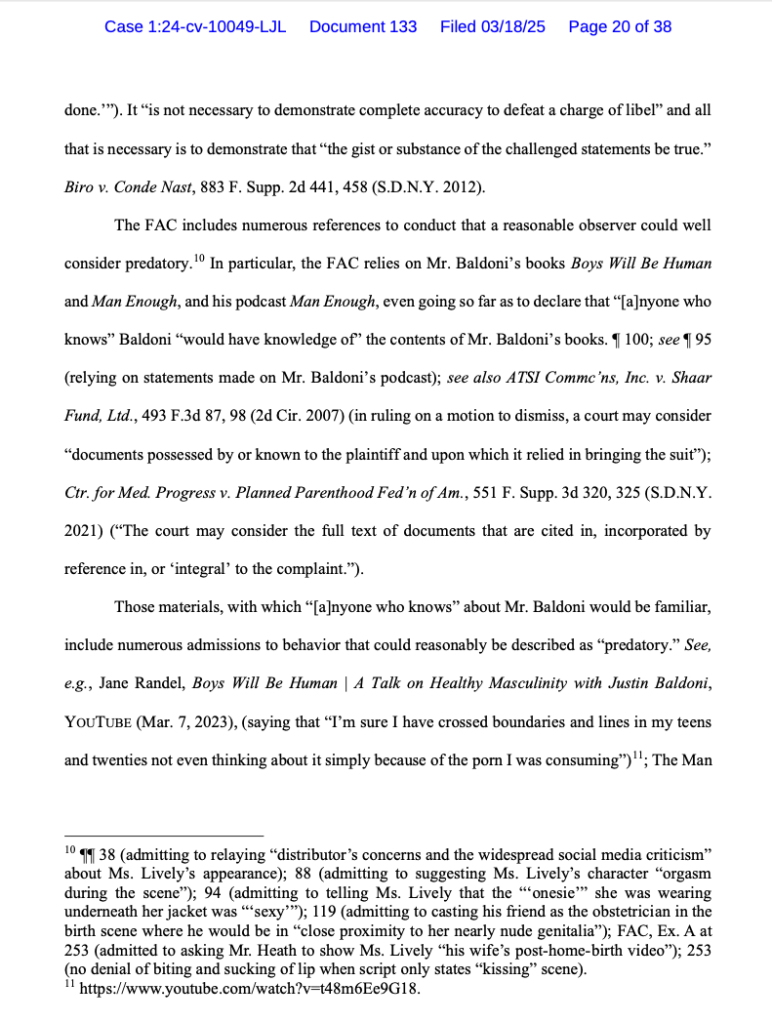
Reynolds’ Argument: Statements as Opinion, Not Fact
Reynolds’ legal team argues that even if he did refer to Baldoni as a “predator,” the term should be understood as an opinion rather than a factual assertion. He has the right, they argue, to express his “deep disdain” for a man he believes sexually harassed his wife. The motion points to Baldoni’s past public statements, where he admitted on a podcast that he likely “crossed boundaries” in his younger years due to the influence of pornography. Reynolds’ team claims that these admissions support Reynolds’ characterization of Baldoni.
The defense emphasizes that opinions—especially those rooted in personal experiences—are not actionable under defamation laws. If a court determines that Reynolds’ statements were subjective judgments rather than factual falsehoods, Baldoni’s lawsuit could collapse.
Implications for Free Speech in Hollywood
This case could set an important precedent for how defamation claims are handled in Hollywood, particularly when allegations involve deeply personal and controversial topics like sexual misconduct. If Reynolds prevails, the ruling could reinforce the idea that public figures have wide latitude to express opinions about other public figures without fear of legal repercussions. Conversely, if Baldoni wins, it could redefine the boundaries of what constitutes defamation in cases involving personal and professional reputation.
The broader implications extend beyond Reynolds and Baldoni, touching on the intersection of free speech, the #MeToo movement, and the legal standards for reputational harm in the entertainment industry. As the case unfolds, it will be closely watched by legal experts, media professionals, and industry insiders.
 celebchai.com