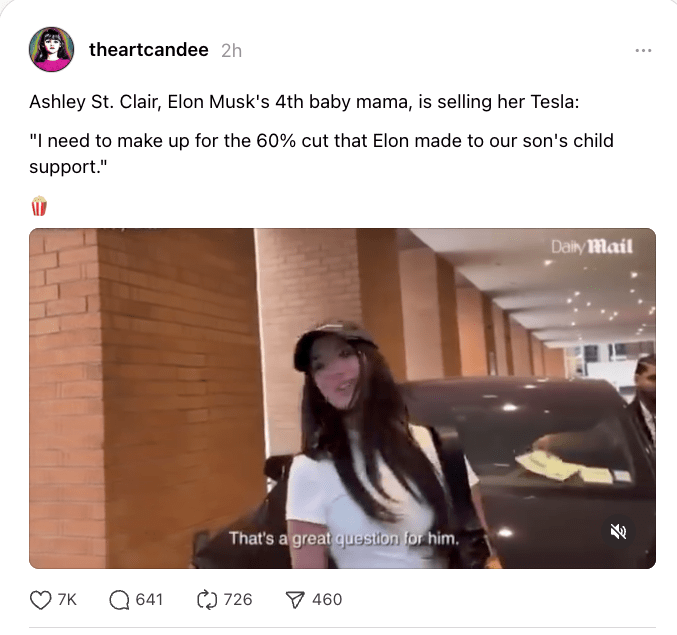
When Ashley St. Clair appeared in a viral video claiming she had to sell her Tesla because Elon Musk slashed their son’s child support by 60%, the internet ignited. Some were shocked that one of the world’s richest men would cut back support for his child. Others scoffed, suggesting St. Clair knew what she was getting into. The backlash, however, went far beyond debate — it spiraled into a full-blown campaign of digital harassment, misogyny, and targeted abuse.
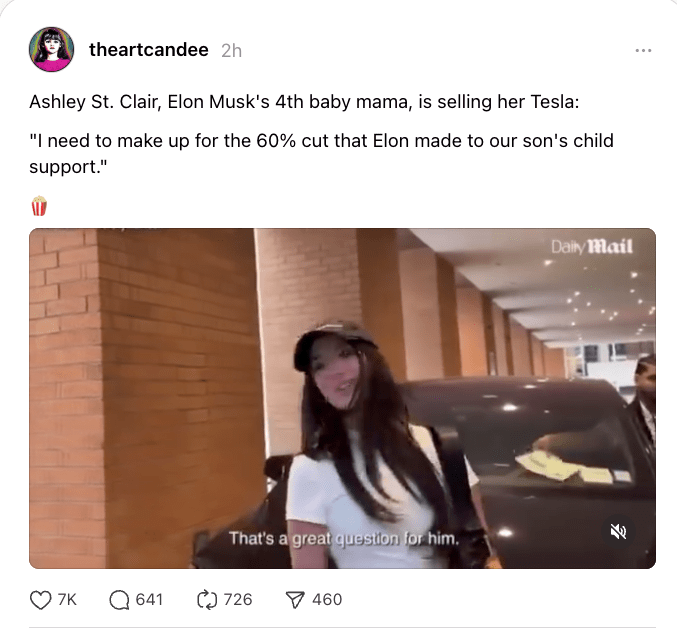
St. Clair, labeled “Elon’s fourth baby mama” by users across platforms, was mocked, insulted, and dehumanized. Comment sections filled with slurs, sexually explicit attacks, crypto scams, and calls to “stop giving this idiot a platform.” Within hours, she wasn’t a person—she was content. A meme. A spectacle.
But amid the digital chaos, two narratives emerged—both worth exploring.
The first: accountability. Elon Musk’s relationship history, especially his aversion to long-term child support, is hardly a secret. Critics argue that St. Clair willingly entered a dynamic where emotional and financial stability were unlikely. For them, her current situation is not a surprise but a consequence. “She did this to herself” has become the dominant refrain, with many refusing to offer sympathy for someone who aligned herself with a notoriously an absentee father. The subtext is brutal but common: if you knowingly get involved with a powerful man known for instability, you lose the right to complain.
But that argument has limits.
Because the second, and arguably more disturbing, reality is what happened once she did speak. Regardless of her personal choices, St. Clair became the target of mass misogyny. Comments labeled her a “cum dumpster” and accused her of trying to “trap” Musk for money. Her worth was reduced to her reproductive role. Her intelligence, integrity, and motherhood were dragged through the dirt. And while criticism of her choices is fair game, the volume and nature of the abuse reveal something darker: a societal impulse to punish women who publicly expose private male failings.
This is a common pattern, especially when the man in question is wealthy or powerful. The woman’s character is dissected. Her motives are questioned. Her financial struggles are mocked. Meanwhile, the core issue—in this case, Musk allegedly slashing child support—fades into the background. What should be a conversation about fatherhood, responsibility, and power becomes a referendum on a woman’s morality.
Social media platforms amplify this dynamic. Algorithms push polarizing content. Moderation systems fail to curb hate speech or spam. Fake accounts join the pile-on, not just to troll but to promote crypto scams and bots. And all of this happens in real-time, with very little intervention.
Ashley St. Clair might not be a perfect victim. But she doesn’t need to be. The bar for human decency should not rest on whether someone “should have known better.” It should rest on whether public discourse allows space for complex truths without dehumanization.
Yes, she made a choice. But the response she received—disproportionate, misogynistic, and digitally weaponized—is not accountability. It’s harassment, plain and simple. If we don’t learn to tell the difference, then any woman who dares speak publicly against a powerful man will face the same fate: silenced by noise, vilified by strangers, and remembered not for what she said, but how much attention she drew.
 celebchai.com