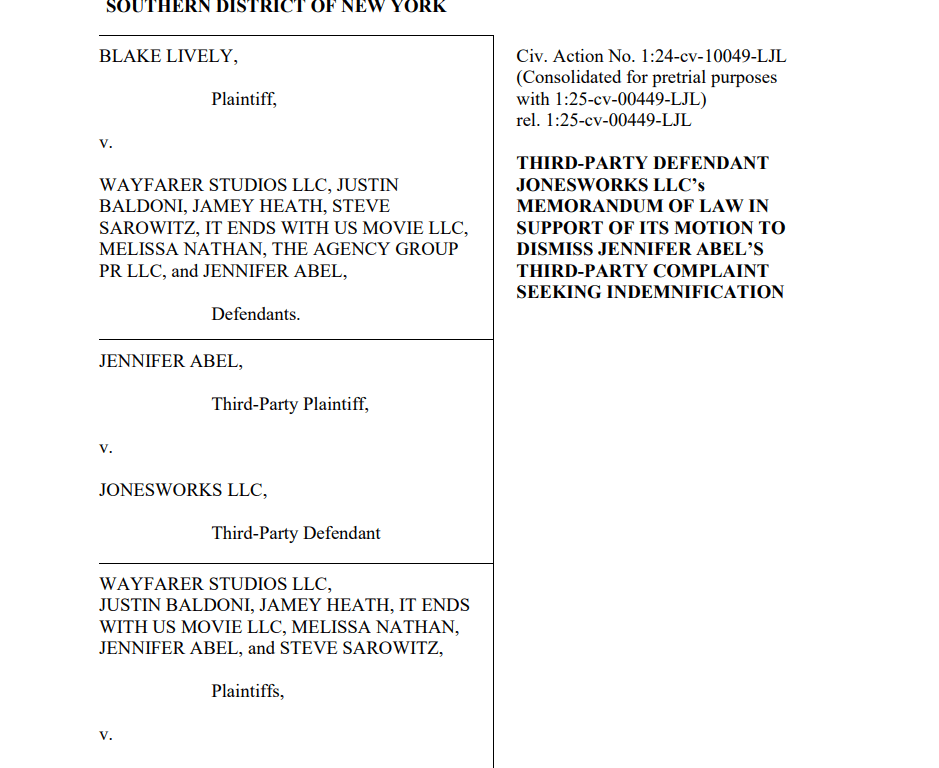
This filing is a motion to dismiss filed by Jonesworks LLC, seeking to dismiss Jennifer Abel’s third-party complaint for indemnification. The argument is forceful, aggressive, and deeply strategic.
Overview
Jennifer Abel, a former VP at Jonesworks, has been sued by Blake Lively for allegedly aiding and abetting harassment, defamation, and conspiracy alongside Justin Baldoni, Wayfarer Studios, and others. Abel, in turn, sued Jonesworks, seeking indemnification for the legal consequences she now faces. Jonesworks responds by portraying Abel as a rogue employee who violated her duties, sabotaged the company, and cannot now seek its protection.
Strongest Points
1. New York Choice-of-Law Clause Bars California Labor Code § 2802
Jonesworks successfully argues that the employment contract contains a valid and enforceable New York choice-of-law clause, making California indemnity statutes (Labor Code § 2802) inapplicable. This is devastating for Abel’s first cause of action because:
- Courts generally uphold clear contractual choice-of-law provisions.
- Abel accepted the benefits of New York law (suing in NY federal court) and cannot cherry-pick favorable California statutes.
- The motion cites Ministers & Missionaries Benefit Bd. v. Snow and Stevens & Co. v. Espat (2025) to support enforcement of New York law even when the employee resides in California.
2. “Rogue Employee” Theory Under Respondeat Superior
Jonesworks methodically dismantles the idea that Abel was acting within the scope of her employment:
- Abel allegedly ran a shadow PR campaign to “bury” Lively, despite being told not to by her employer.
- She “sidelined” her boss, founder Stephanie Jones, excluded Jonesworks from decision-making, and poached clients.
- The doctrine of respondeat superior only applies when employees act in furtherance of the employer’s business. This doctrine fails when the employee acts for personal motives.
Cited cases such as Doe v. Guthrie, Hammond v. Equinox Holdings, and Dykes v. McRoberts Protective Agency reinforce the argument that employers are not liable when employees act on personal vendettas or grudge missions.
3. Contractual Indemnification Clause Excludes Self-Caused Liability
The employment agreement expressly excludes indemnification for:
- Any liability “caused by Employee” or
- Resulting from a “breach of this Agreement by Employee.”
The motion argues that all claims against Abel—such as conspiring with Nathan to publish defamatory materials—fall outside the indemnification clause. Abel not only allegedly breached the contract but also attempted to harm the company actively.
Weakest Points
1. Tone and Rhetoric
While legally strong, the tone is scathing, accusatory, and personal—e.g., calling Abel’s claims “diabolically illogical” or saying she wants to make the employer “fund her own betrayal.” This could backfire:
- Judges may prefer restrained legal argument over rhetorical flourishes.
- The vitriolic tone could inadvertently lend credence to any claims by Abel that she was retaliated against or scapegoated.
2. Factual Dismissal of Agency Relationship
While the motion denies that Abel’s actions were within her scope of employment, Abel may argue:
- She was ostensibly acting as Jonesworks’ representative for Wayfarer.
- Wayfarer was a Jonesworks client, and Abel had delegated authority.
- If Abel did any of this while still on payroll or using Jonesworks resources, a judge might find factual disputes that preclude dismissal at this early stage.
Courts sometimes deny 12(b)(6) motions when there’s a plausible dispute over scope of employment.
3. Discovery-Heavy Arguments in a Motion to Dismiss
The motion draws extensively from extrinsic materials—texts, internal documents, and Abel’s alleged statements—which may require discovery to substantiate. Although some of these come from Abel’s own pleadings, others may not be judicially noticeable at this stage, making dismissal premature on some counts.
Suggestions for Abel (Defense Strategy)
If you were advising Abel, key rebuttal points could include:
- Claim that California Labor Code provides non-waivable protections under public policy exceptions, especially for California-based employees.Conclusion
Scope of Employment Defense:
- Argue that Abel was authorized to manage Wayfarer and had ongoing duties.
- Highlight that Abel was acting under apparent authority and using Jonesworks channels.
Partial Indemnification or Estoppel:
- Assert that Jonesworks ratified her actions by not intervening sooner.
- Argue that Jonesworks benefited initially from her PR efforts, or at least failed to prevent them.
Challenge the Overbreadth of Choice-of-Law Clause:
Jonesworks’ motion is comprehensive, blisteringly worded, and tightly framed around controlling law. Its most powerful assets are the contractual language and the dismantling of Abel’s scope-of-employment argument. However, the motion may overreach in some areas and risks underestimating the factual disputes about Abel’s role and authority.
 celebchai.com