
Cover Letter (Exhibit A): A discovery motion letter from Leslie Sloane’s legal team (Boies Schiller) to Judge Liman, asking the court to compel discovery from the Wayfarer Parties, particularly detailed answers to Interrogatories 3, 4, 5, and 7 and to produce documents responsive to RFP 32. The letter accuses Wayfarer of failing to identify who Sloane allegedly defamed them to, what statements she made, and what facts support their accusations of calling Baldoni a “sexual predator.”
Exhibit B: Justin Baldoni’s responses and objections to Leslie Sloane’s First Requests for Production (RFPs), which generally object to scope, vagueness, and proportionality, while offering limited production of relevant, non-privileged documents.
Exhibit C: The California state complaint filed by the Wayfarer Parties (including Justin Baldoni, Jennifer Abel, and others) against The New York Times Company, alleging libel, false light, promissory fraud, and breach of implied-in-fact contract. This complaint accuses the NYT of colluding with Blake Lively to publish a defamatory article based on an allegedly misleading and selectively edited CRD complaint.
BACKGROUND
In a saga blending Hollywood drama with high-stakes litigation, the defamation case involving Blake Lively, Justin Baldoni, and publicist Leslie Sloane is unraveling before it gains traction. At the center of the dispute is an allegation that Sloane defamed Baldoni by labeling him a “sexual predator” in media conversations leading up to the release of It Ends With Us. Yet, court filings now reveal a glaring lack of evidence—and even contradictions—in the case mounted by the Wayfarer team.
In December 2024, Wayfarer Studios, along with Baldoni and others, filed a libel lawsuit in California state court against The New York Times, accusing it of publishing a hit piece that regurgitated Blake Lively’s allegedly false claims without scrutiny. The plaintiffs suggested the Times worked hand-in-glove with Lively’s PR team—specifically Leslie Sloane—to spin a narrative that would harm Baldoni while burnishing Lively’s image.
The problem? When asked to provide the underlying facts in federal discovery, Wayfarer and its lawyers could not deliver.
In a recent letter to Judge Lewis Liman of the Southern District of New York, Sloane’s legal team accused Wayfarer of hiding behind boilerplate objections and refusing to answer key discovery questions. Among them: who exactly did Sloane allegedly speak to, what did she say, when, and how did it harm Baldoni? These are the fundamentals of any defamation case, and Wayfarer has yet to supply them.
In fact, one of their own exhibits includes a direct contradiction. A Daily Mail reporter stated in writing: “I had many conversations with [Sloane] about Blake and never once did she say anything about sexual assault.” That reporter also claimed Melissa Nathan—a PR rep aligned with Wayfarer—may have listened in on Sloane’s calls without her consent, raising concerns of a potential wiretapping violation under California law.
Adding to the confusion, Wayfarer has publicly claimed it has “new evidence” against Sloane that will be included in an amended complaint. But when asked to produce this material in discovery, they refused. Their attorneys have argued that revealing this information now would be premature—even as they insist it justifies future legal filings.
Sloane’s team isn’t buying it. They’ve asked the court to compel Wayfarer to respond to several interrogatories and produce documents, arguing that plaintiffs should not be allowed to wage war in the press while offering nothing in the courtroom. The court will now decide whether Wayfarer’s case can survive without the details required under the Federal Rules of Civil Procedure.
Wayfarer’s core problem may be that its strategy has shifted from litigation to image control. Rather than filing a lawsuit against Lively—the source of the alleged falsehoods—Baldoni and his co-plaintiffs attacked the press and its alleged collaborators. This tactic spared Lively from discovery, depositions, and document production. But it left Wayfarer with a legal burden it may not be able to meet.
In the absence of specific, provable statements from Sloane, the federal court is left with vague allusions and conflicting accounts. The Sloane team has characterized Wayfarer’s claims as not only unsubstantiated but potentially sanctionable under Rule 11, which prohibits parties from filing lawsuits without evidentiary support.
If the court agrees, it could spell the end of the Wayfarer v. Sloane subplot and further damage the credibility of Wayfarer’s larger lawsuit against The New York Times.
The takeaway? In the age of screenshot warfare and coordinated PR, litigation may be the last refuge of a party losing in the court of public opinion. But even there, you need receipts.
ANALYSIS
Sloane’s Strongest Legal Points
- No Particularity: Wayfarer’s defamation claims violate Fed. R. Civ. P. 8 and 9 by failing to identify:
- What was said
- To whom
- When or how it was defamatory
- Contrary Evidence: Their own Exhibit C includes statements by the journalist contradicting Wayfarer’s allegations.
- No Rule 11 Basis: The record suggests Wayfarer may have fabricated or exaggerated their basis for suing Sloane, given their refusal to produce documents.
Based on the documents provided, I’ll focus on analyzing the first two items:
1. Side-by-Side Chart: Sloane’s Discovery Demands vs. Baldoni’s Responses
The chart reveals a pattern of discovery disputes where Sloane’s legal team is attempting to obtain specific information about the alleged defamatory statements that form the basis of the Wayfarer Parties’ claims.
Key points:
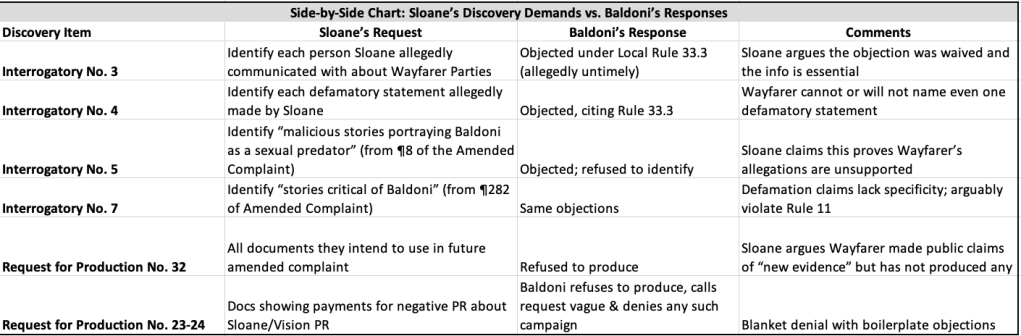
Sloane’s team requested identification of each person Sloane allegedly communicated with about Wayfarer, but Baldoni/Wayfarer objected claiming the request was untimely under Local Rule 33.3.
Multiple interrogatories (Nos. 4, 5, and 7) seeking identification of specific defamatory statements Sloane allegedly made were met with objections. These interrogatories specifically asked Baldoni/Wayfarer to identify the “malicious stories portraying Baldoni as a sexual predator” and “stories critical of Baldoni” referenced in their Amended Complaint.
Sloane also requested documents that Baldoni/Wayfarer intend to use in their future amended complaint, which they refused to produce.
This suggests the Wayfarer Parties may be struggling to provide specifics about the alleged defamatory statements that form the foundation of their claims against Sloane.
2. California Complaint Against the New York Times
The complaint filed by Wayfarer Studios, Baldoni, and other plaintiffs against the New York Times contains numerous significant allegations:
The complaint alleges the Times published an article titled “‘We Can Bury Anyone’: Inside a Hollywood Smear Machine” on December 21, 2024, which the plaintiffs claim was false and defamatory. According to the complaint, the Times rushed publication despite receiving a denial from plaintiffs’ representatives.

The plaintiffs allege the Times worked “in concert with Lively’s team for weeks or months” and participated in “legal maneuvering” at the heart of Lively’s strategy.
The complaint claims Lively filed a “right-to-sue” letter with the California Civil Rights Department rather than a lawsuit to avoid discovery while using the “appearance of legitimacy” to launch allegations and reshape her public image.
A critical piece of evidence in the complaint shows text messages that plaintiffs claim were “unscrupulously altered and selectively edited” to create a false narrative. The complaint provides screenshots of messages that allegedly show the full context, demonstrating that Nathan (one of the plaintiffs) actually denied involvement in planting negative stories about Lively.
The complaint includes evidence suggesting that Lively’s publicist, Leslie Sloane, was actually the one who “seeded stories critical of Baldoni, including that Baldoni was a sexual predator, ahead of the Film’s release.”
The plaintiffs further allege that at least one Daily Mail reporter acknowledged having “many conversations with [Sloane] about Blake and never once did she say anything about sexual assault,” directly contradicting claims made in the Times article and Lively’s CRD complaint.
There appears to be significant tension between the claims in the California complaint, which presents evidence that Sloane never called Baldoni a “sexual predator,” and the Wayfarer Parties’ current refusal to specify the alleged defamatory statements in the New York litigation. The California complaint actually seems to undermine the basis for their claims against Sloane in the New York case.
This contradiction is precisely what Sloane’s attorneys highlight in their motion to compel discovery responses – they point to this exact contradiction between the Wayfarer Parties’ New York and California filings as evidence that the defamation claims lack merit.
 celebchai.com