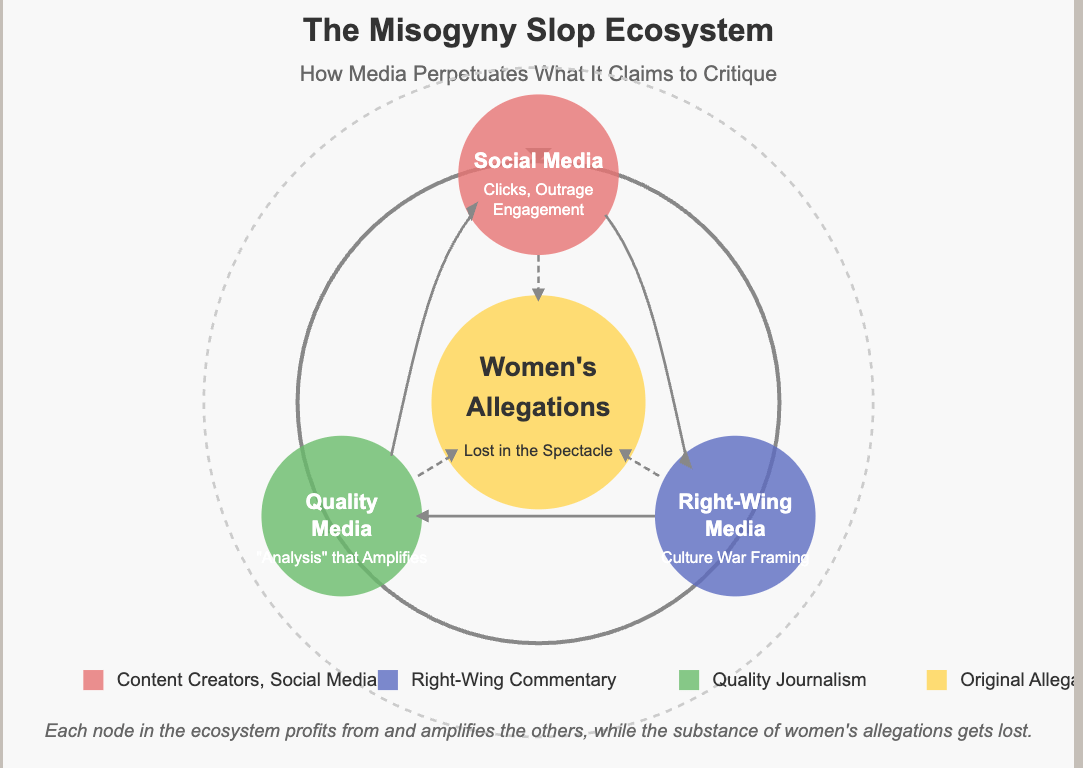
In examining the Guardian’s recent coverage of the Lively-Baldoni legal dispute, we witness journalism’s most insidious contradiction: the self-righteous spectator who profits from the very spectacle they condemn. The article, while ostensibly analyzing how media machinery monetizes women’s pain, seamlessly integrates itself into that same machinery—creating another node in what it aptly calls the “misogyny slop ecosystem.”
The Guardian positions itself as standing outside the fray, diagnosing the disease without acknowledging its role as carrier. But look closer at its construction: the article leads with celebrity names to capture search traffic. It features prominent images of both actors and Candace Owens. It recycles inflammatory accusations (“burping on Gossip Girl“) and details the very social media spectacle it claims to lament. Every component is engineered for maximum engagement—not education.
This isn’t merely hypocrisy; it’s an institutional blindspot. Quality publications consistently fail to recognize that their “analysis” of digital degradation frequently amplifies that degradation. When the Guardian reports that rightwing commentators have discussed the case “at least 25 times,” it doesn’t recognize that it has now become the 26th instance. When it highlights that Fox News has run “nearly 80 stories,” it doesn’t acknowledge that this article constitutes story 81 in the broader media ecosystem.
The most revealing evidence comes midway through the piece. Social media researcher Zhouhan Chen reveals that approximately 80% of pro-Baldoni content appears to be “inorganic”—manufactured rather than genuine public sentiment. This should be explosive. It suggests coordinated manipulation campaigns potentially funded by crisis PR firms. It undermines the entire narrative of public opinion turning against Lively. Yet the Guardian buries this information beneath colorful accounts of “mommy sleuths” and TikTok conspiracies, treating manufactured harassment as merely another fascinating facet of celebrity culture.
When publications like the Guardian frame abuse allegations primarily as culture war battlegrounds, they diminish their severity. The article briefly mentions Lively’s claims—unwanted touching, violations of privacy while breastfeeding, inappropriate comments about her body—before quickly returning to the more clickable terrain of social media warfare. The allegations themselves become footnotes in their own story.
This pattern extends beyond this single article. Liberal media organizations routinely sanitize misogyny through intellectualization. They transform harassment campaigns into sociological case studies. They repackage women’s testimony as content for chin-stroking analysis. The Guardian is hardly alone in this practice, but its self-positioning as a bastion of progressive thought makes its complicity more striking.
What would genuine media accountability look like? It would mean refusing to amplify manufactured outrage. It would mean centering the alleged misconduct rather than its social media aftermath. It would mean examining how media outlets—including one’s own—benefit financially from these spectacles. Most crucially, it would mean finding ways to report on misogyny without reproducing it.
Until publications like the Guardian recognize that their “analysis” often serves as just another delivery mechanism for the toxins they claim to study, the ecosystem will continue cycling its sludge through increasingly respectable channels. The slop doesn’t disappear when filtered through an expensive editorial process. It simply becomes harder to identify as slop.
 celebchai.com