
From Castle Goring this week, Lady Colin Campbell delivered another blistering commentary on Meghan Markle. Ostensibly reflecting on the memorial of legal titan Michael Reynolds and a theater night out, the video quickly turned into an unfiltered monologue against the Duchess of Sussex. The pretext? A photograph Meghan posted that Lady C claims is proof of exhibitionism and deception.
Comparison Kevin Sullivan and Lady Colin Campbell
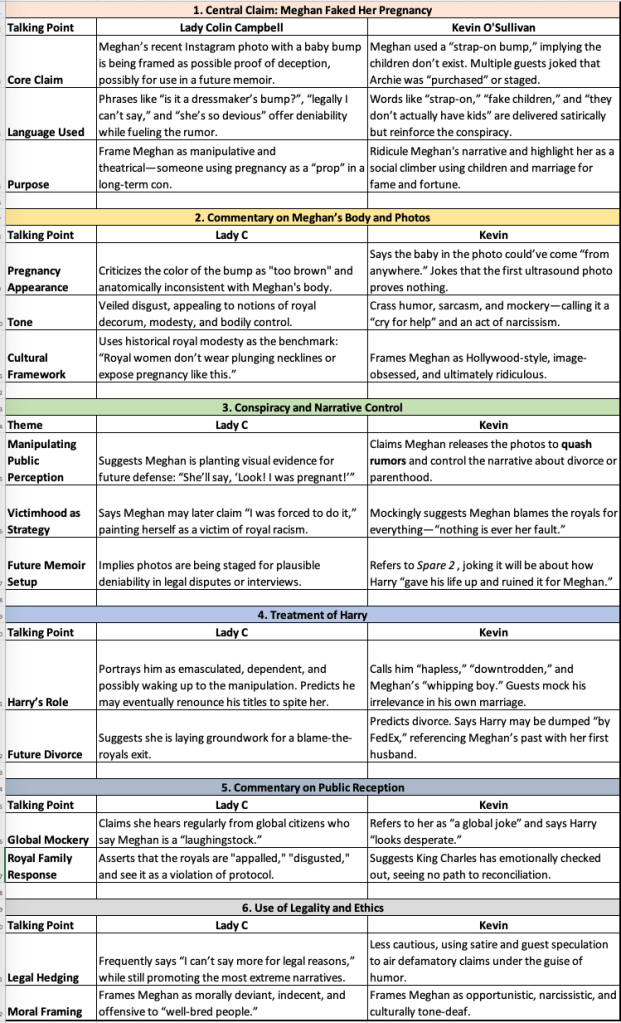
Lady C’s tone was theatrical, her claims expansive. She alleged that Meghan’s now-viral pregnancy photo may be a deliberate fake—potentially a staged image with a “strap-on bump” to be used later in a memoir to rewrite history. The idea, she suggests, is that Meghan can point to this image to justify fabricated pregnancy claims or deflect scrutiny by blaming her conduct on racism within the monarchy.

While these accusations are unsupported, they reveal something crucial about how royal women—especially Meghan—are expected to behave. According to Lady C, Meghan has breached an ancient code of decorum. Royal women, she insists, should be modest, muted, and maternal—but only in the most conservative sense. The comparison she draws is not subtle: Elizabeth Taylor-style cleavage and Kardashian-like self-promotion are deemed unacceptable. Meghan, by posing in a body-conscious dress, is framed as obscene, vulgar, and morally transgressive.
Lady C’s critique is also steeped in class anxiety. She labels Meghan a “working-class girl” who “sells her body for pounds rather than pence,” referencing George Bernard Shaw’s Mrs. Warren’s Profession. Her subtext is clear: Meghan, a biracial American actress, does not belong in the aristocratic world of the Windsors—not because of her conduct, but because of what she represents. Race, gender, class, and modernity all collide in this critique.
The accusations escalate. Lady C implies that Meghan and Harry’s children might not be real. She claims their birth certificates are suspicious, that the pregnancy bumps look “too brown,” and that their obstetrician vanished from public view. She weaves these into a theory of narcissistic performance: Meghan allegedly posts such images to bait the royals, manipulate King Charles, and ensure she can frame herself as a victim if the relationship collapses.
Even Harry is not spared. He’s framed as emasculated, silenced, and financially dependent. Lady C claims he may one day wake up and renounce his titles in retaliation, leaving Meghan as “Mrs. Rachel Meghan Windsor.” She further asserts that their lifestyle brand As Ever should be renamed Was Never, mocking its alleged commercial underperformance.
Beneath the satire and vitriol, this video reveals a broader cultural struggle. Lady C is not merely critiquing Meghan—she’s defending a worldview where royalty is sacred, tradition is unchallenged, and women who breach those boundaries must be publicly humiliated. The video’s tone mimics that of a social trial, in which Meghan is both defendant and scapegoat.
But these critiques raise troubling questions. Why is a woman’s body, pregnancy, or social media post fair game for international dissection? Why are conspiracy theories about motherhood, privilege, and victimhood so easily accepted when the target is Meghan? And why does the press amplify voices that flirt with defamation under the guise of tradition?
Lady C’s followers might find comfort in her certainty. But it’s certainty built on conjecture, resentment, and nostalgia. The truth is simpler and far less scandalous. Meghan may be building a brand, but so is Lady C—and outrage is her currency.
 celebchai.com
One thought on “Modesty, Myth, and Meghan: What Lady C’s Latest Rant Reveals About Royal Expectations”