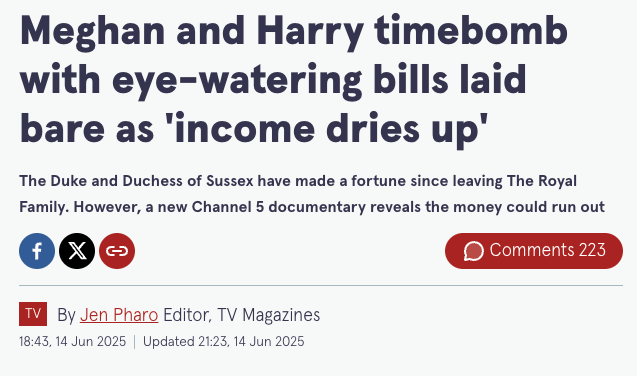
While presented as reporting on a new Channel 5 show called Meghan and Harry:y, the article primarily amplifies and embodies the highly critical, often gleeful, and intrusively judgmental tone of the commentary featured in Channel 5’s “Meghan and Harry: Where Did The Money Go?”. The problem isn’t that it’s commentary, but how that commentary is delivered:
- Schadenfreude as the Driving Force: The core narrative isn’t neutral analysis; it’s the palpable anticipation of financial downfall. Phrases like “the money could run out,” “income is going to decline,” “nothing else to sell,” and the very title “Where Did The Money Go?” are not just observations – they are expressions of a desire to see the Sussexes stumble. The commentary revels in predicting their decline, bordering on relish.
- Sensationalism Over Substance: The commentary relies heavily on hyperbole and emotionally charged language:
- Moaning: Framing Harry’s factual statement about being cut off financially as “moaning” is deliberately dismissive and mocking, setting a derisive tone.
- Staggering, Astronomical, Splashed out: These descriptors for their spending aren’t neutral; they are sensationalist, designed to provoke gasps of disapproval and reinforce a narrative of reckless extravagance.
- Grifters: Highlighting this inflammatory slur (even if attributed) without significant pushback or context allows it to hang in the air, poisoning the well of discourse. Commentary should challenge such language, not merely parrot it.
- Intrusive and Unfair Personal Judgments: The commentary crosses the line from financial critique into unwarranted personal attacks:
- Emily Andrews’ Speculation (“What is Harry doing?”): This isn’t financial analysis; it’s gossipy, sexist speculation about domestic roles and Harry’s perceived uselessness. It contributes nothing to understanding their finances and everything to painting a negative caricature.
- The “Girl Boss” Quip: Presenting Meghan’s work ethic with the slightly sneering label “girl boss” undermines her professional efforts.
- The “Not Getting Paid” Anecdote: Dragging up a single, context-free remark from years ago serves only to reinforce the “mercenary Meghan” trope favored by their critics, ignoring any possible nuance (e.g., comparing unpaid royal labor to her previous career).
- Implied Moral Condemnation: The commentary consistently implies that the Sussexes’ chosen path – earning money through media deals – is inherently distasteful or illegitimate:
- “Selling their story,” “apart from themselves,” and the focus on deals “drying up” carry an undertone of disapproval for their commercial activities.
- Highlighting the mortgage as “unheard of for a senior Royal” isn’t just a fact; it’s a judgment implying they’ve fallen from grace or broken some sacred code.
- False Balance & Amplifying Negativity: While Afua Hagan’s more positive perspective is briefly included, it feels like a token gesture immediately drowned out by the sheer volume and prominence of critical voices (Baker, Andrews, Morgan, Ede, Mamata) and the overall framing. The commentary structure overwhelmingly favors the pessimistic, critical narrative.
- Lack of Empathy or Context: There’s no attempt to understand the immense pressure and unique challenges of funding their own security after a lifetime of state provision, nor the difficulty of building entirely new careers under global scrutiny after leaving a rigid institution. The commentary treats their situation with detached criticism, bordering on cruelty.
COMMENTS ANALYSIS
1. Vitriolic Schadenfreude
- Many comments actively revel in the idea of the couple’s financial downfall (“Bankruptcy—It couldn’t happen to a nicer pair!!!”, “Good no wonder people are wary of being in their company”). This isn’t critique—it’s spiteful glee.
- Nicknames like “Twerkles,” “grifters,” or “Me-gain” dehumanize them, reducing complex lives to crude punchlines.
2. Misogynoir & Racist Undertones
- Meghan bears the brunt of the hostility: Comments mock her acting career (“twerking lessons”), imply sexual impropriety (“yachting days”), and dismiss her work ethic (“girl boss” sneers). The racism is thinly veiled.
- Harry is criticized too, but Meghan is consistently portrayed as a manipulative “gold-digger” — a trope rooted in racist and sexist stereotypes.
3. Hypocrisy and Obsession
- Claims of indifference (“Who cares anymore”) clash with hundreds of aggressive comments dissecting their finances, parenting, and marriage. If they truly didn’t care, they wouldn’t be here.
- Outrage over their spending ignores that they fund their own lifestyle, unlike royals supported by public funds or the Duchies. Yet Andrew’s taxpayer-subsidized existence rarely draws equal fury.
4. Willful Ignorance and Conspiracy-Mongering
- Baseless claims proliferate: “Meghan kept the kids hidden to sell photos later,” “Harry wants back in for money.” Zero evidence—just projection.
- Dismissal of legitimate security concerns (e.g., ignoring documented threats) as “trying to look important” shows reckless disregard for fact.
5. Deflection from Real Issues
- While wars and crises unfold (“Why can’t we comment on WWIII?”), this thread fixates on two people’s mortgage. The outrage is selective and performative.
6. The Few Voices of Reason
- A handful of comments push back: “What the hell has it got to do with anyone?” or “They use their money.” Others note the double standards (e.g., Andrew’s scandals). These are drowned out by the noise.
Conclusion:
This commentary, as presented and amplified by the article, goes beyond legitimate critique of public figures’ finances. It adopts a consistently sneering, sensationalist, and intrusive tone, driven by schadenfreude and a desire to see the Sussexes fail. It weaponizes anecdotes, employs loaded language, indulges in personal speculation, and implies moral failings for their chosen livelihood. While commentary is inherently subjective, this tone crosses into unnecessary cruelty and tabloid-style glee, prioritizing negativity and judgment over thoughtful analysis or even basic fairness. It’s commentary designed not just to inform, but to condemn and delight in potential downfall.
 celebchai.com