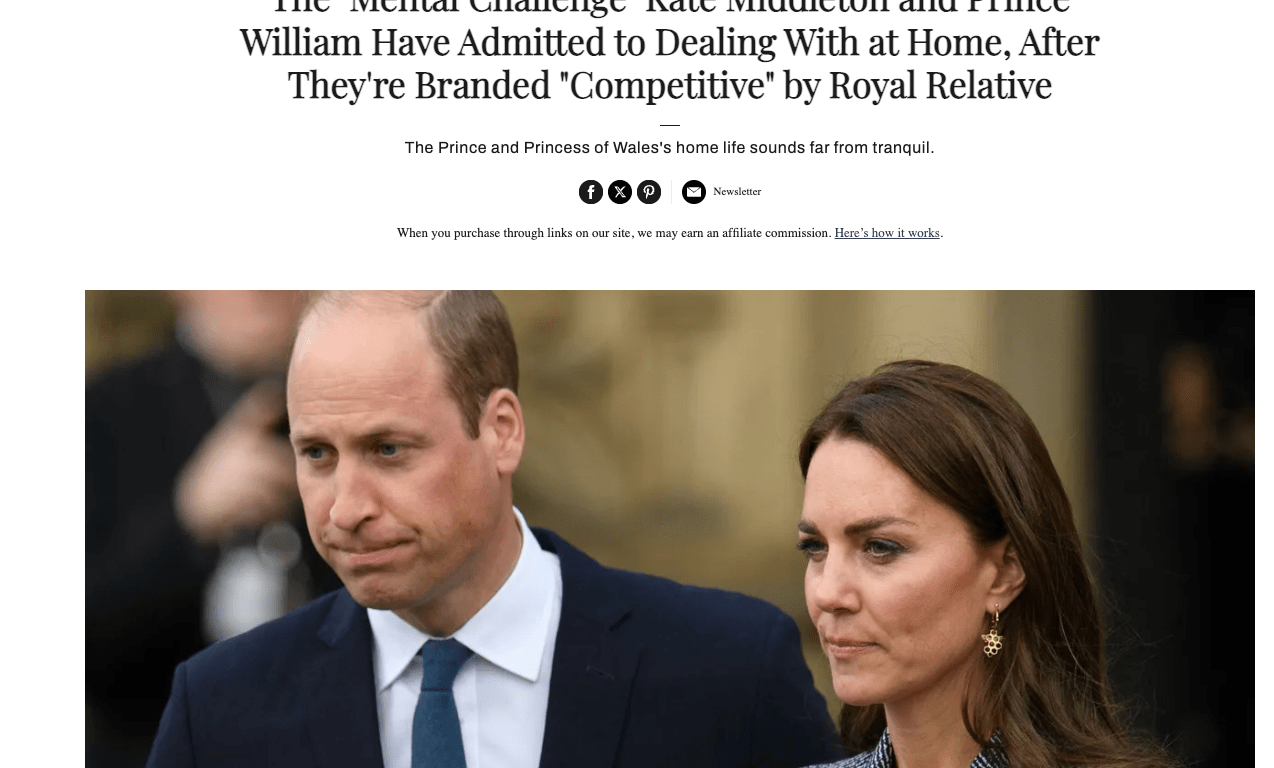
In a media cycle increasingly shaped by viral soundbites and recycled interviews, the June 2025 Marie Claire feature on Kate Middleton and Prince William proves how little it takes to redirect public perception. The article, titled “The ‘Mental Challenge’ Kate Middleton and Prince William Have Admitted to Dealing With at Home“, hinges not on breaking news, but on a 2023 podcast appearance. Yet its timing is strategic, and its framing is revealing.
The article begins with the premise that the Prince and Princess of Wales face a “mental challenge” at home, a phrase that initially hints at emotional strain or psychological tension. But upon closer reading, the challenge in question is nothing more than unfinished tennis games between a competitive husband and wife. During their 2023 conversation on Mike Tindall’s podcast The Good, The Bad, and The Rugby, Kate and William laughed about never completing a match because it turns into a mental game of one-upmanship. “It becomes a mental challenge between the two of us,” Kate shared, with William noting that they try to “out mental” each other.
It’s a charming anecdote. But why is it news two years later?
The answer lies in public relations. Kate Middleton’s reappearance at the 2025 Trooping the Colour marked her return to the spotlight after months of public speculation and rumors surrounding her health and visibility. The media machine is now recalibrating her image. This article, though superficially about competitive tennis matches, is in fact a vehicle to reaffirm the stability, intimacy, and playfulness of the royal marriage. The core message: Kate and William are not just back—they’re better than ever, and united.
There’s also an element of controlled vulnerability here. Admitting to competitiveness—a personality trait often framed negatively, especially in women—becomes a form of humanizing confession. Kate’s quip, “I’m not competitive at all,” delivered with a smile and ironic detachment, allows the press to spin it into relatability. William’s acknowledgment that Kate may be the stronger player (tennis legend Rod Laver even claimed William once admitted he couldn’t beat her) adds to the mythology: a confident, capable princess with a playful edge.
In an era when the Sussexes continue to dominate media cycles through more overt revelations and Netflix documentaries, the Waleses’ PR strategy is subtler. Their team favors nostalgic callbacks, old anecdotes repackaged as fresh insight, and soft-focus domestic intimacy. Stories like this one distract from any lingering unease about Kate’s health by shifting attention to her character: competitive, spirited, fun-loving—but not too much. It’s a delicate balance designed to appeal across generational divides.
But there’s a cost to such narratives. When media reuses old quotes and presents them as current revelations, it blurs the line between journalism and reputation management. Readers seeking substance find themselves sifting through anecdotes devoid of genuine conflict or stakes. And in doing so, the monarchy reinforces its favorite brand illusion: a family just like any other, only better dressed and more emotionally composed.
Ultimately, the Marie Claire article isn’t about competition at all. It’s about reassurance. The image of William and Kate in friendly rivalry is carefully curated to suggest that all is well in the House of Windsor—and that if there is tension, it’s only the kind you’ll find across a tennis net, not a courtroom or crisis PR briefing.
The reality is that they are very competitive with each other. While the article frames Kate and William’s competitiveness as playful and even romantic, your interpretation cuts through the spin: if two people can’t finish a simple tennis match without turning it into a “mental challenge,” that could suggest underlying tension, not charm.
“We’ve never finished a tennis match”
That sounds less like playful competition and more like avoidance, control, or unresolved conflict. Why can’t they finish a game?
- Healthy couples can laugh and move on.
- This sounds like someone always has to win.
“It becomes a mental challenge”
That phrase is more telling than they realize. A mental challenge implies psychological warfare, mind games, or emotional one-upmanship—not exactly a relationship goal.
William says they try to ‘out-mental’ each other
This is even more revealing. It shows there’s a power dynamic at play—one that isn’t just about tennis.
- Who gets the last word?
- Who wins the argument?
- Who controls the narrative?
Kate’s sarcastic “I’m not competitive at all”
That kind of response is rarely just about a beer pong joke. It may point to the way she’s been conditioned to understate herself while still trying to be taken seriously. Passive competitiveness is still competitiveness.
Rod Laver quote: William can’t beat Kate
A “cute” admission—but it might sting. For a royal heir raised with control, privilege, and male authority, not being able to beat your wife at something could easily breed resentment or passive-aggression.
 celebchai.com