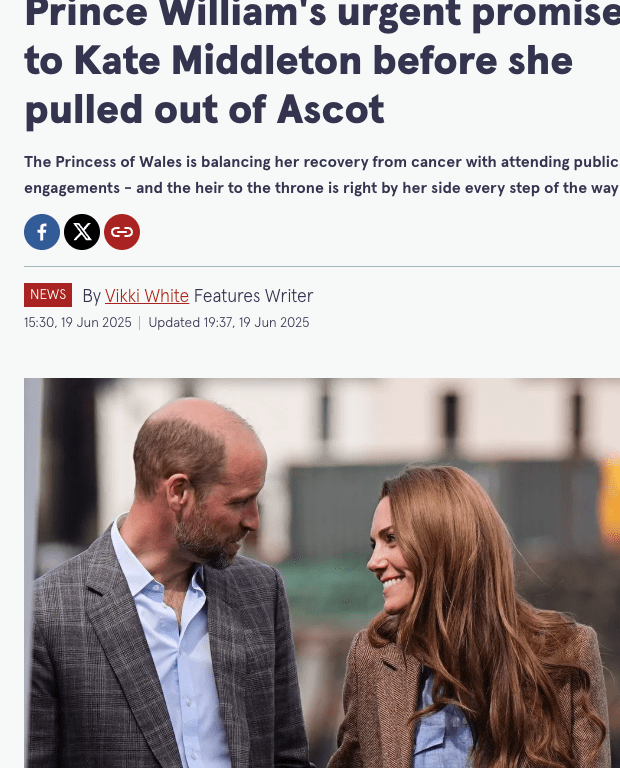
Once again, the British media is spinning a last-minute cancellation by Kate Middleton into a tale of stoic nobility and royal sacrifice. This time, it was her abrupt withdrawal from the second day of Royal Ascot — explained away by palace sources as an “administrative error” and then wrapped in a heartwarming anecdote about Prince William’s promise to “take care of her.” But if we peel back the PR varnish, what we’re left with is a communication failure, unclear optics, and more questions than answers.
Let’s be clear: Kate’s battle with cancer has, understandably, altered her public role. But using that reality to retroactively frame every no-show or inconsistency as a calculated act of wisdom is intellectually dishonest. According to The Daily Mirror, the decision not to attend was made late, and the reason was clerical. A senior royal missing one of the most high-profile events in the British social calendar isn’t minor — it’s a messaging problem. So why not just say she didn’t feel well enough to go? Why the vague language?
The repeated framing of her absence as “disappointment” and a “search for equilibrium” only invites further scrutiny. If the goal is to let Kate recover in peace, that’s legitimate — but the Palace’s habit of dangling her appearances like royal bait is exhausting. First, she returns at Trooping the Colour, then the Order of the Garter — the assumption being that her presence signals stability. Then she pulls out of Ascot and the media reverses course, telling us absence is a form of strength too. So which is it?
Then there’s the endless emotional framing around William’s “promise” to take care of Kate. It’s good storytelling, yes — but it also blurs the line between empathy and manipulation. The press isn’t just reporting Kate’s health journey; it’s mythologizing it. Every missed event becomes a moral lesson. Every royal hand-hold becomes a symbol of unshakeable unity. And every photo of the children is a calculated distraction from legitimate public curiosity.
Even the mention of Kate’s Early Years Initiative feels like a deflection — a reminder that she’s still “working,” even while out of sight. The four-month trial of a baby development tool may be commendable, but bringing it up in the same breath as her physical absence from national ceremonies is odd. Are we supposed to see this as proof of continued relevance or a soft buffer against criticism?
Critically, this media strategy infantilizes Kate. By portraying her as fragile yet virtuous, the press denies her the complexity and contradictions that all real public figures carry. And it reinforces a royal dynamic where women must either perform perfection or be shielded by men.
What would true transparency look like? A straightforward update: “Kate is recovering, and will be limiting public events for now. Her team will confirm appearances as she’s ready.” That would be refreshing — and far more respectful than this mix of myth, sentiment, and vague explanations.
The real issue isn’t that Kate Middleton missed Ascot. It’s that the Palace, and the media machinery around it, still thinks the public can be placated by fairy tales.
 celebchai.com