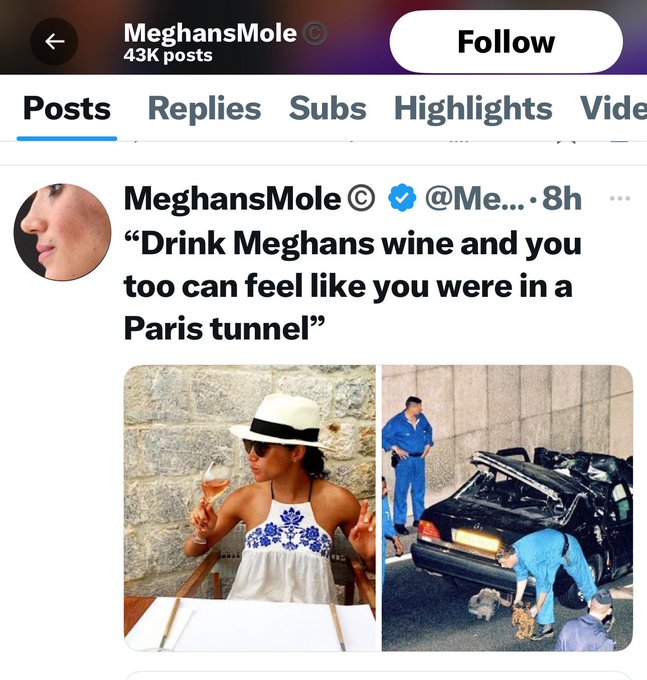
On what should have been a solemn occasion—Princess Diana’s birthday—an account named MeghansMole crossed a red line on social media. A tweet from the account stated, “Drink Meghan’s wine and you too can feel like you were in a Paris tunnel,” juxtaposed with two photos: one of Meghan Markle sipping wine, the other of the wreckage from the 1997 car crash that killed Diana. The post ignited widespread condemnation for what many see as a vile blend of misogyny, racism, and targeted psychological abuse.
To understand why this particular tweet has generated such visceral outrage, we need to unpack the layers. First, the imagery. Diana’s death remains one of the most emotionally charged events in modern royal history. For many, the tragedy is not just about the loss of a beloved figure—it symbolizes the brutal cost of media intrusion and a monarchy that failed to protect her. Weaponizing this trauma to vilify Meghan Markle, who herself has faced relentless media attacks and familial alienation, is not only unethical—it’s dangerous.
The implication of the tweet is unmistakable. It seeks to draw a direct line between Meghan and the circumstances surrounding Diana’s death, as if inviting or even manifesting a similar fate. The outrage isn’t just about bad taste. It’s about the normalization of dehumanization. When a woman of color who married into the British royal family is portrayed as deserving of a fatal car crash, the issue transcends online trolling—it becomes a cultural indictment.
Even more disturbing is the growing belief among critics that the account is not just a fringe troll, but potentially institutionally protected. Some have alleged ties to Kensington Palace or operatives working in service of Prince William’s public strategy. Whether true or not, the allegations expose a deeper fracture: the public no longer trusts that the monarchy is above weaponizing public sentiment or that social platforms are enforcing their own community guidelines equally.
The tweet in question also reinforces longstanding double standards in media representation. When Meghan is criticized, it is rarely for specific actions and almost always for symbolic ones: what she wears, how she holds her child, her tone. In contrast, posts like this normalize cruelty as satire. The message is clear: if you are Meghan Markle, your pain is content. Your trauma is entertainment.
Numerous X (formerly Twitter) users called for the account to be suspended. Some claimed their own accounts were temporarily locked after reporting MeghansMole, suggesting that the offending account enjoys disproportionate protection. Others viewed the tweet as a deliberate psychological operation—an attempt to trigger Meghan’s supporters and provoke chaos.
The moral and ethical failure here isn’t just the original tweet. It’s the silence that follows. Neither platform moderators nor members of the royal family have condemned the message. This silence operates as a form of complicity, allowing the cycle of abuse to continue.
The irony is bitter. Meghan Markle has often spoken of her admiration for Diana, and comparisons between them have followed her since the day her relationship with Prince Harry became public. But while Diana was eventually viewed as a victim of a merciless machine, Meghan is being cast as the villain. The cycle hasn’t been broken—it has been repackaged and rebranded for the digital age.
This moment demands accountability—from platform enablers, from the monarchy, and from the public. Social media users must ask themselves: when we laugh at cruelty, what are we endorsing? When we remain silent, what are we protecting?
As Princess Diana once said, “Only do what your heart tells you.” The question now is whether hearts in high places will have the courage to act—or whether we’ll continue to pretend that hashtags and digital avatars can’t kill.
 celebchai.com