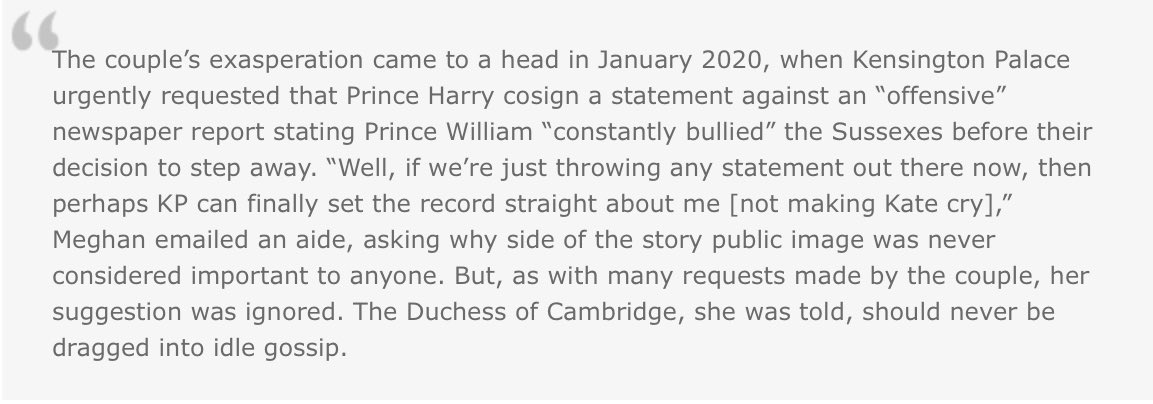

First, the excerpted passage shared frames January 2020 as a moment of institutional asymmetry. Kensington Palace is depicted as acting urgently to protect Prince William from an “offensive” report, while Meghan’s contemporaneous request for reputational correction is described as ignored on the grounds that Catherine should not be drawn into “idle gossip.” That framing matters because it establishes a hierarchy of whose reputation is systemically defended and whose is treated as expendable. Once that hierarchy is accepted by readers, reconciliation becomes structurally incoherent: one party is portrayed as protected by the institution, the other as harmed by it.
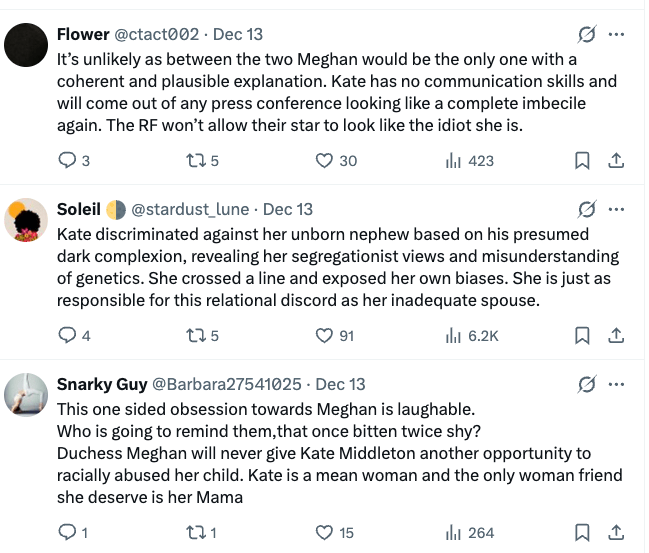
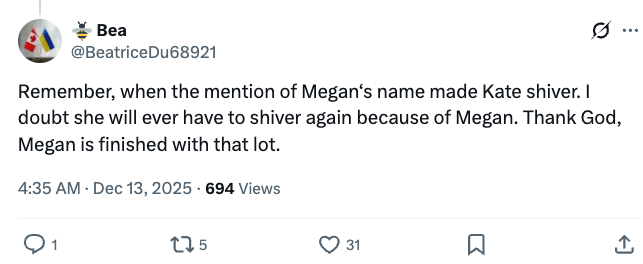
Second, the responses quoted are not primarily about Kate Middleton as an individual actor. They are about Kate as a proxy for “the system” and Meghan as a proxy for exit, autonomy, and racialized vulnerability. That is why commenters repeatedly contrast “inside the system” versus “outside the system,” “reliant” versus “commercially independent,” and “protected” versus “exposed.” In that framing, reconciliation would require not just personal apology but institutional confession and repair, something commentators assume is impossible or will never be offered.
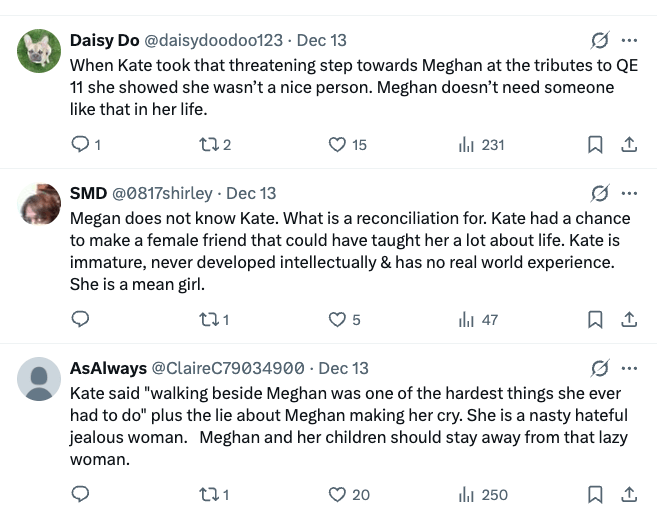
Third, the rhetoric in these replies is absolutist by design. Words like “never,” “unforgivable,” “100% untrustworthy,” and “not in the cards” serve a boundary-policing function. They are not trying to persuade skeptics; they are reinforcing group identity among people who already share a moral conclusion. Reconciliation is rejected not after weighing evidence, but because accepting even the possibility of it would destabilize the moral clarity of the narrative.
Fourth, the “Meghan made Kate cry” incident remains central because it operates as a synecdoche for broader grievances: misrepresentation, silence by authority, and asymmetric correction of the record. The insistence that the lie was “unforgivable” is less about the incident itself than about the belief that the institution knowingly allowed a falsehood to stand because it was convenient. Under that belief, forgiveness without public acknowledgment is equated with erasure.
Finally, reconciliation here is being judged against a standard that is intentionally unreachable. Many comments explicitly say that even a public apology would, at best, justify civility, not trust. That tells one the debate is no longer about restoring a relationship. It is about asserting that some breaches permanently reclassify relationships from personal to political. Once that reclassification occurs, reconciliation is treated as naïve, dangerous, or morally compromising.
In short, this discourse is not really asking whether Kate and Meghan could reconcile. Within that worldview, rejection of reconciliation is not spiteful; it is framed as rational self-protection and moral consistency.
 celebchai.com