Dr. Aparna Vashisht Rota, December 23, 2025
The palace claimed it couldn’t protect Meghan Markle from relentless tabloid attacks. New evidence suggests it didn’t want to because those attacks were serving a strategic purpose. A temporal analysis of media coverage reveals a disturbing pattern: negative Meghan stories surged precisely when Prince Andrew scandals threatened to dominate headlines. This wasn’t a coincidence. It was institutional crisis management that sacrificed one family member to shield another from accountability for documented associations with sex trafficking.
The “Real Estate” Principle
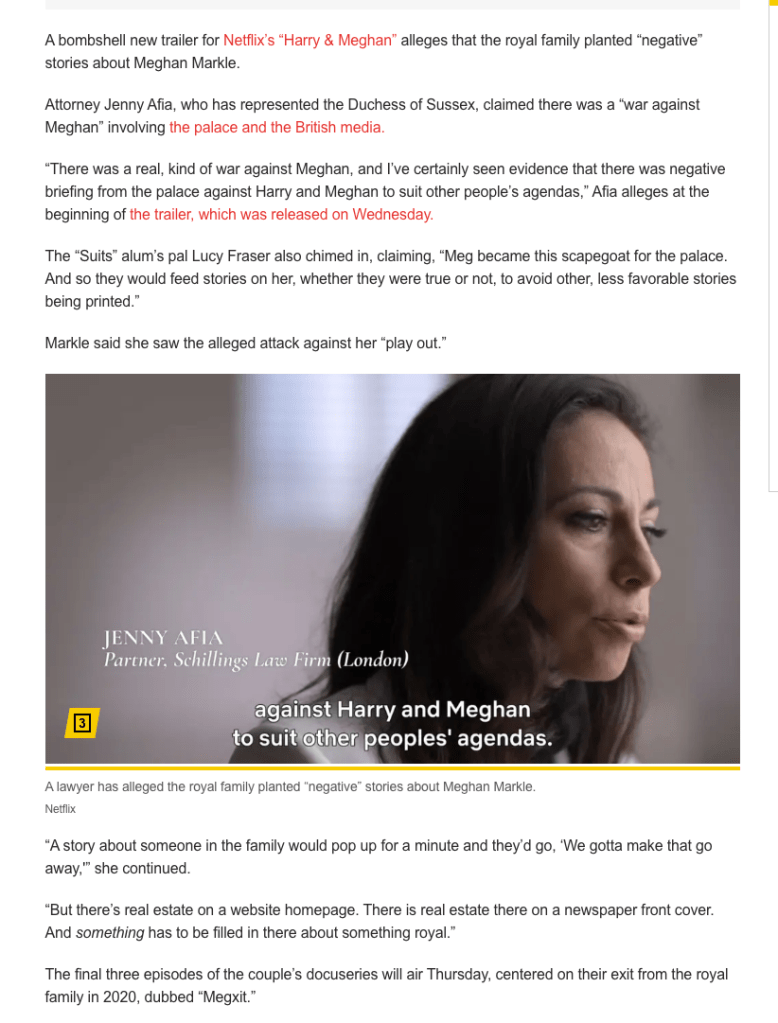
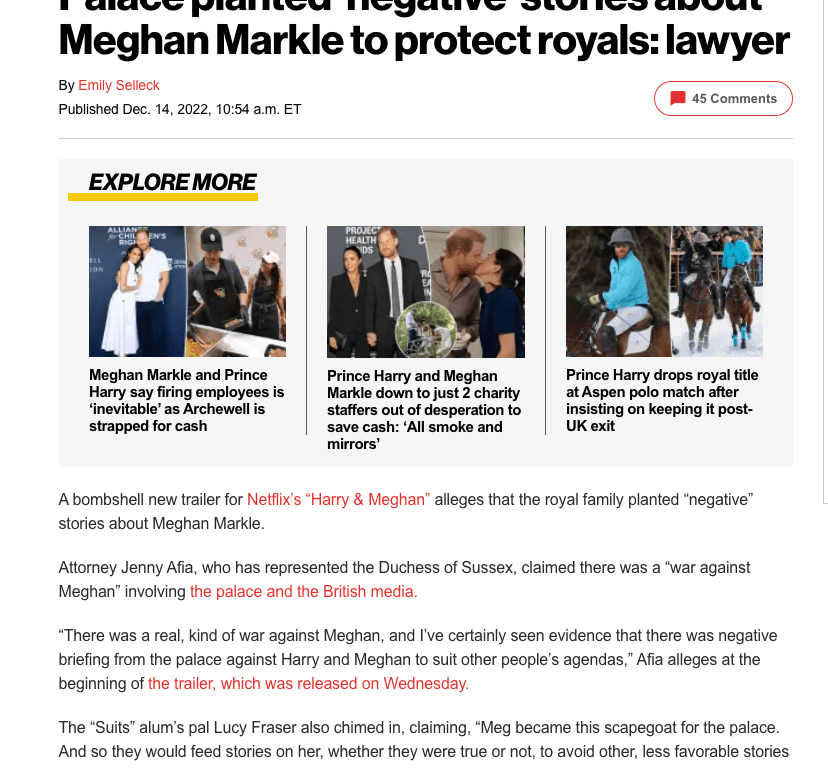
In the Netflix documentary Harry & Meghan, the Duchess of Sussex explained the mechanics with surprising clarity: “There’s real estate on a website homepage. There is real estate there on a newspaper front cover. And something has to be filled in there about something royal.”
She continued: “A story about someone in the family would pop up for a minute and they’d go, ‘We gotta make that go away.’ But… something has to be filled in there about someone royal.”
Her friend Lucy Fraser was more explicit: “Meg became this scapegoat for the palace. And so they would feed stories on her, whether they were true or not, to avoid other less favorable stories being printed.”
Attorney Jenny Afia, who represented Meghan, stated on camera: “I’ve certainly seen evidence that there was negative briefing from the palace against Harry and Meghan to suit other people’s agendas.”
These weren’t vague allegations. They described a systematic displacement strategy. The question is: what was being displaced?
The Timeline Reveals the Pattern
August 2019: When Evidence Became Public
August 9, 2019: Court documents from the Giuffre v. Maxwell defamation case were unsealed, revealing detailed allegations that Prince Andrew had sexually abused Virginia Giuffre on three separate occasions when she was 17. The documents included testimony that “Epstein instructed her ‘to give the prince whatever he demanded, and required [her] to report back to him on the details of the sexual abuse.'”
August 10, 2019: Jeffrey Epstein was found dead in his jail cell.
Same month, August 2019: Meghan Markle’s guest-edited British Vogue issue hit stands and was immediately met with what biographer Tina Brown called her “unexpected Waterloo.” The issue became “a lightning rod for caustic British ridicule,” with critics attacking her choice of liberal-leaning women, the exclusion of Queen Elizabeth II and Princess Kate from the cover, and positioning it as evidence of Meghan’s “political territory” violations.
The Vogue issue became British Vogue’s fastest-selling edition in history—and simultaneously the focal point of coordinated negative coverage that drowned out deeper examination of the Epstein documents.
November 2019: When Andrew’s Defense Collapsed
November 16, 2019: Prince Andrew sat for a BBC Newsnight interview intended to clear his name. Instead, it became what one publication described as “plane crashing into an oil tanker, causing a tsunami, triggering a nuclear explosion level bad.” Andrew failed to show empathy for Epstein’s victims, defended his friendship with a convicted sex offender, and offered bizarre alibis including being at “Pizza Express in Woking” on the night in question.
November 20, 2019: Just four days later, Buckingham Palace announced Andrew would step back from royal duties “for the foreseeable future.”
Same period, Fall 2019: Meghan Markle became what she later described as “the most trolled person in the entire world, male or female.” She told the Teenager Therapy podcast: “In 2019, I was the most trolled person in the entire world… Eight months of that, I wasn’t even visible, I was on maternity leave with the baby—but what was able to be manufactured and churned out, it’s almost unsurvivable.”
An analysis published in PR Week found that Meghan appeared in nearly five times more negative stories in 2019 than Kate Middleton, her sister-in-law. Research by Hope Not Hate revealed that just 20 Twitter accounts were responsible for approximately 70% of anti-Meghan content—suggesting coordinated amplification rather than organic criticism.
Six out of nine stories cited by Meghan’s attorneys in subsequent court filings came from 2019—the same year Andrew’s Epstein associations exploded into public view.
The Institutional Record
As documented in our recent analysis of the Epstein files, the evidence against Andrew extends far beyond allegations:
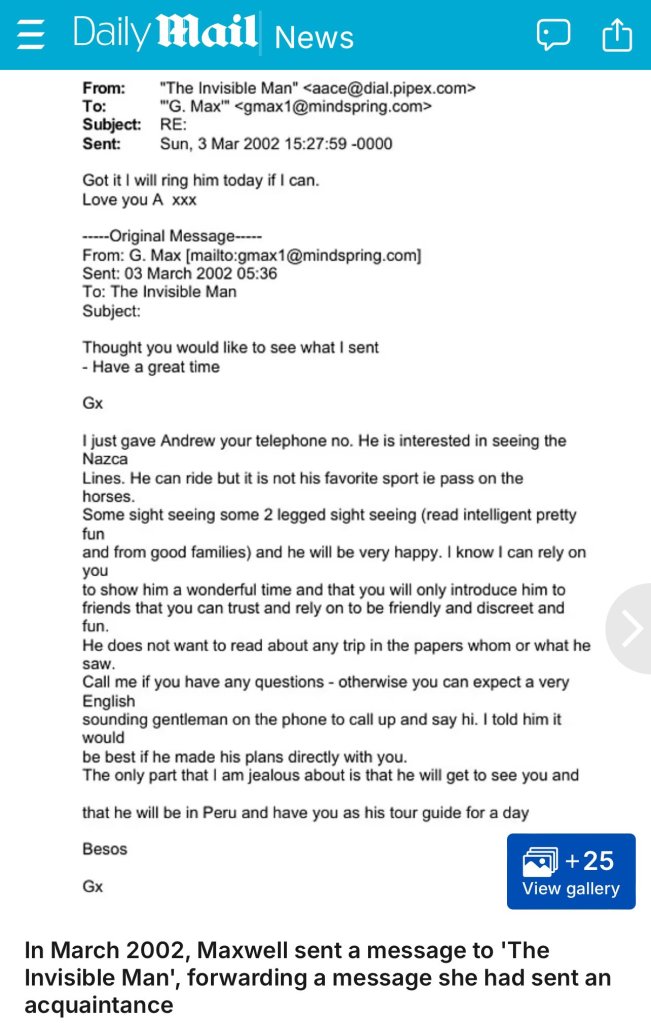
- A 2001 email sent from Balmoral, signed “A xxx,” asking Ghislaine Maxwell about “new inappropriate friends”
- Photographs showing Andrew in social settings within Epstein’s circle
- Flight records documenting travel on Epstein’s aircraft
- FBI requests that the UK compel Andrew’s testimony—requests that were ignored
Multiple survivors described a network that relied on status to normalize access. Andrew’s proximity to Epstein during the period when trafficking occurred is not disputed. His denials of knowledge sit against documented, sustained contact.
Yet Andrew faced no criminal charges in the UK. He settled Virginia Giuffre’s civil lawsuit in February 2022 for an undisclosed sum without admitting liability. As of 2025, he has been stripped of his titles but remains financially supported by King Charles III, with recent reports indicating he will relocate to a private residence on a royal estate.
The Disparity That Exposes the Strategy
The institutional response to Andrew versus Meghan illuminates the palace’s actual priorities:
Prince Andrew:
- Documented associations with convicted sex traffickers
- FBI requests for interrogation rebuffed
- Remained shielded and financially supported
- Journalists reportedly discouraged from pursuing Epstein ties during William and Kate’s 2011 wedding
- Continued access to royal protection despite stepping back from duties
Meghan Markle:
- Married Prince Harry
- Faced “sustained hostility” (per recent reporting) that pushed the couple out of the institution
- Told palace HR she was experiencing suicidal thoughts in early 2019; palace response was that seeking help would damage the brand
- Described as “too big for her boots,” a “dictator in high heels,” subject to “degree wife” speculation about how long the marriage would last
- Security protection removed
The late Queen Elizabeth II stripped Andrew of his royal duties only after the Newsnight disaster made his position untenable—yet she reportedly tolerated Epstein and Maxwell’s presence at royal events including a party at Windsor Castle and a shooting weekend at Sandringham.
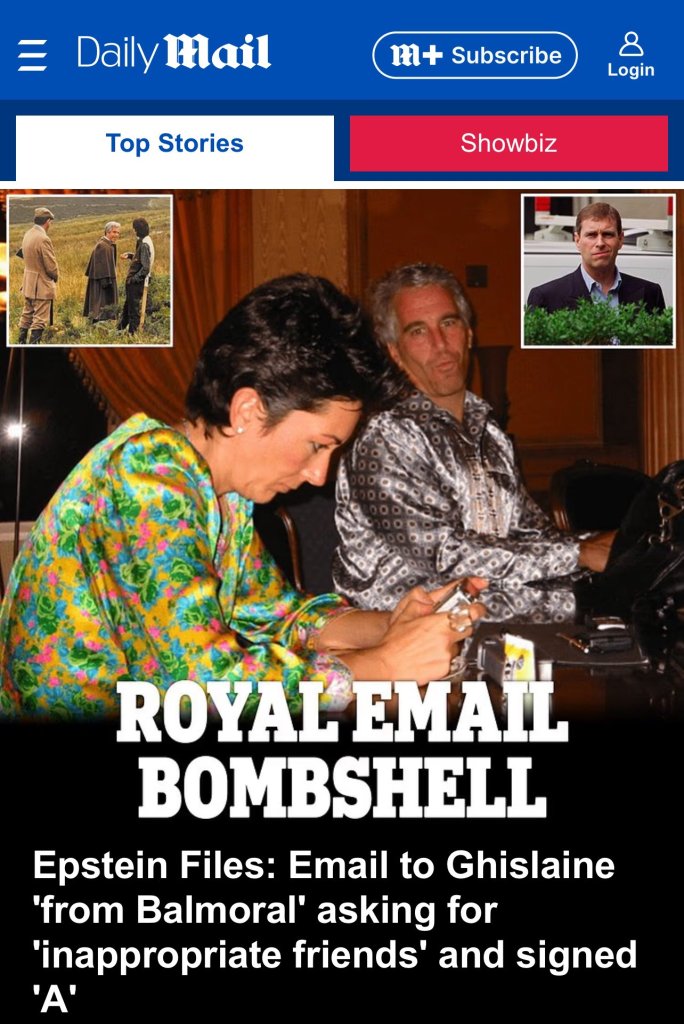

When Meghan experienced what she described as an “almost unsurvivable” year of coordinated attacks in 2019, the palace claimed it could do nothing to protect her from the press. Yet during that same period, the palace was reportedly feeding negative stories about Meghan to those same publications.
The Mechanism: Attention as a Zero-Sum Game
Media attention operates as finite resource. News organizations have limited front-page space. Digital platforms have limited above-the-fold real estate. Television news has limited airtime. When one story dominates, others recede.
The palace understood this. Meghan’s description of the “real estate” principle wasn’t metaphorical. It was operational.
The strategy functions through three elements:
- Displacement through volume: Generate enough negative Meghan content to crowd out Andrew coverage
- Narrative simplification: “Difficult duchess” is more digestible than institutional complicity in sex trafficking
- Attention capture: Personality conflicts generate more engagement than complex criminal accountability questions
A CNN investigation in 2019 found that anti-Meghan content was being systematically amplified, with certain accounts driving disproportionate volume. The palace didn’t need to create all the negativity—it only needed to feed initial stories that trolls and tabloids would amplify.
Why This Pattern Matters Beyond the Royals
This isn’t unique to Buckingham Palace. It’s a replicable institutional power-preservation technique visible across contexts:
The mechanics:
- Damaging institutional story threatens to emerge or intensify
- Generate compelling “problem person” narrative
- Media attention shifts to personality story
- Institutional accountability recedes
- Original misconduct becomes invisible
The requirements:
- Access to media channels (direct or through “sources”)
- Identified scapegoat positioned as expendable
- Issue requiring protection (scandal, criminal conduct, institutional failure)
- Willing or complicit media ecosystem
The outcome:
- Individual blamed and often expelled
- Institution preserved
- Accountability avoided
- Pattern remains invisible unless temporal correlation examined
The Questions That Remain
If the palace could feed stories to protect certain family members by attacking others, several questions demand answers:
What did senior royals know about Andrew’s activities? The email from Balmoral, the photographs, the sustained access to Epstein and Maxwell during active trafficking—all of this occurred while Andrew was a working royal with full institutional support.
When did protection of Andrew become official strategy? Journalists have stated they were discouraged from pursuing Andrew’s Epstein connections during major royal events. That’s not passive tolerance—it’s active suppression.
Who authorized the negative briefing against Meghan? Attorney Jenny Afia stated she had “seen evidence” of palace briefing. That evidence should be disclosed, particularly if it shows coordination between Andrew protection and Meghan vilification.
Why did palace HR fail Meghan while protecting Andrew? When Meghan reported suicidal thoughts in early 2019, she was told seeking help would damage the institution’s image. When Andrew’s associations with sex traffickers threatened the institution, he received financial support and housing.
The Institutional Reckoning That Hasn’t Happened
No independent inquiry has examined the palace’s knowledge of or response to Andrew’s Epstein associations. No investigation has reviewed the decision-making that kept Andrew financially supported while driving out Harry and Meghan. No accountability has followed the admission that negative stories were planted to serve “other people’s agendas.”
The pattern documented here—Andrew scandals coinciding with Meghan vilification—suggests those agendas were directly connected. The institution that claimed it couldn’t protect a suicidal pregnant woman from tabloid attacks was simultaneously orchestrating those attacks to shield a family member from accountability for documented proximity to sex trafficking.
That’s not crisis management. That’s institutional complicity made visible through the very “real estate” principle Meghan described.
Conclusion
The temporal correlation is clear. The palace admissions are on record. The outcome speaks for itself: Andrew protected, Meghan expelled.
What the Epstein files reveal about Andrew’s access and associations makes the palace’s treatment of Meghan even more damning. The institution that hosted Epstein and Maxwell at royal residences, that ignored FBI requests for Andrew’s testimony, that continues to financially support him despite a settled civil lawsuit—that same institution claimed it was powerless to stop negative coverage of a woman whose primary transgression was existing while biracial and American.
The “real estate” on those front pages wasn’t filled by accident. It was filled by design. And every Meghan headline that displaced an Andrew investigation represents a choice—a choice that prioritized institutional preservation over survivor justice, reputation over accountability, and complicity over truth.
Until an independent inquiry examines these decisions and the people who made them, the pattern will continue. Power will protect power. And the “real estate” will keep getting filled with the wrong stories.
Dr. Aparna Vashisht-Rota is an attorney-in-training, business strategist, and academic researcher whose career spans legal practice, international education, and institutional reform. Her work examines how power operates within universities, corporations, and legal systems—and how individuals navigate institutions designed to serve other interests. Currently enrolled in California’s Law Office Study Program, Dr. Vashisht-Rota works on client cases in complex civil litigation including landlord-tenant disputes, immigration matters, and employment law.
She holds an MBA from UCLA Anderson School of Management, a Doctorate of Business Administration (DBA) from Grenoble Ecole de Management—where she served as elected class representative for her cohort—and is pursuing a Bachelor of Laws (LLB) through the University of London. Her academic research focuses on how institutional reputation shapes strategic decision-making in business education, with published work examining MBA program portfolios and ongoing collaborative research analyzing AI adoption and strategic change in universities, targeting publications in top-tier management journals.
As founder and CEO of August Network LLC and August Education Group since 2015, Dr. Vashisht-Rota built organizations supporting international students and universities navigating U.S. regulatory frameworks for OPT/CPT programs, cross-border pathways, and workforce placement.
As Editor-in-Chief of Celeb Chai since 2023, she oversees analysis of celebrity culture, media economics, and structural power—work that examines how narratives are constructed, who benefits from them, and whose voices get displaced in the process.
Colleagues describe her as analytically rigorous, strategically focused, and relentless in execution. Former supervisors and collaborators emphasize her ability to manage complexity, build consensus across diverse stakeholders, and translate research into operational outcomes. Her career demonstrates sustained attention to how institutions actually function versus how they claim to function—and consistent advocacy for accountability where power and vulnerability intersect.
Dr. Vashisht-Rota’s work asks uncomfortable questions: Who gets protected when institutions face scandal? Whose misconduct gets displaced onto expendable targets? How do procedural systems serve those who already have access? Her professional life—spanning law, education, business, and media—represents sustained engagement with these questions across multiple institutional contexts.
 celebchai.com