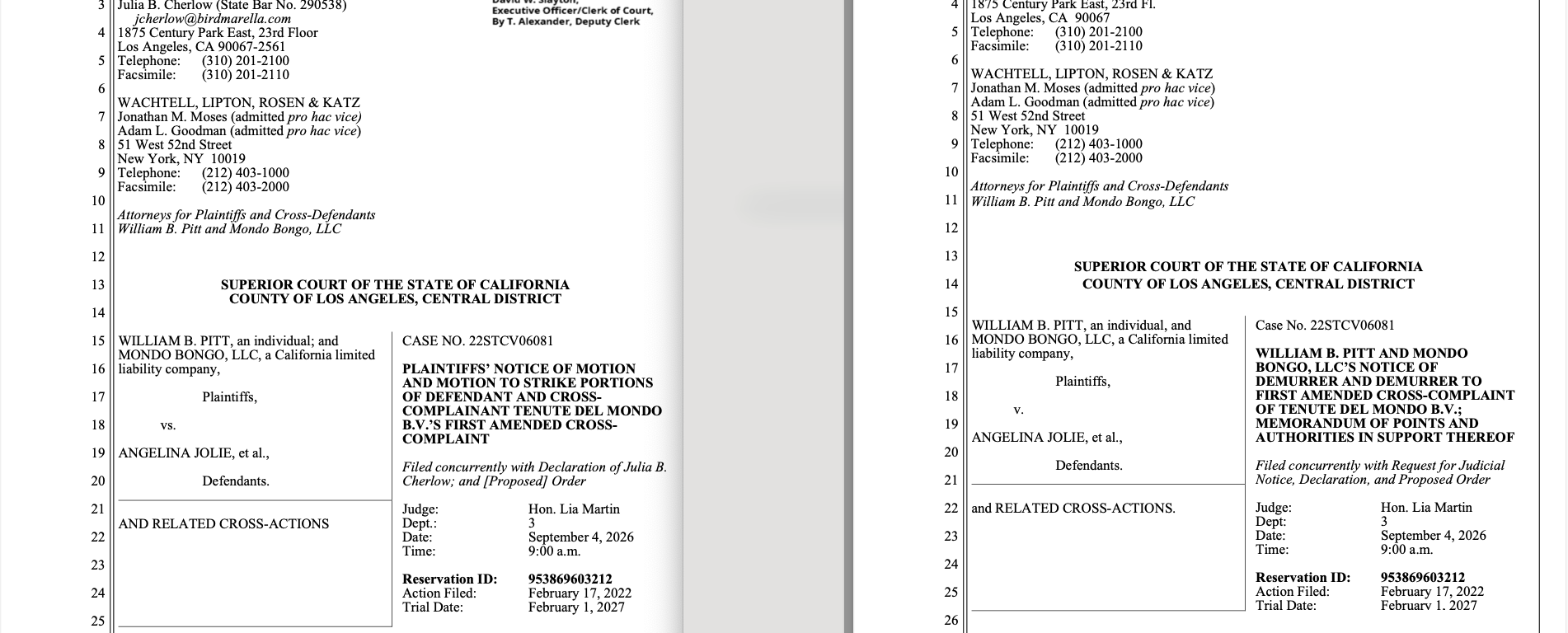
The documents analyzed include: Pitt’s Notice of Demurrer and Demurrer to First Amended Cross-Complaint of Tenute del Mondo B.V. (filed Dec. 22, 2025) and Pitt’s Notice of Motion and Motion to Strike Portions of Tenute’s First Amended Cross-Complaint (filed Dec. 22, 2025), both in case no. 22STCV06081, Superior Court of California, County of Los Angeles.
The latest filings in Pitt v. Jolie reveal a masterclass in procedural manipulation—one that transforms legitimate statute of limitations doctrine into a mechanism for evading accountability while generating sympathetic media coverage that obscures the underlying allegations.
The Substantive Allegations Being Obscured
Before examining Pitt’s procedural maneuvers, it’s worth establishing what Tenute del Mondo (the company that purchased Jolie’s interest in Château Miraval) actually alleges:
The Core Embezzlement Claims:
- In 2020 alone, Château Miraval spent €8 million on projects benefiting Pitt personally: €4 million on construction at a nearby house owned by the château, €1.1 million on a swimming pool, and €3 million on “garment works”
- These expenditures were diverted from profits that should have been distributed to shareholders or used to repay shareholder loans
- The music studio project involved additional undisclosed spending
- All renovations occurred at property Pitt exclusively used after the separation, while Jolie never returned
The Pattern of Control:
- After the 2016 separation, Pitt allegedly took unilateral control of Miraval’s finances
- In June 2021, Pitt wrote to Miraval’s CEO: “I believe we should no longer send AJ reports as she is trying to shop her shares”
- This correspondence suggests intentional exclusion of a 50% shareholder from financial information
- The CEO, Roland Venturini, was simultaneously on Pitt’s personal payroll between 2020-2022
The Shareholder Deadlock:
- In September 2020, Nouvel (Jolie’s entity) requested analysis of profit distributions or loan repayments
- Pitt disagreed, creating a deadlock that prevented any shareholder oversight
- This deadlock conveniently prevented scrutiny of expenditures benefiting Pitt personally
The Procedural Strategy: Transforming Substantive Weakness into Technical Victory
Faced with these allegations, Pitt’s legal team has deployed a two-pronged strategy that prioritizes procedure over substance:
Prong One: The Extraterritoriality Gambit
Pitt’s demurrer argues that California Penal Code § 496 cannot apply because the alleged embezzlement occurred in France. The argument proceeds through several rhetorical moves:
Move 1: Narrow the Geographic Focus The filing emphasizes repeatedly that the “alleged diversion of profits at a French estate,” the “shareholder deadlock at its Luxembourgish holding entity,” and the harm to “a Dutch private limited company” all occurred outside California.
Move 2: Minimize California Connections When addressing Tenute’s allegations of California-based conduct, Pitt’s team dismisses them as “conclusory” while imposing impossibly high pleading standards. For instance, regarding Pitt’s June 2021 message about withholding reports from Jolie, the filing argues:
- The message contains no “directive or order” (reframing clear instruction as mere observation)
- Pitt was under no obligation to share reports (ignoring fiduciary duties to co-shareholder)
- The message doesn’t indicate “attempt or intent” to conceal (despite its plain meaning)
Move 3: Demand Impossible Specificity The demurrer argues Tenute failed to adequately plead that Pitt was physically in California when sending specific messages, despite alleging he was filming in California during the relevant period. This creates an evidentiary standard—requiring geolocation data for text messages—that cannot be met at the pleading stage.
The Strategic Benefit: This framing allows Pitt’s team to generate coverage suggesting he’s being unfairly subjected to California jurisdiction for conduct that occurred elsewhere—obscuring that he’s a California resident who controlled decisions about a business in which he held his interest through a California LLC.
Prong Two: The Time-Bar Trap
The motion to strike reveals even more sophisticated procedural manipulation. Here’s the timeline:
September 29, 2025: Court strikes allegations from Tenute’s cross-complaint as time-barred, granting leave to amend “to allege a ‘pattern of conduct’ which does not include time-barred allegations”
October 22, 2025: Tenute files amended cross-complaint, repleading the same factual allegations but now framed as part of a continuing violation (the ongoing withholding/concealment of allegedly stolen property)
December 22, 2025: Pitt moves to strike the same allegations again, arguing Tenute “waived” the continuing violation theory by not raising it in opposition to the first motion to strike
The Procedural Jiu-Jitsu:
Pitt’s motion creates a logical trap:
- The court struck allegations as time-barred in the original pleading
- The court granted leave to amend (typically understood as permission to replead with additional factual allegations to address deficiencies)
- Tenute repleaded with additional allegations about continuing concealment/withholding
- Pitt now argues this new theory is “waived” because Tenute should have raised it when opposing the first motion to strike
This is procedural bootstrapping: Pitt’s team essentially argues that Tenute had to predict and defend against the statute of limitations argument before it was raised, and having failed to do so, cannot now articulate a theory of timeliness.
The Substantive Weakness of Pitt’s Arguments
Beneath the procedural sophistication lie substantively weak positions:
On Extraterritoriality:
Pitt’s Argument: California Penal Code § 496 doesn’t apply to embezzlement that occurred in France, even if preparatory acts occurred in California.
The Problem:
- Pitt is a California resident
- He held his Miraval interest through a California LLC (Mondo Bongo)
- He was physically in California during key decision-making periods
- California has legitimate regulatory interest in conduct by California residents using California entities
The demurrer cites Sullivan v. Oracle Corp. for the proposition that California courts won’t “speculate about the place” conduct occurred even when defendant was “headquartered in California.” But Sullivan involved employment decisions about out-of-state employees—not a California resident’s management of his own business interests through California entities.
On the June 2021 Message:
Pitt’s Argument: The message “I believe we should no longer send AJ reports as she is trying to shop her shares” is merely a “personal view or observation, not an instruction.”
The Reality:
- Pitt sent this to Miraval’s CEO (who was on Pitt’s personal payroll)
- The message came in context of business proposal for music studio
- It explicitly recommends withholding financial information from a 50% shareholder
- Jolie was indeed subsequently excluded from financial information
The characterization as “personal view” is textbook minimization. When the controlling shareholder tells the CEO (who he personally pays) what he “believes” should happen regarding company information, that’s an instruction, regardless of grammatical hedging.
On Continuing Violation:
Pitt’s Argument: Merely withholding stolen property isn’t a continuing violation; only active concealment qualifies.
The Problem: This distinction collapses in the context of corporate embezzlement. When:
- Property was allegedly stolen through corporate expenditures in 2020
- The co-shareholder was affirmatively excluded from financial information in 2021
- A shareholder deadlock prevented any distribution or accounting
- The CEO was simultaneously on Pitt’s personal payroll
…the “withholding” isn’t passive retention—it’s active prevention of recovery through corporate control mechanisms.
The filing argues the renovations “could not have been physically ‘secreted'” because they were visible at the château. But Tenute’s concealment theory doesn’t require hiding a swimming pool—it alleges concealing the diversion of funds through manipulation of corporate information flows.
On Waiver:
Pitt’s Argument: Tenute “waived” the continuing violation theory by not raising it when opposing the first motion to strike.
The Problem: This misunderstands how pleading amendments work. The court granted leave to amend—permission to replead with additional factual allegations. Tenute did exactly that: repleaded the same events but with additional allegations about ongoing concealment and withholding.
Pitt’s waiver argument would effectively require plaintiffs to make every possible legal argument in opposition to a motion to dismiss, rather than addressing deficiencies through amendment—precisely what leave to amend is designed to permit.
The Media Strategy: Procedural Victories as Substantive Exoneration
The real sophistication lies in how these procedural moves generate coverage that obscures the underlying allegations. The Us Weekly article demonstrates this perfectly:
Key Framing Elements:
- “Pitt told the court that any expenses made by Miraval were disclosed and never kept a secret” (establishing innocence frame)
- Extensive quotation of Pitt’s legal arguments about the June 2021 message
- “A source tells Us” providing Pitt’s characterization of Tenute’s filing as “frivolous”
- Emphasis on Pitt’s “recent win” ordering Jolie to produce emails
What’s Minimized:
- The actual amounts allegedly diverted (€8 million in 2020 alone)
- The French prosecutor dismissed the criminal complaint for insufficient evidence—not because conduct was lawful
- The ongoing related litigation in Europe
- The power dynamics of a CEO simultaneously on Pitt’s personal payroll making expenditure decisions
The Structural Advantage of Procedural Warfare
This litigation strategy reflects broader structural advantages available to well-resourced defendants:
Advantage 1: Procedure Favors Possession The entity in possession of disputed property (Pitt’s continued exclusive use of Miraval) can use procedural mechanisms to delay substantive adjudication indefinitely. Each successful motion to dismiss/strike requires amended pleading, followed by new motions, creating years of delay.
Advantage 2: Procedural Victories Generate Sympathetic Coverage Winning a motion to strike time-barred allegations becomes “Brad Pitt fights embezzlement accusations”—coverage that primes audiences to view the underlying claims as baseless without engaging the substantive allegations.
Advantage 3: Discovery Asymmetries By challenging personal jurisdiction of various parties and moving to strike allegations, Pitt’s team limits discovery into the substantive allegations while the procedural issues are litigated. This preserves information advantages.
Advantage 4: Attrition Through Expense Each procedural motion requires substantial briefing, hearing preparation, and potentially appeals. For a plaintiff like Tenute (even though backed by a spirits conglomerate), this imposes ongoing costs that might not be cost-justified by the recovery amount, potentially forcing settlement.
The Deeper Pattern: When Process Becomes Punishment
The Miraval litigation exemplifies how procedural law, designed to ensure fair adjudication, can be weaponized to avoid accountability:
In Domestic Violence Context: Pitt has used procedural mechanisms to delay resolution of custody matters for eight years post-separation, including:
- Disqualifying judges who ruled against him
- Challenging Jolie’s right to sell her Miraval interest (extending litigation)
- Pursuing sanctions against Jolie’s attorneys (raising costs of representation)
In Business Dispute Context: The current filings show similar strategies:
- Challenging extraterritorial application of California law
- Moving to strike time-barred allegations (twice)
- Demanding impossibly specific pleading standards
- Seeking sanctions against opposing party for procedural violations
The Common Thread: In both contexts, procedural sophistication serves to extend litigation timelines, increase opposing party costs, generate favorable media coverage, and avoid substantive adjudication of underlying conduct.
What This Reveals About Access to Justice
The Miraval litigation is particularly instructive because both parties have access to elite counsel and substantial resources. Yet even in this context, procedural complexity favors the party seeking to avoid accountability:
If Tenute Wins These Motions: The litigation continues, but Pitt has already:
- Generated coverage suggesting claims are “frivolous”
- Delayed discovery into substantive allegations
- Imposed substantial legal costs on opposing party
- Created record for future appeals
If Pitt Wins These Motions:
- Time-barred allegations are struck (limiting evidence of pattern)
- Extraterritoriality argument may dismiss claims entirely
- Coverage emphasizes “victories” rather than underlying allegations
- Sanctions against Tenute create deterrent effect
Either Way: The substantive question—did Pitt improperly divert millions from Miraval while excluding his co-shareholder from financial information?—remains unaddressed while procedural issues are litigated.
For parties without Tenute’s resources, these procedural barriers would likely be insurmountable, effectively insulating wealthy individuals from accountability for corporate misconduct.
Conclusion: The Cost of Procedural Sophistication
The December 22, 2025 filings in Pitt v. Jolie demonstrate litigation strategy operating at the highest level of procedural sophistication. The demurrer and motion to strike are masterfully crafted documents that deploy extraterritoriality doctrine, statute of limitations law, and waiver principles to attack Tenute’s claims without engaging their substance.
But this very sophistication reveals the costs of our current litigation system:
- Substantive allegations of serious misconduct (€8M+ in allegedly improper diversions) are displaced by procedural disputes about pleading standards and geographic scope
- Media coverage emphasizes procedural victories as vindication, without interrogating whether those victories address the underlying conduct
- Years of litigation focus on threshold issues rather than substantive adjudication, imposing costs that may exceed recovery even for well-resourced plaintiffs
- The party controlling corporate information can use pleading specificity requirements to demand evidence only they possess as a condition of proceeding to discovery
The Miraval litigation thus functions as a case study in how procedural law, however necessary for fair adjudication, can be deployed to avoid accountability entirely. When the party with the most resources and the most sophisticated counsel is also the party accused of misconduct, procedural warfare becomes a rational strategy—one that may succeed regardless of substantive merit.
The September 4, 2026 hearing will reveal whether the court sees through this strategy or treats each procedural issue in isolation. But regardless of outcome, these filings demonstrate that in high-stakes litigation between sophisticated parties, the real battle often isn’t about what happened—it’s about whether what happened will ever be adjudicated at all.
 celebchai.com