The British monarchy has perfected something remarkable: a two-pronged defense system where Prince Andrew absorbs outrage through spectacular personal failure while Prince William neutralizes investigative journalism through access control. Together, they create an environment where institutional accountability becomes structurally impossible.
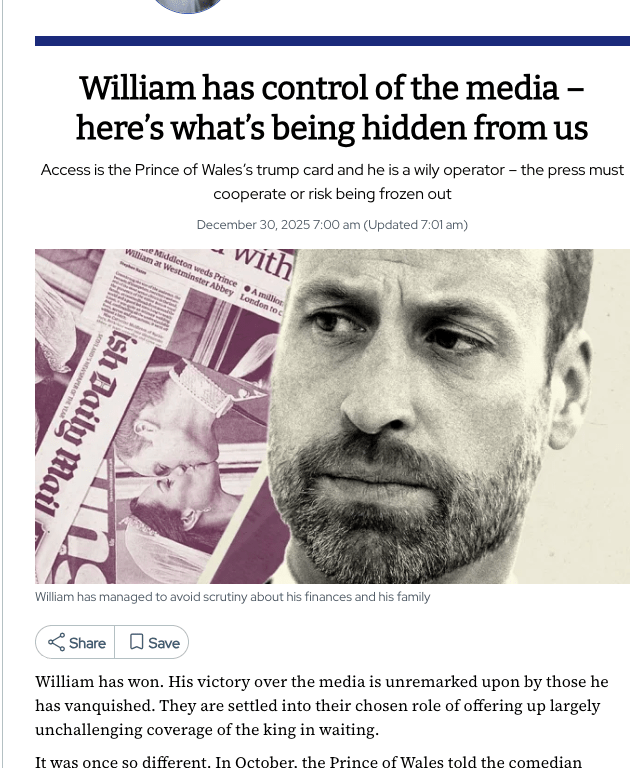
Andrew provides morally unambiguous scandal—Epstein associations, disastrous interviews, Royal Lodge standoffs. These generate intense but contained outrage focused on individual moral failure. Each Andrew crisis resets public attention, preventing cumulative analysis of systemic problems. Meanwhile, William has methodically captured royal reporting through access control. He once “temporarily froze out someone who asked questions of his advisers that weren’t to his liking.” The lesson was learned. Royal correspondents now practice omertà on difficult topics—finances, duchy exploitation, his role in Andrew’s “defenestration.”
Both strategies shield the same institutional realities. William receives £23 million annually from the Duchy of Cornwall while Charles extracts £829,000 annually from a single NHS warehouse rental. The duchies collect rental income from armed forces, schools, prisons, and emergency services, with some duchy properties failing minimum energy efficiency standards. Andrew’s scandals provide dramatic distraction while William’s captured press ensures no sustained investigation. The result is that taxpayers fund services that pay rent to hereditary landlords, and nobody asks follow-up questions.
Consider the “forever home” shell game. In 2014, Kensington Palace apartments were renovated at £4.5 million in taxpayer expense, described as the main home for “many, many years to come.” By 2025, the family had moved to Forest Lodge, now described as their “forever home.” Andrew dominates headlines with his Royal Lodge standoff while William’s cooperative press buries the pattern. Nobody tracks the cumulative public expenditure across multiple “permanent” residences.
Or take the honours-for-cash rehabilitation that should be generating continuous scandal. Michael Fawcett coordinated with “fixers” over honours nominations for a Saudi billionaire. An investigation confirmed misconduct, police dropped their investigation, and Fawcett was “welcomed back into the King’s charmed circle.” But Andrew’s email to Epstein—”Let’s play again soon!!!”—gets a historian declaring it “perhaps the gravest crisis since the 1936 abdication.” Fawcett’s return gets a paragraph in the Daily Mail. The selective outrage isn’t accidental.
The tax arrangements reveal the deepest protection. The King ranks among the richest 100 people in the UK, exempt from corporation and capital gains taxes while extracting rent from public services and receiving public funding for security and property maintenance. Andrew’s scandals make him the face of royal financial impropriety. William’s press management ensures no journalist asks him directly about £23 million annual income during an inflation crisis. The systemic issue—hereditary wealth accumulation with extraordinary tax privileges—never becomes the story.
Watch the Andrew displacement pattern in action. Investigative journalism reveals an institutional problem: duchy income from NHS and schools, the Fawcett honours scandal, Highgrove employment practices, coronation extravagance during crisis. A brief attention cycle begins, lasting a couple days. Then an Andrew scandal surfaces or resurfaces—new email, interview anniversary, Royal Lodge update. Attention shifts to individual moral failure, which is emotionally satisfying, offers a clear villain, and requires no complex analysis. The institutional story “mysteriously evaporates” with no follow-up, no accountability, no cumulative analysis. Then the pattern repeats. As one commentator observed, Andrew’s “tired speculations about his income, role, house and ex-wife serve to distract subjects from the many other scandals in that family, which come, shock and mysteriously evaporate.”
William has engineered a different form of protection through captured coverage. During his South Africa trip, which came after the Duchy investigation revealed his income sources, his TV interview focused on discussing a Taylor Swift bracelet from his daughter. Questions about £23 million in annual duchy income derived from taxpayer-funded services were never asked. Print reporters observed a “similar omertà.” During his Brazil trip, five days of coverage focused on environmental work and barefoot beach volleyball skills when the much bigger story was his contribution to the defenestration of his uncle. As one article noted, this was never raised with him directly.
On the Harry conflict, William maintains public silence while using anonymous “sources” to brief his narrative. The media “in large part, has cast Harry as the guilty person and portrayed William as wounded and above reproach,” though critical analysis suggests “the truth, as always, is more nuanced.” On future plans, he promises “change” with no details provided and pledges “small ‘r’ in royal” with no specifics. He gets to make vague pronouncements on homelessness, mental health, and environment with zero testing of actual plans, despite the fact that “the fine print is crucial when it comes to the position of an unelected constitutional monarch where the room for manoeuvre is severely limited.”
The system works because media cooperation is economically rational. Access to William provides exclusive interviews and photo opportunities, inside track on royal family developments, professional advantage over competitors, and content that reliably generates engagement. Loss of access means exclusion from major royal events, professional disadvantage, and reduced ability to compete for the royal audience. As one article notes, “Access is the Prince of Wales’s trump card and he’s a wily operator.” He once froze out someone temporarily for asking unwelcome questions. Message received. Cooperation is professionally rewarded; scrutiny is professionally punished.
Andrew provides moral satisfaction. The public gets a clear villain, emotionally satisfying outrage, a sense of accountability since someone is being criticized, and no requirement for complex institutional analysis. This creates the illusion of functioning oversight while protecting the actual power structure.
The comparison reveals the strategy with stark clarity. As one observer asked, “Imagine a government minister being given such an easy ride.” Elected officials face regular hostile questioning, opposition scrutiny, freedom of information requests, electoral accountability, financial disclosure requirements, and conflict of interest investigations. The hereditary monarchy receives cooperative coverage avoiding “difficult topics,” anonymous sources briefing preferred narratives, no requirement to explain £23 million annual income, no detailed scrutiny of future plans, tax exemptions beyond elected officials, and Andrew scandals absorbing accountability pressure. The contrast isn’t accidental. It’s engineered.
The structural outcome becomes clear when you map what each strategy conceals and prevents. Andrew’s scandals conceal honours for cash through the Fawcett affair, duchy extraction from public services, employment abuses at royal estates, the £72 million coronation during cost-of-living crisis, and systemic tax avoidance. William’s media control prevents investigation of the £4.5 million renovation followed by residence change, £23 million annual duchy income during inflation, his role in Andrew’s removal which went completely unquestioned, actual plans for “change” and “small ‘r’ royal,” and his use of anonymous sources against Harry while maintaining public silence. The combined effect creates a formula: individual scandal plus neutralized scrutiny equals what one article described as “the current status quo is seductive for a prince and means he’ll become king, unchallenged.”
The charity test case proves the system’s effectiveness. Andrew’s withdrawal from 64 charities “had no effect on their income overall, with many seeing an increase after he stepped down.” This should have demolished the entire patronage justification. If charities don’t need royals for fundraising, what’s the value proposition? The answer is legitimacy laundering for the institution, not charity benefit. But this finding gets buried beneath the next Andrew scandal. No systemic reform is demanded. The pattern continues.
What makes this brilliant is that most institutional capture requires active suppression—legal threats, financial pressure, direct intervention. This system is cooperative. Media outlets voluntarily subordinate their investigative function to maintain access. The public voluntarily focuses on Andrew’s moral failures rather than demanding institutional accountability. Politicians voluntarily avoid questioning tax arrangements or duchy income sources. The system disciplines itself through rational incentives. Reporters who cooperate advance professionally. Outlets that cooperate get exclusive access. The public that focuses on Andrew gets moral satisfaction. Politicians who avoid scrutiny avoid being portrayed as anti-monarchy. Nobody needs to force anything. The structure perpetuates through willing participation.
Andrew equals outrage theater—spectacular personal failure that absorbs attention, generates emotionally satisfying but structurally useless scandal coverage, and prevents cumulative analysis of institutional patterns. William equals scrutiny neutralization—access control that disciplines the press, vague promises of reform that go untested, anonymous briefings that shape narratives, and “difficult topics” that are systematically avoided. Together they create accountability impossibility. Individual scandal diverts from institutional analysis. Captured press prevents institutional investigation. Systemic problems “mysteriously evaporate” after brief attention. The pattern repeats indefinitely.
The result, as one commentator observed, is that “they’re arrogant. They think they can get away with it and they think they have an entitlement, and they carry on regardless. They sail on.” They sail on not despite the scandals and the coverage, but because of how scandals and coverage have been architected to make accountability structurally impossible. That’s the system. Andrew and William aren’t opposites—they’re complementary components of the same defensive structure.
 celebchai.com