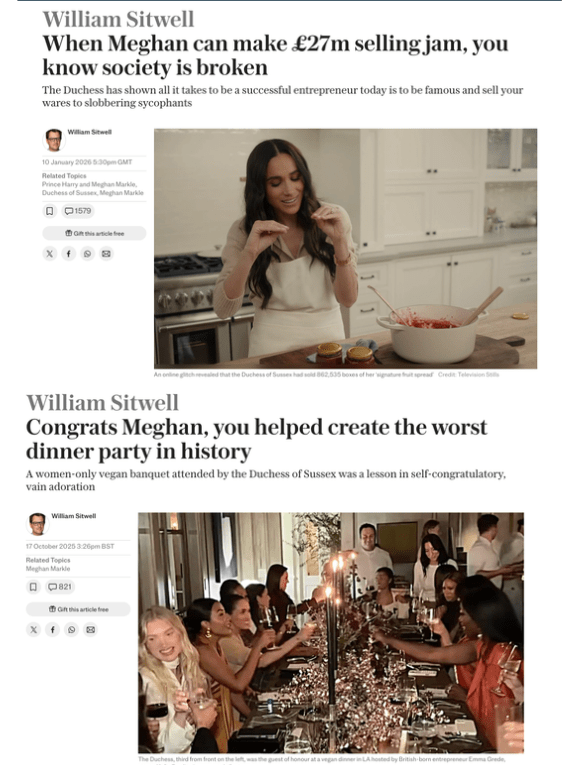

Here we have 2 columns from William Sitwell who is obviously not sitting well with a woman’s success.
For reference, the author is William Sitwell, and the piece leans heavily on the royal framing surrounding Prince Harry to anchor what is otherwise a straightforward consumer-brand story.
Both columns are best read as a single argument in two acts. In the first, commercial success is framed as civilizational failure; in the second, social visibility is framed as moral decadence. Together, they form a coherent posture rather than two discrete critiques: when Meghan Markle succeeds in the market, it proves society is broken; when she convenes or participates in elite social spaces, it proves culture is hollow. What unites the jam column and the dinner-party column is not evidence or analysis, but a refusal to recognize legitimacy across any domain in which she operates. Revenue is dismissed as fame laundering, community is dismissed as vanity, and participation itself is treated as provocation. Read this way, William Sitwell is not oscillating between business and culture commentary; he is advancing a single thesis through different venues: that certain people, once marked as unacceptable, cannot succeed correctly, gather correctly, or exist publicly without that success being reclassified as proof of societal decline.
First, the argument quietly abandons any consistent definition of “entrepreneurship.” Sitwell treats fame as a disqualifier rather than a form of capital. In modern consumer markets, attention is not incidental to value creation; it is a primary input. To say that leveraging an existing platform invalidates the resulting business is equivalent to arguing that founders with venture backing or inherited networks are not “real” entrepreneurs. That is not a serious market position; it is a moral one dressed up as economics.
Second, the rhetoric collapses causation into contempt. The fact pattern is simple: demand exceeded supply at a high price point. Instead of interrogating why consumers were willing to pay $42 for jam (branding, scarcity, parasocial trust, lifestyle signaling), the article substitutes a character narrative in which consumers are “slobbering sycophants.” That move absolves the writer from engaging with consumer agency or market logic. Markets are wrong because the people in them are foolish is not analysis; it is disdain.
Third, the gendered framing is not incidental. The repeated use of diminutives and domestic imagery (“homecraft,” “syrupy,” “snagging a prince”) performs a familiar minimization: commercial success is reframed as manipulation rather than competence. Comparable male celebrity ventures—spirits, sports teams, SPACs—are routinely discussed in terms of valuation, distribution, and brand equity. Here, the same outcome is reinterpreted as proof of decadence.
Fourth, the “society is broken” refrain functions as an escape hatch. Once success is declared illegitimate by definition, no counter-evidence matters. Revenue becomes vulgar, customers become dupes, and execution becomes irrelevant. This is a common move in culture-war commentary: economic facts are acknowledged only to be morally inverted.
Finally, the piece is doing identity work for its readership. By positioning commercial success as civilizational decay, it reassures readers that they are not merely losing cultural influence; they are morally superior for doing so. The target is not jam, or even celebrity commerce. It is the idea that someone like Meghan Markle is entitled to participate in—and win within—elite markets on her own terms.
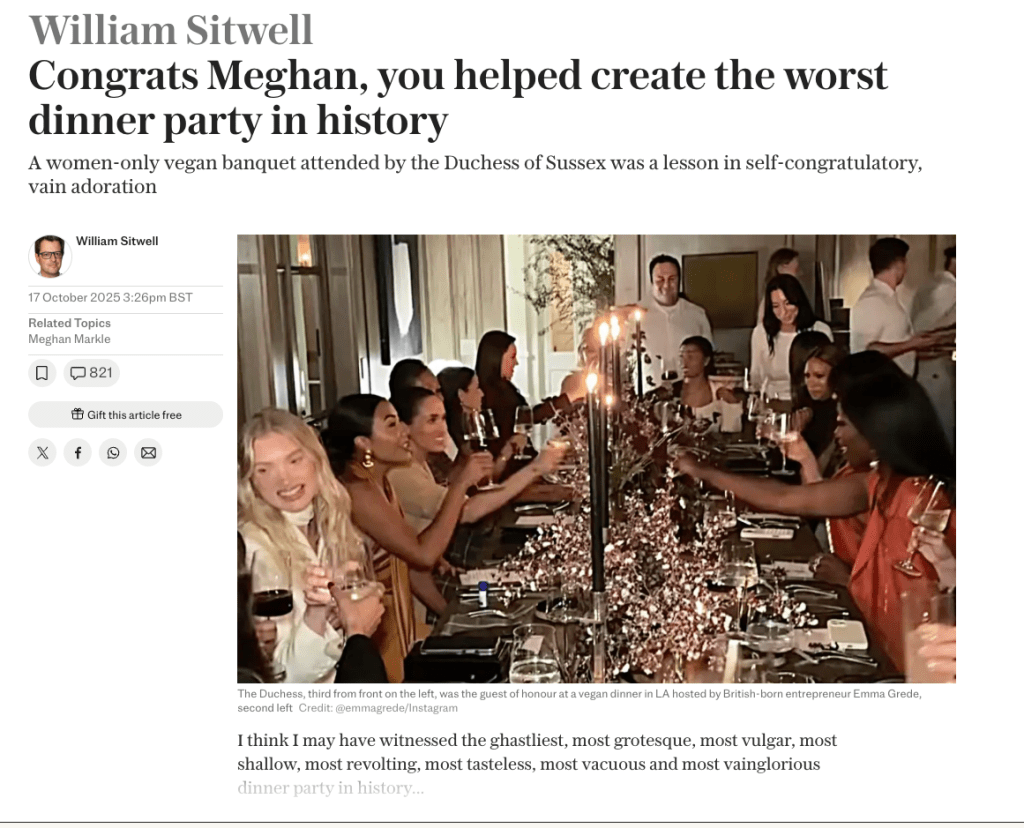
This piece is even less disguised than the jam column. It abandons any pretense of cultural or business commentary and functions as spectacle-driven derision. Several elements stand out.
First, exclusion is weaponized as grievance. Sitwell opens by stressing that he was “ruled out” because he is a man, then spends the remainder of the column deriding a women-only space he neither attended nor was invited to. The exclusion is framed not as a neutral curatorial choice but as evidence of moral and cultural corruption. That move converts a boundary into an insult, which then justifies contempt.
Second, the language is deliberately maximalist. The piling on of adjectives such “ghastliest, most grotesque, most vulgar…” is not descriptive; it is performative. It signals to the reader that disgust is the correct response before any substantive claim is evaluated. Once that tone is set, no fact can function neutrally. Everything becomes proof of decadence by definition.
Third, social media is treated as both sin and evidence of sin. Sitwell condemns the dinner for being performative, then relies entirely on Instagram posts to reconstruct the event and judge it. The contradiction is unresolved because it is not meant to be. Visibility itself is the offense. The problem is not what was said or done, but that it was seen.
Fourth, the “women helping women” rhetoric is reframed as hypocrisy through sponsorship. The Shop by Google sponsorship is presented as a gotcha, as if the presence of a corporate sponsor nullifies the possibility of genuine networking, mentorship, or solidarity. This is a selectively applied standard. Male-dominated conferences, summits, and dinners routinely feature sponsors without being dismissed as morally fraudulent by default.
Fifth, the vegan angle is treated as a cultural punchline rather than an ideological position. The chef’s comments on regenerative food systems are caricatured into an absurd fantasy of vegans “killing all the tasty animals.” This is not engagement; it is culture-war shorthand. Veganism here functions as a proxy for elitism, not as a subject worthy of analysis.
Sixth, Meghan’s presence is again framed as contamination. Her attendance is not described as participation but as validation of everything the author dislikes: visibility, self-regard, women-only spaces, wellness culture, and Los Angeles influence. The wine, the poses, the awards circuit are stitched together into a narrative of narcissism that requires no evidence beyond repetition.
Finally, as with the jam column, the piece is doing reassurance work for its audience. The dinner is declared “the worst in history” not because of any demonstrable harm, but because it represents a social world in which the author has no standing and no authority. Mockery becomes a way to reassert hierarchy: if the event is ridiculous, then exclusion from it is a virtue, not a loss.
Seen together, these columns form a pattern. William Sitwell is not critiquing discrete actions by Meghan Markle. He is reacting to her sustained visibility in elite commercial, cultural, and philanthropic spaces that were once gatekept by different norms. Figures like Emma Grede—and by extension her association with Kim Kardashian—anchor that discomfort in a broader shift: power circulating through female-led networks, lifestyle branding, and social media rather than through traditional institutions.
The dinner is not really the subject. The loss of cultural control is.
 celebchai.com