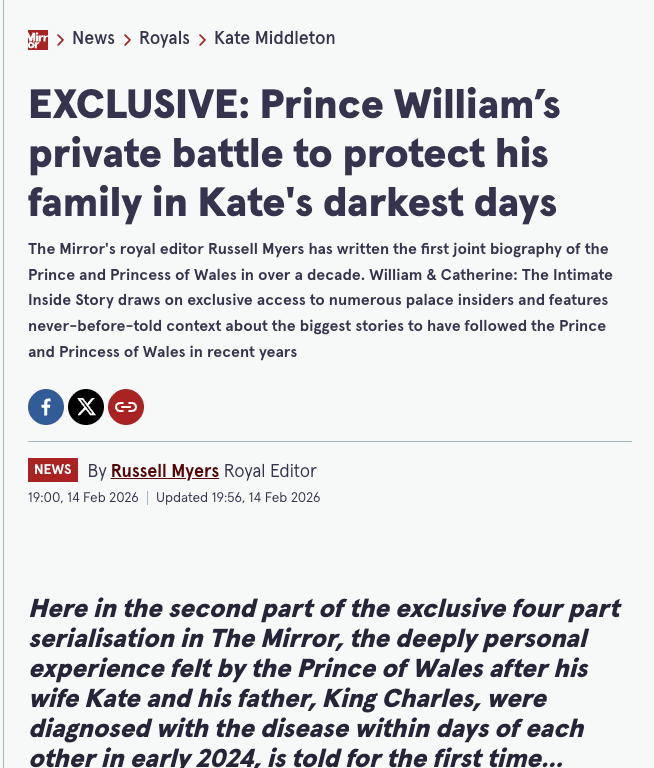
The second installment of Russell Myers’ serialization of William and Catherine: The Intimate Inside Story covers the most sensitive territory a royal biography can enter: a cancer diagnosis, young children, and a family in crisis. It deserves to be handled with care. It also deserves to be read with precision, because what Myers has produced is not a medical narrative. It is a communications case study dressed in the language of vulnerability.
Nothing in this analysis questions the seriousness of Catherine’s diagnosis or the difficulty the family experienced. What it examines is how that experience has been packaged, timed, and deployed through a sympathetic royal editor to serve institutional and reputational objectives that extend well beyond the personal.
The “No Live-In Staff” Construction
The serialization opens by establishing William’s domestic isolation. He was, we are told, left with “three children to care for at home and no live-in staff at their Adelaide Cottage home.” Catherine was in hospital. Charles was in hospital. William was alone.
This framing is doing specific work. It constructs an image of ordinary fatherhood under extraordinary pressure: school runs, cooking, managing bedtimes. The reader is meant to see a man stripped of institutional scaffolding, operating on love and determination alone.
The problem is that “no live-in staff” is not the same as “no staff.” Adelaide Cottage exists within the Windsor estate ecosystem. Royal households operate with security details, private secretaries, aides, drivers, and domestic support personnel who do not need to sleep in the house to be functionally present. The Middleton family, as the serialization itself notes, were “regular visitors.” Pippa helped write Catherine’s video statement script. The children had organized playdates.
None of this diminishes the emotional weight of the situation. But the framing choice, emphasizing the absence of live-in staff rather than the presence of an extensive support network, is designed to generate a particular kind of sympathy. It positions William as an everyman father rather than a prince with institutional resources that most families facing cancer could not begin to imagine.
Strategic Transparency and What Was Withheld
The serialization describes Catherine’s cancer announcement as an act of personal courage and public generosity. She had, we are told, “seen the positivity and warmth that had greeted the King when he had been so open about his own diagnosis” and “believed that her experience could benefit others in similar distressing circumstances.”
Both of these motivations can be genuine. But the structural reality is that Catherine’s announcement was a carefully managed communications event. The statement was scripted (with Pippa’s help), recorded in secrecy by a BBC special events team, and broadcast on the 6pm national news. The setting was curated: a wooden bench, daffodils, a striped jumper and jeans. The language was controlled: “huge shock,” “preventative chemotherapy,” no cancer type, no staging, no treatment regimen, no prognosis.
This is what the second analysis document accurately identifies as “strategic transparency”: reveal the diagnosis, withhold the clinical specifics, control the timing, frame resilience and family unity. It is not unusual for public figures to take this approach. But it is worth naming the strategy rather than simply absorbing the emotion it is designed to produce.
The comparison to Charles is instructive. Charles also withheld his cancer type. The palace observed strong public sympathy for his openness. Catherine’s team then calibrated her disclosure against that benchmark. This is not spontaneous vulnerability. It is institutional learning applied to personal crisis, and the serialization presents it as the former while the evidence describes the latter.
The Medical Records Breach and the Two-Day Window
Myers treats the medical records investigation as a backdrop detail, noting that on 20 March, the Mirror revealed that three hospital staff had allegedly attempted to access Catherine’s private records. Two days later, on 22 March, Catherine made her public announcement.
The serialization frames this sequence to emphasize Catherine’s composure: she “was not concerning herself with the probe or the people at the centre of it. She was steadying herself for something much more life-changing.”
That framing is emotionally effective. It is also strategically convenient. The two-day proximity between the records story and the public announcement raises a question the serialization has no interest in exploring: did the breach story accelerate the announcement timeline? The palace had created an information vacuum by withdrawing Catherine from public view for months with minimal explanation. That vacuum generated intense media speculation, which in turn created conditions where hospital staff curiosity (however inappropriate) became almost predictable.
None of this excuses unauthorized access to medical records. But the serialization’s disinterest in examining whether the palace’s own communications strategy contributed to the conditions that produced the breach is characteristic of the entire project. The institution creates the problem, then frames its response to the problem as heroism.
The Hagiographic Register
The most revealing aspect of Part 2 is not what it discloses but how it speaks. A “close friend” describes William’s reaction to the diagnosis:
“It was like being hit by a bus, sudden, brutal, and completely disorienting… He worships her, truly. She’s his world… it was heartbreak, fear and helplessness all at once… the depth of his devotion is something that stays with you. It’s love in its rawest, most powerful form.”
This is not how people talk about their friends’ private grief. This is copy. It reads like a passage drafted for publication, designed to establish William as a romantic figure defined by devotion under fire. The language is performatively intimate, offering the appearance of private access while functioning as reputation management.
Compare this to how the same serialization describes Harry in Part 3: “paranoid, angry, obsessive and firmly rooted in the past.” One brother gets the language of epic love. The other gets clinical pathology. The asymmetry is not accidental. It is the architecture of the entire project.
The Children as Narrative Anchors
Throughout Part 2, George, Charlotte, and Louis function less as people and more as narrative instruments. They are the reason William cooks. They are the audience for the “calm” explanation of Mummy’s illness. They are the beneficiaries of organized playdates and weekends at the Middletons’. They are the motivation for Catherine’s positivity: “Being as positive and optimistic as possible was all for them.”
This is not a criticism of William and Catherine’s parenting. It is an observation about how the serialization uses children to render the narrative criticism-proof. Once children are positioned at the center of the story, any skepticism about framing choices or communications strategy feels callous. The children become a rhetorical shield.
It is worth noting that this is the same rhetorical move the serialization deploys against the Sussexes in Part 3, where it never once considers the effect of pathologizing Harry through the press on his own children. Archie and Lilibet do not appear as narrative considerations. The concern for children operates selectively, activated when it serves the Wales narrative and invisible when it might complicate the characterization of the Sussexes.
Forest Bathing and the Wellness Rebrand
The serialization closes Catherine’s cancer narrative with her embrace of “shinrin-yoku,” the Japanese practice of forest bathing. A friend explains that Catherine is “a big believer in the natural world and its ability to help us heal” and that outdoor time “was a huge factor in her recovery.”
This is brand positioning embedded in a health narrative. Catherine’s public identity has long been associated with nature, outdoor activity, and wellness. The forest bathing detail serves dual purposes: it humanizes the recovery (she healed through walks, not just through hospital appointments) and it reinforces the brand identity that her public communications have cultivated for years.
Again, the practice itself may be entirely genuine and personally meaningful. But its inclusion in a serialized biography is a choice, and the choice serves image as much as it serves storytelling.
What Part 2 Actually Accomplishes
Read as a standalone piece, the cancer serialization is moving. A young mother receives a devastating diagnosis. Her husband steps up. The family rallies. She faces treatment with courage and emerges stronger. That is a powerful story, and the emotions behind it are almost certainly real.
Read as part of a serialized biography by a palace-connected royal editor, timed to a book launch and structured across four installments designed to maximize commercial and reputational impact, Part 2 accomplishes something more specific. It establishes Catherine as brave, William as devoted, and their partnership as strengthened by adversity. It builds the emotional foundation that makes Part 3’s characterization of the Sussexes (paranoid, abrasive, not to be trusted) land harder by contrast.
The cancer diagnosis is not being exploited in any crude sense. But it is being deployed. The sequencing matters: first establish William and Catherine’s humanity and resilience, then introduce the Sussexes as the destabilizing force. Part 2 is not just a chapter about cancer. It is the emotional setup for Part 3’s institutional verdict.
The reader who absorbs Part 2 before encountering Part 3 arrives at the Sussex material already sympathizing with William and Catherine, already admiring their composure, already inclined to accept that anyone who disrupted this family must have done something unforgivable. That is not an accident of serialization. It is the serialization’s entire purpose.
 celebchai.com
2 thoughts on “Part Two: Kate & William Sterilization”