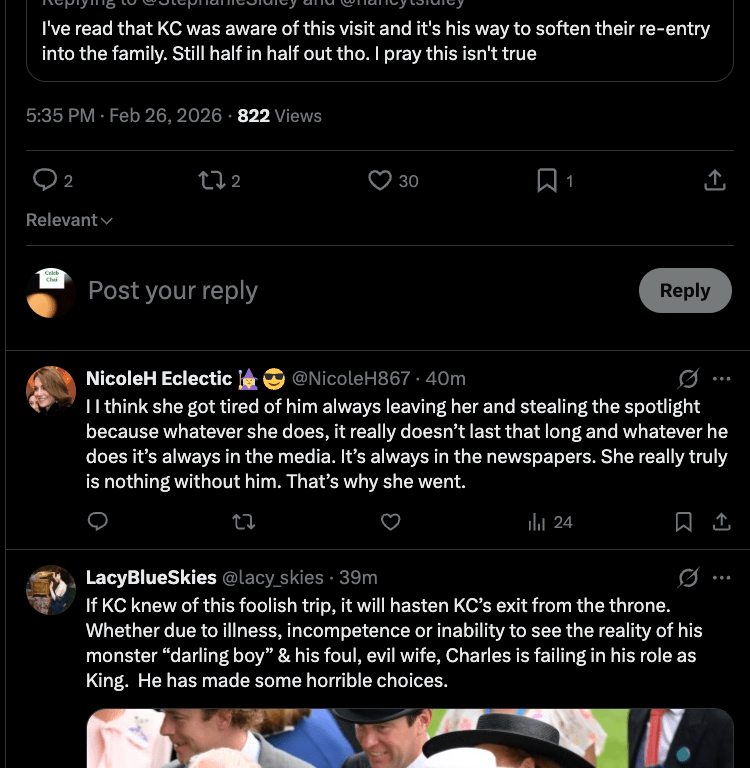
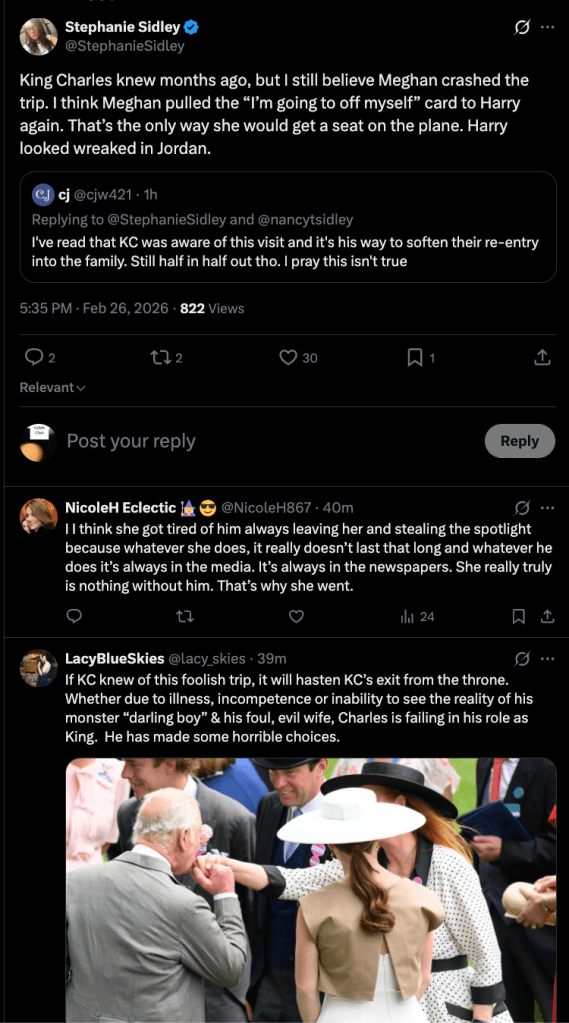
A mainstream press column does not complete its work the moment it is published. The column plants a frame. Social media waters it. By the time the frame has travelled through enough replies, quote tweets, and comment sections, it no longer feels like a media product. It feels like public opinion.
This is not an accident. It is a process. And it is worth examining in real time, because on February 26, 2026, we have an unusually clean example of it in operation.
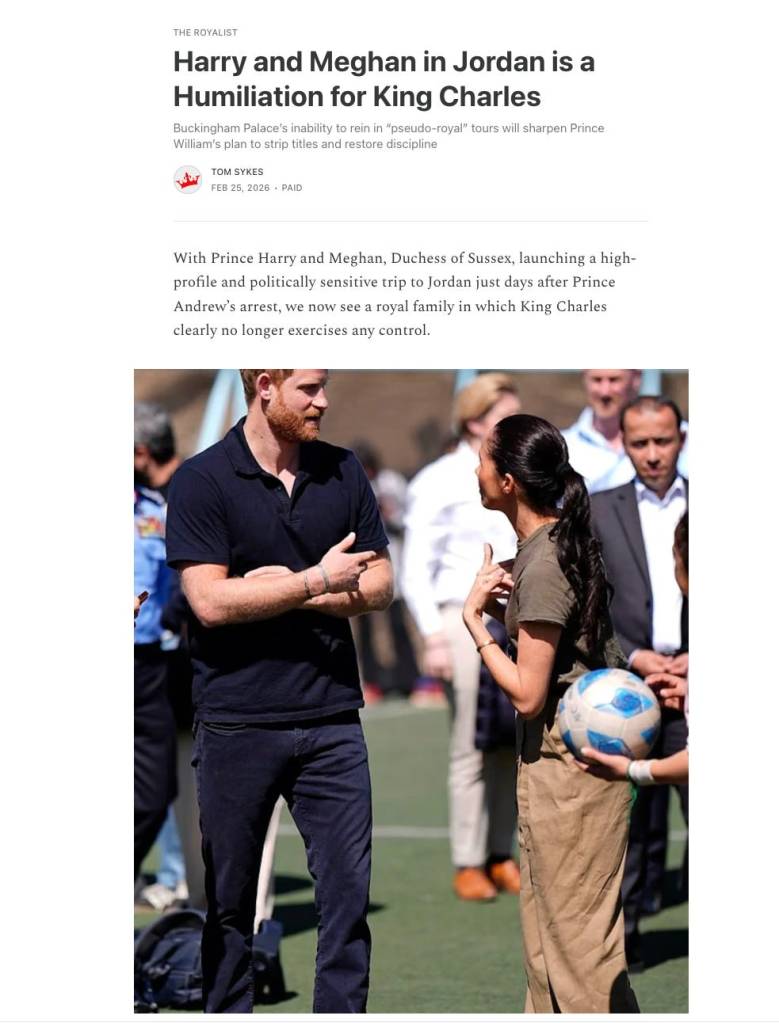
The Sykes column in The Royalist established the frame: Harry and Meghan’s WHO-coordinated, Palace-informed trip to Jordan is evidence of institutional chaos, quasi-royal overreach, and a monarchy in crisis. Within hours, the social media layer had absorbed the frame and was doing its secondary work, adding the domestic drama, the psychological speculation, and the personal contempt that a mainstream column cannot carry without legal or reputational risk.
Below are four comments from that secondary layer. They are worth reading carefully, not for what they say about Harry and Meghan, but for what they reveal about how the laundering process works.
The Four Comments
@lacy_skies · 1h King Charles knew months ago, but I still believe Meghan crashed the trip. I think Meghan pulled the ‘I’m going to off myself’ card to Harry again. That’s the only way she would get a seat on the plane. Harry looked wrecked in Jordan. |
| @cjw421 1h I’ve read that KC was aware of this visit and it’s his way to soften their re-entry into the family. Still half in half out tho. I pray this isn’t true |
| @NicoleH867 39m I think she got tired of him always leaving her and stealing the spotlight because whatever she does, it really doesn’t last that long and whatever he does it’s always in the media. It’s always in the newspapers. She really truly is nothing without him. That’s why she went. |
| @lacy_skies 38m If KC knew of this foolish trip, it will hasten KC’s exit from the throne. Whether due to illness, incompetence or inability to see the reality of his monster ‘darling boy’ and his foul, evil wife, Charles is failing in his role as King. He has made some horrible choices. |
Stage One: The Press Plants the Frame
Before examining the comments, it is worth being precise about what the Sykes column actually established. It did not allege wrongdoing. It did not produce evidence of harm. What it did was construct a frame in which a legitimate humanitarian trip became, by virtue of its framing, a problem requiring institutional correction.
The frame contained several load-bearing elements: the word ‘rogue,’ the phrase ‘quasi-royal,’ the pairing of the Jordan trip with Andrew’s arrest, and the repeated suggestion that the absence of Palace oversight was itself a form of disorder. None of these elements required proof. They required only repetition and a sympathetic reader.
Frames do not need to be believed to be effective. They need only to be available. Once a frame exists in published form, it becomes the vocabulary through which subsequent commentary operates, even commentary that appears to be independent.
The column does not tell its readers what to think. It tells them what to think about, and in what terms.
Stage Two: The Comments Do the Work the Column Cannot
Mainstream press operates under constraints. Legal risk, editorial standards, and reputational exposure mean that certain claims cannot be made in a published column without evidence. A columnist cannot write that Meghan threatened suicide to manipulate Harry into bringing her on a trip. A columnist cannot write that she is ‘foul’ and ‘evil.’ A columnist cannot assert that Meghan is ‘nothing’ without her husband.
Social media has no such constraints. And so the comment layer handles what the press layer cannot carry directly.
This is not a conspiracy. It does not require coordination. It requires only that the press provide a hostile enough frame that a certain kind of reader feels licensed to extend it. The frame provides the permission. The comments provide the content.
Comment One: The Suicide Card
The first comment performs the most complex operation of the four. It opens with a concession (‘King Charles knew months ago’) that appears to acknowledge the documented facts, then immediately pivots to a claim that requires no documentation whatsoever: that Meghan threatened suicide to secure a place on the trip.
This is a specific technique. The concession establishes the commenter as reasonable and informed, someone who accepts inconvenient facts. The pivot then uses that established credibility to carry a claim that would otherwise have no weight at all. Having acknowledged what is true, the commenter is implicitly asking the reader to extend the same trust to what is invented.
The suicide reference is doing additional work. It recycles a disclosure from the 2021 Oprah interview in which Meghan described experiencing suicidal ideation, and reframes it as a manipulation tactic. A mental health disclosure becomes, in this reading, a weapon Meghan deploys on demand. The clinical term for this rhetorical move is stigmatisation. It takes a statement about psychological suffering and converts it into evidence of bad character.
The comment requires Meghan to be simultaneously powerful enough to hijack an international diplomatic trip and so lacking in credibility that she needs a fabricated crisis to board a plane. These two characterisations cannot occupy the same person at the same time.
‘Harry looked wrecked in Jordan’ closes the comment by recruiting visual evidence. Photographs of a man visiting a refugee crisis are read as proof of domestic victimhood. Exhaustion at a humanitarian site becomes confirmation of a marriage in distress. The image does not show what the commenter says it shows. But the frame makes the interpretation feel inevitable.
Comment Two: Transparency as Suspicious
The second comment is, analytically, the most revealing of the four. The commenter has read that Charles knew about the trip in advance. This should, by any reasonable standard, be reassuring. The visit was coordinated, disclosed, and above board. The institution was informed.
The commenter finds this alarming.
Charles knowing about the trip becomes evidence of a secret reconciliation plot. Transparency becomes a cover for something more sinister. The ‘half in half out’ frame, which the institution itself rejected in 2020, is resurrected as a threat. The commenter closes with ‘I pray this isn’t true,’ performing distress about a documented and unremarkable fact.
This is the goalpost in motion. When the Sussex trip appeared to be unsanctioned, that was the problem. Now that it is sanctioned, the sanction itself is the problem. There is no version of this trip that the frame permits to be unproblematic. The frame is not responsive to facts. It precedes them.
A frame that cannot be satisfied by any evidence is not a frame about the facts. It is a frame about the subject.
Comment Three: The Zero-Sum Reading
The third comment advances a psychological explanation for Meghan’s presence on the trip: she went to Jordan because she is jealous of Harry’s media attention and cannot sustain relevance independently.
Set aside, for a moment, that the trip was a WHO invitation and not a personal initiative. The comment’s internal logic is worth examining on its own terms.
The commenter argues that Meghan is ‘nothing without him,’ that her independent projects ‘really don’t last that long,’ and that Harry’s work ‘is always in the media.’ This is the zero-sum reading: Harry’s success diminishes Meghan, and Meghan’s presence on his trips is therefore an act of competitive parasitism rather than partnership.
The difficulty is that this comment exists in the same ecosystem as comments arguing that Meghan controls Harry, directs his decisions, and exercises undue influence over his movements. In one reading she is nothing without him. In another she is the power behind everything he does. The two characterisations are mutually exclusive. The frame does not notice this because the frame’s function is not coherence. Its function is hostility, and hostility does not require a consistent theory of its subject.
It is also worth noting what the comment does not engage with: the actual content of the Jordan trip, the WHO’s stated reasons for the invitation, or the humanitarian situation that prompted the visit. The refugees in Jordan do not appear in the comment. They do not appear in any of the four comments. The people the trip was designed to help are entirely absent from the conversation about whether the trip was legitimate.
Comment Four: The Loyalist Escalation
The fourth comment is the escalation comment. Where the first three operate through insinuation and psychological speculation, the fourth moves to direct condemnation. Meghan is ‘foul’ and ‘evil.’ The trip is ‘foolish.’ Charles is ‘failing in his role as King’ for knowing about it.
The escalation comment serves a specific function in the secondary narrative ecosystem. It establishes the emotional ceiling: this is how strongly a committed member of this community feels about the subject. Subsequent commenters calibrate against it. Those who express milder views appear moderate and reasonable by comparison. The escalation comment does not persuade anyone. It anchors the emotional register of the conversation.
It is also worth noting what the ‘foolish trip’ label requires the commenter to believe. A two-day visit to Jordan, conducted at the invitation of the World Health Organisation, focused on the refugee crisis and the humanitarian impact of the Gaza war, is ‘foolish.’ The foolishness is asserted but not argued. What would a non-foolish trip look like? The comment does not say, because the comment is not actually about the quality of the trip. It is about the people who took it.
When the word ‘foolish’ is applied to a WHO-coordinated visit to a refugee crisis, the word is not describing the trip. It is describing the speaker’s relationship to its participants.
The Structural Pattern
Taken together, the four comments perform a recognisable sequence. It is worth naming the stages explicitly.
First, the press column establishes a hostile frame and provides the vocabulary: ‘rogue,’ ‘quasi-royal,’ ‘no chain of command,’ ‘chaos.’ The column does this within the constraints of mainstream journalism, which means it cannot make personal accusations, cannot allege specific misconduct without evidence, and cannot deploy the kind of language that would expose it to legal challenge.
Second, the social media layer absorbs the frame and removes the constraints. The vocabulary from the column (‘rogue trip,’ ‘institutional chaos’) licenses the social layer to extend the frame into territory the column could not enter: suicide manipulation, jealousy, evil, foolishness, parasitism. None of these extensions require evidence because they are presented as the reader’s own independent conclusions rather than as claims requiring substantiation.
Third, the extensions travel. They appear in comment sections, in reply threads, in quote tweets. They are picked up by other commenters who did not read the original column and have no idea they are operating within a frame that was constructed elsewhere. By the time the narrative reaches its third or fourth generation of circulation, it feels like widespread public sentiment rather than the downstream product of a single piece of institutional journalism.
Fourth, the widespread sentiment is noted. Future press coverage can now reference ‘public concern’ about the Sussexes, ‘questions being asked’ about Meghan’s influence, ‘observers noting’ Harry’s apparent distress. The social media layer has produced the evidence that the press layer cites as independent confirmation of its original frame.
This is the loop. The press produces the frame. Social media produces the sentiment. The press cites the sentiment as evidence. The frame strengthens. The next column arrives.
What Is Absent from All Four Comments
A useful analytical exercise when examining a cluster of comments like this one is to note not only what is present but what is systematically absent.
The WHO’s stated reasons for the invitation are absent. The humanitarian situation in Jordan is absent. The refugee crisis that prompted the visit is absent. The documented advance notification to Buckingham Palace is absent from three of the four comments, and present in the fourth only as a source of suspicion.
Prince Andrew’s arrest, which occurred days before the trip and which represents the most serious institutional crisis the monarchy has faced in modern times, is absent from all four comments. The question of what the Palace knew about Andrew’s conduct and when is absent. The decades of institutional protection extended to Andrew while he was, by all available evidence, doing considerably worse things than visiting refugee camps with the WHO, is absent.
This systematic absence is not random. It reflects the frame’s function. The frame is not designed to produce a complete picture of the situation. It is designed to produce a particular picture of two specific people. Everything that does not contribute to that picture is excluded, not by decision, but by the logic of the frame itself.
What a frame excludes is as revealing as what it includes. These four comments, between them, manage to discuss a humanitarian crisis without once mentioning the humans experiencing it.
A Note on Good Faith
It would be easy to read this analysis as an accusation that everyone operating in this comment ecosystem is acting with conscious malice or deliberate coordination. That is not the argument.
Most people who share frames do not know they are sharing frames. They believe they are forming independent opinions. The frame feels like their own conclusion because they encountered it at the point where it had already been naturalised, where it was no longer a product of institutional journalism but simply the way the situation was understood.
This is what makes the secondary narrative layer effective. It does not require bad faith participants. It requires only participants, people willing to engage, to react, to extend, to share. The frame does its work through normal human social behaviour: the desire to have an opinion, to be part of a conversation, to understand a complicated situation in terms that feel stable and legible.
The four commenters quoted above almost certainly believe what they wrote. That is not evidence that what they wrote is accurate. It is evidence that the frame is working.
Conclusion
On February 26, 2026, a WHO-coordinated, Palace-informed humanitarian visit to Jordan by two private individuals became, within hours, a social media narrative about suicide manipulation, jealousy, foolishness, and a failing king.
No new facts entered the conversation between the trip’s announcement and the appearance of these comments. The trip itself did not change. The WHO did not revise its invitation. The Palace did not withdraw its acknowledgment. The refugees in Jordan remained in the same situation they had been in before Harry and Meghan arrived.
What changed was the frame. And the frame changed because a column deployed specific vocabulary, established a specific emotional register, and made specific associations that the social media layer was then able to develop, extend, and amplify into what now presents itself as organic public concern.
Understanding this process is not the same as dismissing the concerns of every person who expresses them. People can hold genuine views that have been shaped by frames they did not choose and cannot see. The point of naming the process is not to invalidate the people inside it. It is to make the process visible to those who are not.
Because once you can see the frame, you can ask the question the frame was designed to prevent: what is not being talked about, and why.
In this case, the answer is straightforward. Prince Andrew has been arrested. The institution that protected him for decades is in the most serious crisis of its modern existence. And we are discussing whether Meghan crashed a plane.
Celeb Chai publishes analysis of media coverage patterns and narrative construction in celebrity and institutional journalism. Comments quoted are from public social media posts dated February 26, 2026.
 celebchai.com