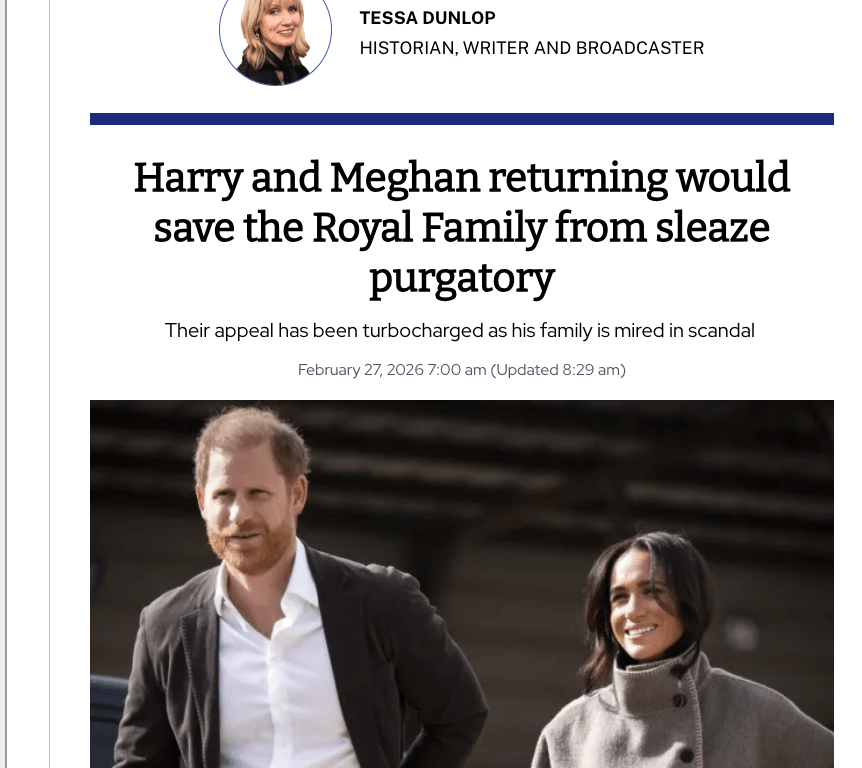
Recent commentary arguing that Prince Harry and Meghan Markle should return to the royal fold in order to help stabilize the monarchy raises an obvious question: what exactly would be in it for them?
The argument, as presented by Tessa Dunlop and others, is that the British monarchy is currently struggling with reputational damage. Scandals surrounding various members of the institution have eroded public trust, and commentators are increasingly suggesting that reconciliation with Harry and Meghan could provide a visible reset. A public reunion, a symbolic olive branch, perhaps even cooperation around future events such as the Invictus Games are framed as potential ways to restore credibility.
From the monarchy’s perspective, that logic is understandable. Harry and Meghan remain globally popular figures who attract significant media attention. Their humanitarian work, their partnerships with international organizations, and their independent philanthropic initiatives provide positive optics that the institution sometimes lacks during periods of controversy. A moment of reconciliation could generate powerful imagery: family unity, generational renewal, and the appearance that past conflicts have been resolved.
But that analysis largely considers the needs of the monarchy. It rarely considers the incentives for Harry and Meghan themselves.
When weighing the issue seriously, the advantages to them are limited.
First, Harry and Meghan have already achieved the central goal that motivated their departure: independence. Since leaving royal duties, they have built their own philanthropic platform, launched creative and media projects, and established a life outside the constraints of palace management. Returning to the royal orbit in any meaningful sense would likely reintroduce the very structures they chose to leave behind.
Second, autonomy has been central to their post-royal identity. As working royals they were subject to strict institutional control over messaging, finances, and public activity. That structure is designed to protect the monarchy as an institution rather than to empower individual members of the family. Their current position allows them to pursue causes, partnerships, and public statements without navigating palace approval or internal royal politics.
Third, remaining outside the institution gives them a unique strategic position. They retain global recognition as members of the royal family while operating independently from it. This hybrid status allows them to maintain influence without bearing responsibility for the institution’s controversies or internal conflicts.
There are, of course, potential benefits to reconciliation. Improved family relationships would undoubtedly reduce tension and could bring personal relief after years of public conflict. A limited détente might also calm media hostility in the United Kingdom and make certain joint appearances less politically fraught. Cooperation on specific charitable initiatives could be mutually beneficial.
However, those advantages do not necessarily require a return to the royal fold. Reconciliation and institutional reintegration are very different things.
The larger problem with commentary like Dunlop’s is the framing. Articles that argue Harry and Meghan should come back so the monarchy can repair its reputation implicitly treat them as instruments of institutional rehabilitation. The underlying message is not that reconciliation would benefit everyone involved, but that their presence could help rescue the monarchy from its current reputational crisis.
That is an unfair premise.
Harry and Meghan are not a reputational clean-up crew for the royal family. They are individuals who made a deliberate decision to build an independent life after years of conflict with both the institution and the media ecosystem surrounding it. Their current work demonstrates that meaningful public service and philanthropy can exist outside royal structures.
If reconciliation eventually happens, it should occur because it serves the people involved, not because commentators believe the monarchy needs a public relations reset.
Until then, it may be more productive for observers to recognize the obvious reality: Harry and Meghan have already moved on. And they appear to be doing quite well on their own terms.
 celebchai.com