Russell Myers’ book William & Catherine: The Intimate Inside Story drops on March 10. The pre-release excerpts are already circulating, and they tell you everything you need to know about what this book is and what it is for.
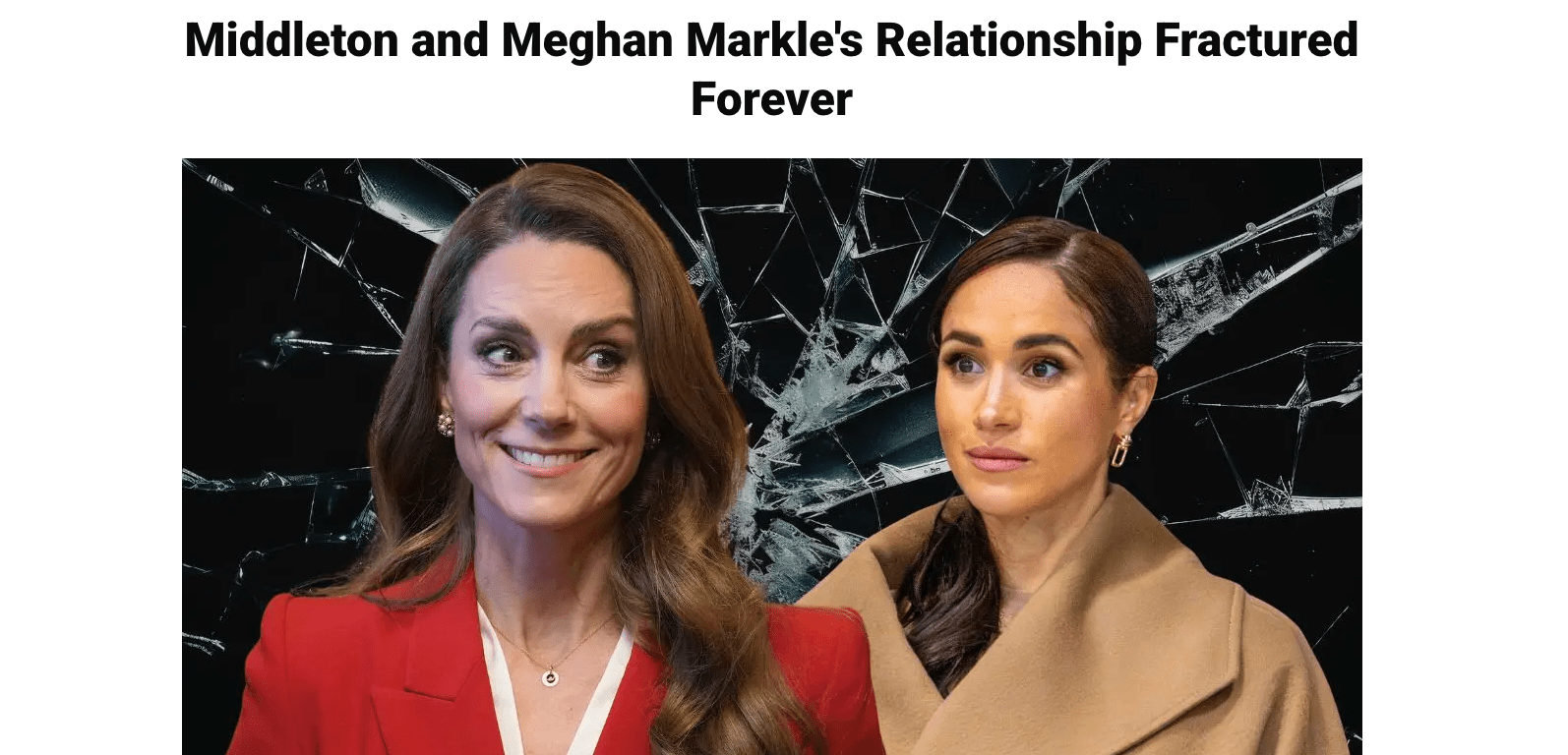
Radar Online ran an “exclusive” this week promising to reveal “the exact moment Kate Middleton and Meghan Markle’s relationship fractured forever.” The framing suggests investigative depth, a pinpointed rupture, a specific event that can be examined and evaluated. What the article actually delivers is a sequence of anonymous quotes from sources close to William and Catherine, arranged to produce a single conclusion: Catherine was reasonable, Meghan was abrasive, and Harry became paranoid.
Not one source in the article speaks from Harry or Meghan’s perspective. Not one. Every quote, every characterization, every emotional descriptor flows from the institutional side. This is not presented as a limitation. It is not flagged as a gap. It is presented as the story.
The Staff Narrative as Substitution
The centerpiece of the excerpt is the claim that Meghan’s treatment of palace staff was the catalyst for the rift between the couples. Myers writes that Catherine and William “cared about” the staff, and that Meghan and Harry’s “attitude towards palace staff” set the couples on “an entirely different course.”
This framing does something very specific. It takes a story that, in Harry and Meghan’s telling, involves institutional racism, a denied request for help during a mental health crisis, hostile tabloid briefings sourced from within the palace, and a family member raising concerns about the skin color of an unborn child, and replaces all of it with an HR dispute. The melanin question vanishes. The suicidal ideation vanishes. The tabloid coordination vanishes. In their place: staff were unhappy, and Catherine noticed.
The staff treatment allegation is not new. It surfaced in 2018, was investigated internally, and the results were never published. It has since been deployed in every cycle where the institutional narrative requires reinforcement. It functions as a permanent trump card: whatever Harry and Meghan say happened to them, the response is that they were difficult to work for. The personal grievance is always subordinated to the professional one. The institution’s employees matter. The institution’s targets do not.
The Psychological Profile
The most revealing passage in the excerpt is the characterization of Harry attributed to a source close to William. The source says William felt that Harry “became paranoid, angry, obsessive, and firmly rooted in the past.”
Read those words carefully. Paranoid. Angry. Obsessive. Rooted in the past. This is not the language of a brotherly disagreement. This is a clinical vocabulary deployed to pathologize a person’s perspective. If Harry is paranoid, then his belief that the institution briefed against his wife is a symptom, not an observation. If he is obsessive, then his refusal to drop legitimate grievances is a disorder, not persistence. If he is rooted in the past, then the things that happened to him have an expiration date, and the institution gets to decide when that date arrives.
The source also says “there was a lot of love and support available for Harry,” a sentence that directly contradicts Meghan’s testimony that her request for mental health support was denied and Harry’s account that his family refused to engage with his concerns. But the contradiction is never acknowledged. The institutional version is stated as fact. The Sussex version does not exist in this article’s universe.
The Catherine Construction
Catherine is drawn with precision throughout. She “has always favored reason over conflict.” She was “brought up in a household that resolved differences with dialogue rather than by bearing grudges.” She “saw the inevitability of the parting of ways.” She had “three young children, who were her focus.”
Every sentence is engineered to produce a specific image: a woman who is calm, reasonable, maternal, and reluctantly resigned to a situation created entirely by someone else. Catherine does not act in this narrative. She observes. She hopes. She focuses on her children. She is the still point around which Meghan’s chaos orbits.
This is not characterization. It is iconography. Catherine is being written as the institution’s ideal woman: patient, silent, long-suffering, and blameless. The construction requires Meghan to be her opposite in every dimension: loud, aggressive, selfish, and culpable. The two women are not being compared. They are being cast in a morality play where the roles were assigned before a single word was written.
The Timing
Myers’ book arrives on March 10. The excerpts landed in the same news cycle as the As Ever/Netflix split, the Scobie interview about Harry’s repeated attempts to reach William, the Callahan “viper” tirade about Jordan, and the Australia trip announcement. This is not coincidence. This is counter-programming.
Every time the Sussexes generate positive coverage or sympathetic framing, the institutional response follows within days. The Jordan trip produced humanitarian imagery that contrasted sharply with the Andrew scandal. The response: Myers excerpts reminding everyone that Meghan was difficult and Harry is paranoid. The Scobie interview positioned Harry as the one reaching out. The response: Myers’ sources positioning William as the one who was betrayed. The As Ever split was reported as a founder taking ownership of a growing brand. The response: a media cycle that reframes every Sussex story as evidence of dysfunction.
Myers is the same journalist whose coverage of William’s Saudi Arabia trip was buried under the Andrew/Epstein news cycle. His book is a second attempt to deliver the institutional narrative under more controlled conditions, timed to a publication date rather than a news event that can be overtaken.
What the Book Is For
This book is not an investigation. It is a delivery system. It exists to place the institutional version of events into the public record through a credible-seeming vessel: a royal journalist with years of access, writing in measured tones, citing sources who are close to but never named as the principals.
The sources are doing what sources always do in access journalism. They are trading proximity for narrative control. They speak on condition of anonymity, which means they cannot be challenged. They characterize Harry and Meghan’s internal states, intentions, and motivations without those characterizations ever being tested against the people being described. The result is a book-length version of the pattern that has operated since 2018: the institution tells its story through intermediaries, the intermediaries present it as reporting, and the public receives it as truth.
The question is not whether the staff complaints happened or whether William felt betrayed. The question is why this is the only story being told, why it is being told now, why it arrives from one direction only, and why the version of events that includes racism, mental health crises, and tabloid coordination is treated as the one that requires skepticism while the version that includes unnamed sources saying Catherine was reasonable and Harry was paranoid is treated as the one that requires none.
 celebchai.com