By Aparna Vashisht-Rota | Celeb Chai
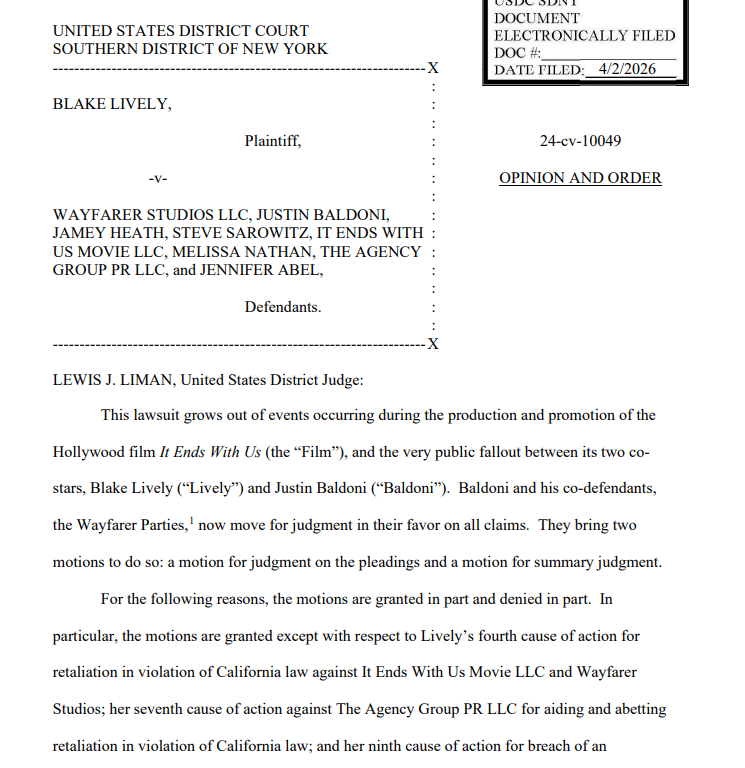
Judge Lewis J. Liman’s 152-page ruling in Lively v. Wayfarer Studios, issued today from the Southern District of New York, granted the defendants’ motions for judgment on the pleadings and summary judgment on ten of Blake Lively’s thirteen causes of action. That is what the headlines will say. The headlines will be wrong about what it means.
The three claims that survived are the contractual and statutory core of Lively’s case. They send the retaliation narrative to a jury. They preserve Lively’s theory that the Wayfarer Parties launched a coordinated campaign to destroy her reputation because she reported sexual harassment on set. And they do so on the strength of evidence the court found sufficient to create genuine disputes of material fact on every required element.
Here is what survived, what it means, and why it matters more than what was dismissed.
The FEHA Retaliation Claim (Fourth Cause of Action)
California’s Fair Employment and Housing Act prohibits retaliation against “any person” who reports workplace harassment. That word, “any person,” is the reason this claim lives while the federal Title VII claim died.
The Wayfarer Parties spent considerable resources arguing that Lively was an independent contractor, not an employee. The court agreed, and that classification killed both the Title VII retaliation claim and the California Labor Code Section 1102.5 whistleblower claim. But FEHA’s anti-retaliation provision is deliberately broader. It protects any person, not just employees. The Wayfarer Parties did not even attempt to challenge the FEHA claims on independent contractor grounds. The court noted this explicitly.
On the merits, the court found triable issues of fact on all three elements of the FEHA retaliation claim: protected activity, adverse employment action, and causation.
On protected activity, there is no serious dispute. Lively sent a formal “Protections for Return to Production” letter through her attorney in November 2023 listing seventeen items that needed to be addressed before she would return to set. That letter and the January 2024 meeting at her apartment constitute textbook protected activity under FEHA.
On adverse action, the court catalogued evidence that the Wayfarer Parties engaged a crisis communications apparatus involving Melissa Nathan, Jennifer Abel, Jed Wallace, and their respective firms. The record includes evidence of plans to amplify negative content about Lively, pitch damaging stories to the Daily Mail, boost videos criticizing her, and place what one participant described as “all kinds of garbage” in traditional media outlets. The court found that “a jury could find that these efforts were proactive and in line with Baldoni’s desire ‘to feel like [Lively] can be buried.'”
On causation, the court rejected the defendants’ argument that the time gap between Lively’s protected activity and the alleged smear campaign defeated her claim. California law imposes no “requisite temporal proximity.” What matters is “conduct consistent with a retaliatory intent.” The court found that a jury could reasonably infer that the Wayfarer Parties “waited to exact their retaliation at an opportune time,” specifically after the film was released and they no longer needed Lively’s cooperation.
The court’s language on this point is worth noting. After Lively raised her complaints, Baldoni felt “angry,” “furious,” and “embarrassed.” But the Wayfarer Parties still needed her to finish the film. Once it was released, that constraint disappeared. The inference is straightforward: the motive existed before the opportunity did.
The Contract Rider Agreement Breach (Ninth Cause of Action)
The second surviving claim may be the cleanest. Paragraph 10 of the Contract Rider Agreement states: “There shall be no retaliation of any kind against Artist for raising concerns about the conduct described in this letter.”
The defendants threw four arguments at this claim. The court rejected all four.
First, they argued the CRA lacked consideration. The court found that Lively’s agreement to return to set after the SAG-AFTRA strike was valid consideration because her obligation to do so was “at least doubtful or subject to an honest dispute.” The Offer Letter required only six consecutive weeks of principal photography. After the strike disrupted the schedule, her duty to return on a different timeline was genuinely uncertain.
Second, they argued the CRA was unenforceable because it referenced the Actor’s Loanout Agreement, which was never executed. The court found the CRA “carried independent and binding force.” Its reference to the ALA meant only that if the ALA were ever signed, the CRA would be incorporated into it and not superseded. The CRA was not contingent on the ALA. The parties’ own conduct confirmed this: both sides performed under the CRA while still negotiating the ALA.
Third, they tried to import the ALA’s notice-and-cure provision into the CRA, arguing Lively couldn’t claim breach without first giving written notice and thirty days to cure. The court held that because the CRA is the only agreement, and no notice-and-cure provision appears in the CRA, Lively is not bound by a term she never agreed to. The court’s analysis here was pointed: the parties “did not effect a wholesale adoption of the ALA through the backdoor of the CRA.”
Fourth, they argued Lively couldn’t prove damages. The court found this premature and left it for trial, noting that Lively’s damages theories, including lost profits to her businesses, are better addressed through motions in limine rather than summary judgment.
Aiding and Abetting Retaliation Against TAG (Seventh Cause of Action)
The third surviving claim targets The Agency Group PR LLC. While the court granted summary judgment to Nathan and Abel individually (because individual nonemployers cannot be held personally liable for aiding and abetting under FEHA per Reno v. Baird and Jones v. Lodge at Torrey Pines), it carved out TAG as a business entity.
Under Raines v. U.S. Healthworks Medical Group (Cal. 2023), business-entity agents with five or more employees can be held directly liable under FEHA. The court found “at least some reason to believe” that aiding and abetting liability extends to such entities as well. Because the parties had not briefed this distinction adequately, the court withheld judgment and denied the motion without prejudice.
TAG is the entity through which the alleged smear campaign was operationalized. Its survival as a defendant means the jury will hear evidence about how the crisis communications infrastructure actually functioned.
What the Dismissals Actually Mean
The ten dismissed claims fell to threshold legal issues, not factual weakness.
The Title VII and Labor Code claims died because Lively was classified as an independent contractor. The court conducted a thorough multi-factor analysis and found that IEWUM did not control the “manner and means” of Lively’s work in the way required for employee status under federal common law. This is a classification question, not a credibility finding.
The defamation and defamation per se claims were dismissed because the allegedly defamatory statements were either non-actionable opinion, not “of and concerning” Lively by name, or protected under New York’s fair report privilege. The court also found that many of the challenged statements were too vague to be provably false.
The false light claim failed on choice of law. The court applied New York law, and New York does not recognize the tort of false light invasion of privacy.
The harassment claims under both Title VII and FEHA were dismissed on the merits after the court found the alleged conduct, while inappropriate, did not rise to the level of severe or pervasive harassment sufficient to alter the conditions of employment.
The ALA breach of contract claim failed because Lively did not comply with the agreement’s notice-and-cure provision before asserting breach.
The failure to prevent harassment claim under FEHA failed as a derivative claim because the underlying harassment claim was dismissed.
The civil conspiracy claims failed because the underlying torts they depended on were dismissed, and the court found that conspiracy cannot be used to circumvent FEHA’s carefully drawn limitations on aiding and abetting liability.
None of these dismissals touch the factual record supporting retaliation. The evidence of the crisis communications campaign, the planned amplification of negative content, the retaliatory motive, all of that remains intact and goes to trial on the surviving claims.
What Happens Next
Blake Lively goes to trial against IEWUM, Wayfarer Studios, and TAG on three claims: FEHA retaliation, aiding and abetting FEHA retaliation, and breach of the Contract Rider Agreement. The jury will decide whether the Wayfarer Parties launched a coordinated campaign to damage Lively’s reputation and career in retaliation for her reporting sexual harassment.
The defendants will argue that their public relations response was a legitimate exercise in reputation management unrelated to Lively’s protected activity. The court acknowledged this possibility. But it also found that “retaliatory intent is not an all or nothing matter” and that a jury could find the Wayfarer Parties were motivated by Lively’s protected activity even if other motivations also existed.
The pending spoliation motion regarding the Wayfarer Parties’ use of Signal for ephemeral messaging has not yet been decided. The court noted in a footnote that “there are triable issues with respect to retaliation regardless,” but the spoliation question could further strengthen Lively’s position at trial.
This case is not over. The part that matters most is just beginning.
 celebchai.com