Stop Calling It “97% My Movie” — You’re Just Mad She Said No

Justin Baldoni’s complaints about Blake Lively in “It Ends With Us” reflect issues of control and ego rather than artistic loss. Despite his praise for her involvement, he reacted negatively when she asserted ownership over her contributions. This public airing of grievances seems more like retaliation than genuine concern for the film. Continue reading Stop Calling It “97% My Movie” — You’re Just Mad She Said No

Motion to dismiss filed by Jonesworks LLC

Jonesworks LLC has filed a motion to dismiss Jennifer Abel’s indemnification claim amidst allegations from Blake Lively of harassment and defamation. The motion argues Abel acted outside her employment scope and breached her contract, excluding indemnification. However, contentious tone and factual disputes about her role could complicate the dismissal process. Continue reading Motion to dismiss filed by Jonesworks LLC

No More Time? Lively and Sloane Parties Slam Wayfarer’s Request to Delay Discovery and Amend Their Claims

The dispute in Lively v. Wayfarer centers on the Wayfarer Parties’ request for extensions to amend their case amid extensive discovery demands, including over 1,600 document requests. Blake Lively and Ryan Reynolds oppose this, accusing Wayfarer of delaying accountability. Meanwhile, Leslie Sloane’s team argues Wayfarer fails to substantiate their claims. Continue reading No More Time? Lively and Sloane Parties Slam Wayfarer’s Request to Delay Discovery and Amend Their Claims

Blake Lively’s Legal Counterattack: Breaking Down Her Scathing Reply to Wayfarer Studios’ Defamation Suit

Blake Lively’s response to Wayfarer Studios’ $400 million defamation lawsuit challenges the claims against her, labeling them a PR stunt. Her attorneys argue that the case lacks specific actionable statements and invoke legal protections for her comments regarding harassment. Lively seeks full dismissal, asserting that the suit undermines victim protections and free speech. Continue reading Blake Lively’s Legal Counterattack: Breaking Down Her Scathing Reply to Wayfarer Studios’ Defamation Suit

Ryan Reynolds to Baldoni: Dimissed

Ryan Reynolds’ Motion to Dismiss Reply

Ryan Reynolds’ recent reply supports his motion to dismiss the $400 million lawsuit by Justin Baldoni and Wayfarer Studios. He dismantles the claims, emphasizing the lack of specific statements, damages, and proximate cause. His arguments highlight that suing over hurt feelings lacks legal validity, ultimately seeking attorney fees under New York’s anti-SLAPP statute. Continue reading Ryan Reynolds’ Motion to Dismiss Reply

Blake’s Motion to Dismiss Wallace; Impressive Legal Work

On April 7, 2025, Blake Lively’s legal team filed a motion to dismiss a defamation lawsuit by Jed Wallace and Street Relations, Inc., arguing lack of jurisdiction and improper venue. They assert that the claims are baseless, focusing on the procedural aspects and previous litigation in New York, while challenging Wallace’s credibility and damages claims. Continue reading Blake’s Motion to Dismiss Wallace; Impressive Legal Work

Let Blake Lively Live: Why Joy Isn’t a Crime—Even in a Legal Battle

Blake Lively faces backlash for smiling and engaging with customers at a Connecticut donut shop amid serious legal accusations against director Justin Baldoni and others for sexual harassment. Critics label her behavior as disingenuous, reflecting a societal double standard. Lively, as the plaintiff, should not be forced to hide her joy while confronting such challenges. Continue reading Let Blake Lively Live: Why Joy Isn’t a Crime—Even in a Legal Battle

NYT Motion to Dismiss Baldoni/Wayfarer is fully briefed

The ongoing lawsuit involves Blake Lively, Justin Baldoni, Wayfarer Studios, and The New York Times concerning the film “It Ends With Us.” Key issues include allegations of false reporting and defamation. The New York Times seeks dismissal based on fair reporting privilege, while Wayfarer argues the article exceeded this protection. Continue reading NYT Motion to Dismiss Baldoni/Wayfarer is fully briefed

Analysis of Jamey Heath’s Legal Defense: Strongest and Weakest Points

Jamey Heath’s response to Blake Lively’s complaints includes strong denials, particularly against a “retaliation campaign,” and seeks to challenge mischaracterized communications. However, weaknesses arise from excessive claims of insufficient knowledge and lack of supporting evidence. Improving the defense requires providing evidence, clarifying admissions, and minimizing reliance on knowledge claims. Continue reading Analysis of Jamey Heath’s Legal Defense: Strongest and Weakest Points

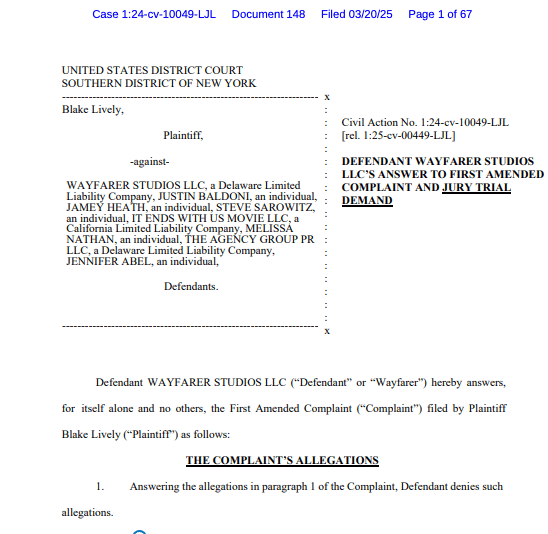
Analysis of Wayfarer Studios’ Legal Defense: Strongest and Weakest Points

Wayfarer Studios’ defense against Blake Lively’s complaint features strong categorical denials and disputes over the plaintiff’s claims. However, it struggles with excessive reliance on insufficient knowledge assertions and partial admissions lacking context. To improve, the studio must provide supporting evidence, clarify admissions, and minimize knowledge claims to bolster their position. Continue reading Analysis of Wayfarer Studios’ Legal Defense: Strongest and Weakest Points