Wake Up Dead Man: A Knives Out Mystery positions itself as the darkest and most morally charged entry in Rian Johnson’s Benoit Blanc series. Set in a cloistered religious community and built around an “impossible crime,” the film gestures toward questions of faith, accountability, truth, and the human instinct to protect power even in the face of harm. On paper, it is a natural evolution for the franchise. In execution, however, the film is compromised by a casting decision that directly contradicts the values it claims to interrogate.

Daniel Craig remains effective as Benoit Blanc, anchoring the story with weary intelligence and moral seriousness. The mystery itself, involving the murder of a monsignor during a Good Friday service and the swift scapegoating of a younger priest, is tightly constructed and atmospherically unsettling. Johnson’s affection for locked-room puzzles and John Dickson Carr–style impossibilities is evident, and the film is technically assured.
Yet Wake Up Dead Man repeatedly asks the audience to think about who is believed, whose character is defended, and how institutions close ranks when faced with allegations of wrongdoing. That makes the presence of Mila Kunis not incidental but actively corrosive.
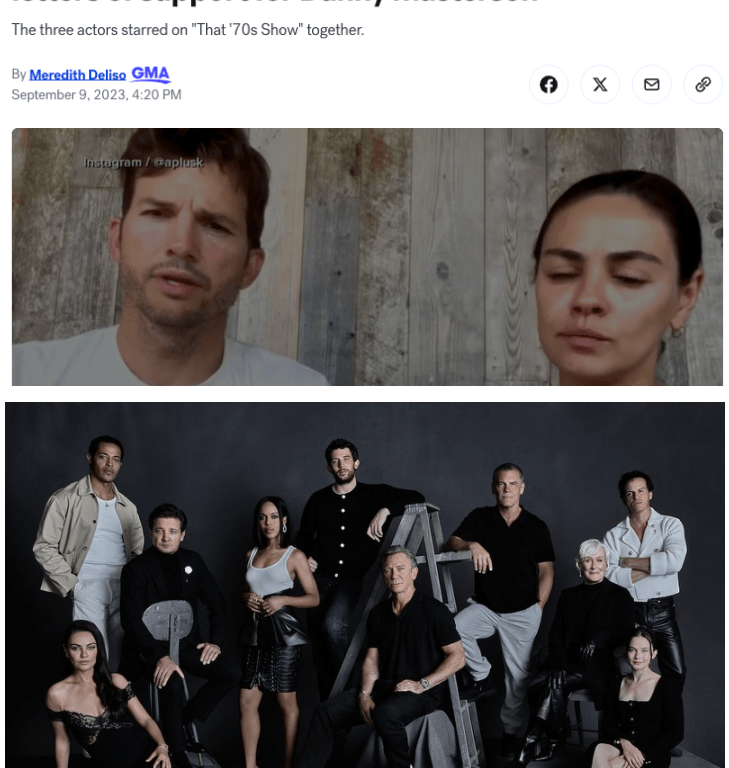
Kunis appears in the film months after she publicly supported Danny Masterson through a character letter submitted at his sentencing, calling him a role model and praising his “innate goodness” despite his conviction for raping two women. That letter was written after sworn testimony detailing the assaults. The subsequent apology issued by Kunis and Ashton Kutcher acknowledged “pain caused” but centered intent over impact, never fully reckoning with how defending a convicted rapist at sentencing functions to minimize victims and rehabilitate perpetrators.
This context matters. Wake Up Dead Man is not a frivolous comedy. It is a story about moral failure, silence, and the dangers of prioritizing reputation over truth. Asking audiences to set aside Kunis’s real-world actions in order to engage with those themes is not reasonable. Her casting collapses the film’s moral coherence. When a movie about accountability includes an actor who has demonstrably used her influence to shield a convicted rapist from consequences, the dissonance is impossible to ignore.
This is not about purity tests or demanding perfection from artists. It is about lines. Writing a character letter urging leniency for a convicted rapist, praising his character while victims are still seeking justice, crosses a line. Continuing to cast and promote that actor as though nothing happened is a choice, and it is one that signals whose harm is considered acceptable collateral.
The Knives Out series has thrived in part because it understands power and hypocrisy. Previous entries skewered wealthy families, tech billionaires, and social elites who believed themselves untouchable. Wake Up Dead Man aims to extend that critique into religious and moral authority. But the film cannot convincingly condemn institutional protection of wrongdoing while participating in celebrity protectionism off-screen.
Mila Kunis should be canceled in the literal sense of the word: her platform should be withdrawn. Not because of an impulsive tweet or a misphrased comment, but because she used her status to advocate for a man convicted of violent sexual crimes. Cancellation is not erasure or exile; it is accountability. It is the industry deciding that some actions disqualify you from being centered, celebrated, or rewarded with prestige roles.
Wake Up Dead Man is a well-made mystery with strong performances elsewhere in the ensemble, including Josh O’Connor, Glenn Close, and Kerry Washington. Daniel Craig remains compelling, and Rian Johnson’s command of genre is intact. But the film arrives burdened by a contradiction it never resolves. It wants to explore the cost of moral failure while asking audiences to overlook a very real one.
In the end, Wake Up Dead Man does not fail because of its plot. It fails because it underestimates viewers’ ability to connect art to reality. When a film about truth ignores the truth surrounding its own cast, the mystery stops being fictional. The answer becomes obvious, and deeply unsatisfying.
 celebchai.com