What began as a Reddit relationship update has turned into something much darker, and much more familiar, for anyone who has watched royal obsession metastasize online. A man describing the breakdown of his marriage never named the celebrity at the center of his wife’s fixation. He didn’t have to. The comment section knew immediately. Meghan Markle.
That instant recognition is the story.
Readers clocked it within minutes because the pattern has become unmistakable. Obsessive hatred framed as “gossip.” Endless scrolling justified as “staying informed.” Racial resentment repackaged as moral outrage. And, eventually, behavior that spills out of the screen and into real life.
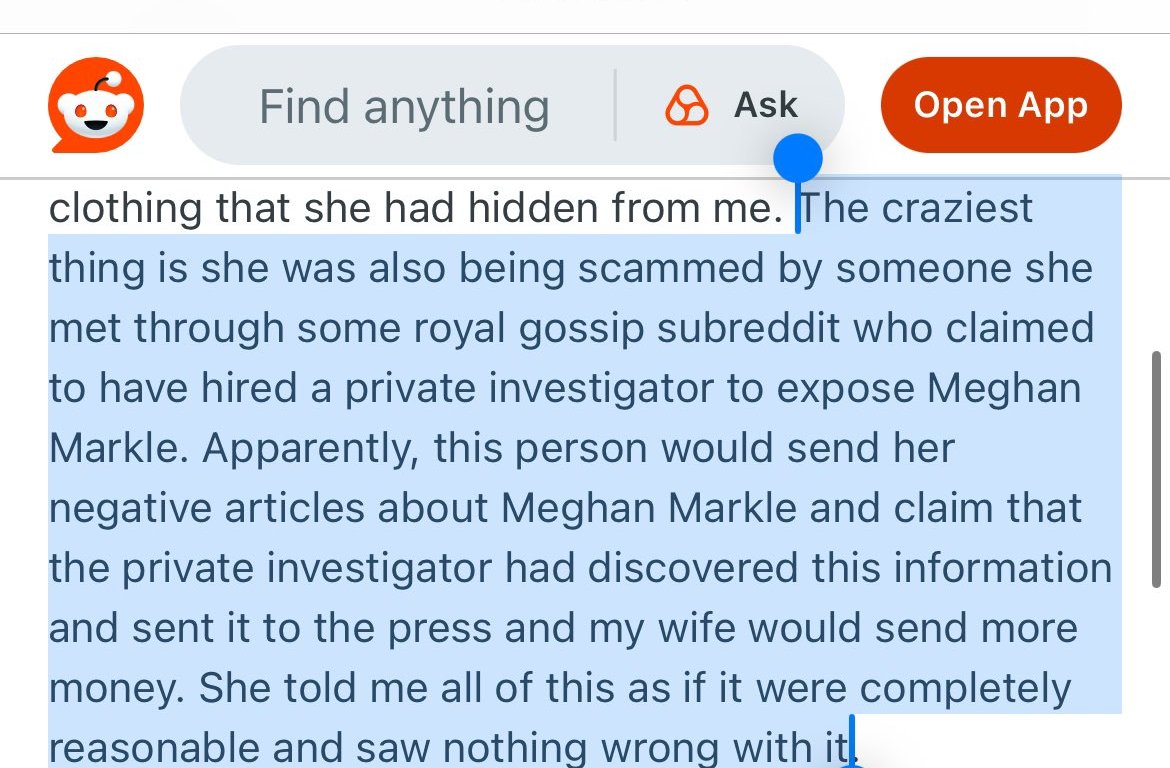
The most chilling detail appears almost casually in the update and is now circulating in screenshots: the wife had been sending money to a stranger she met through a royal gossip subreddit. This person claimed to have hired a private investigator to “expose” Meghan Markle, forwarding negative articles and insisting the information had been passed to the press. Each message prompted more payments. When confronted, she described the entire arrangement as completely reasonable.
This is not fandom. This is not curiosity. This is cult behavior.
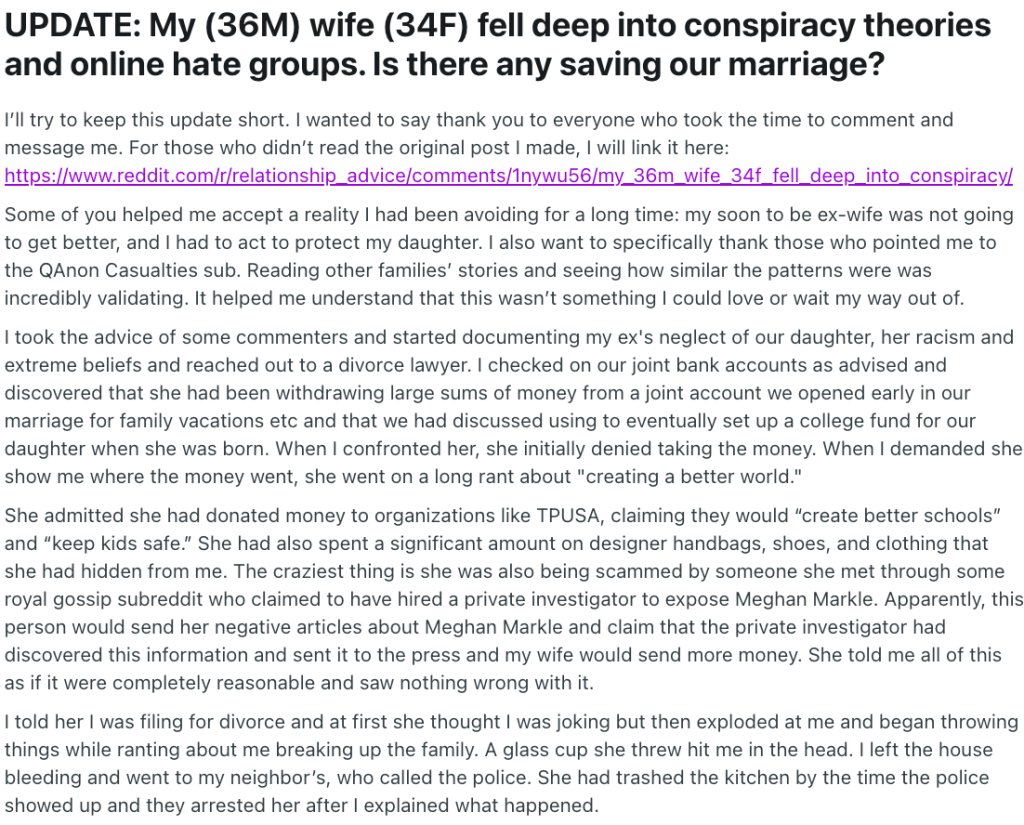
The reactions captured the collective shock in real time. People weren’t just disturbed by the scam itself, but by how seamlessly it fit into the belief system. No job. Drained joint accounts. Money wired to strangers for recycled tabloid narratives. All of it justified by the conviction that something secret, sinister, and world-altering was being uncovered. That conviction is what makes royalism dangerous in its current form.
Royal obsession online now operates with all the familiar features of a grievance cult. There is a fixed moral universe, complete with saints and villains. There is an “insider” class that claims to see through media lies. There is constant reinforcement through algorithm-fed outrage. And there is an ever-expanding justification for cruelty, because the target has been stripped of humanity.
Meghan Markle is uniquely effective as a focal point because contempt for her has been normalized. Entire communities exist where attacking her is treated as analysis, humor, or accountability. Racism slips in under the cover of respectability. Jealousy masquerades as concern. Hatred becomes communal bonding. Once someone is fully immersed, the obsession no longer feels like obsession. It feels like purpose.
That is why scams flourish in these spaces. A person already primed to believe the press is corrupt and that “truth” must be smuggled out by anonymous insiders is the perfect mark. The fake private investigator doesn’t register as absurd; it registers as confirmation. The money doesn’t feel wasted; it feels invested.
The Reddit comments made something else painfully clear: this is not rare. Story after story echoed the same trajectory. Partners lost to screens. Parents radicalized. Children exposed to paranoia and rage. Savings gone. Friendships ended over a single disagreement about Meghan Markle. Many described the same disbelief — how did something so trivial become so consuming?

In this case, the spiral ended with violence. A glass thrown. Police called. A restraining order. Supervised visitation. Courts don’t care about royal drama or celebrity narratives. They care about behavior, risk, and harm. And by the time the fantasy collapses into real-world danger, the damage is already done.
What makes this story so unsettling is not just the scam or the obsession, but how quickly strangers recognized it. The fact that thousands of people immediately said, “Oh, this is Meghan,” should trouble anyone who still insists this is harmless entertainment.
Royalism, as it exists online today, is not a hobby. It is not gossip. It is a grievance-based identity system that rewards obsession, monetizes hate, and leaves real families in ruins. When someone is wiring money to strangers, alienating loved ones, and losing touch with reality in the name of “exposing” a duchess, debate is no longer the appropriate response.
At that point, “seek help” isn’t an insult. It’s the only honest thing left to say.
 celebchai.com