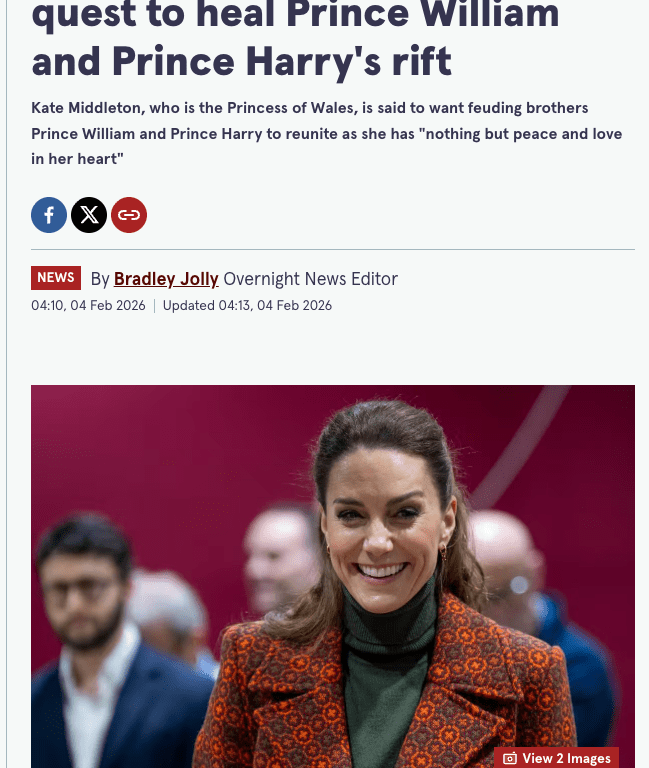
Multiple outlets are reporting that Kate Middleton, Princess of Wales, wants to heal the rift between Prince William and Prince Harry because she has “nothing but peace and love in her heart.” According to unnamed sources, Kate is “determined to open dialogue” with Meghan Markle and is “willing to reach out directly” even if William opposes the approach.
A source told media: “Kate has nothing but peace and love in her heart moving into 2026. She’s willing to open up dialogue with Meghan after years of giving her the silent treatment, even if Prince William thinks it’s a terrible idea. She’s painfully aware there’s no path to Harry without getting Meghan’s blessing. That’s why she’s working with her staff to figure out a viable approach to Meghan.”
Public response suggests the narrative isn’t landing as intended.
The Credibility Gap
Social media reactions to the peace and love framing ranged from skeptical to openly hostile. The overwhelming sentiment questioned why Kate would suddenly position as mediator given her documented role in the conflict’s escalation.
Multiple responses referenced specific incidents contradicting the peaceful image. Comments pointed to Kate’s behavior at the Queen’s funeral, allegations about pre-wedding incidents with Meghan, and her apparent support for narratives that intensified rather than resolved family tensions.
The pattern reveals a fundamental PR problem. When institutional messaging contradicts observable behavior and documented timeline, audiences reject the reframing regardless of how many outlets repeat it.
The Strategic Positioning
The reports position Kate as peacemaker willing to act independently of William’s preferences. This framing accomplishes several objectives simultaneously:
Establishes Kate as reasonable moderate: She recognizes reconciliation requires engaging with Meghan, unlike William who reportedly thinks direct contact is “a terrible idea.”
Creates distance from Andrew crisis: Peace narratives emerge as Prince Andrew faces renewed scrutiny over Epstein connections and alleged removal from Royal Lodge.
Preempts Invictus Games optics: Harry and Meghan return to UK this summer for 2027 Invictus Games countdown, creating inevitable media moment that requires strategic positioning.
Responds to copykeening accusations: Kate’s recent visits to brands Meghan elevated years earlier generated criticism. Peace rhetoric provides alternative narrative.
The narrative serves multiple institutional purposes beyond simple family reconciliation.
The “Working With Staff” Signal
The source notes Kate is “working with her staff to figure out a viable approach to Meghan.” This detail deserves particular attention.
Genuine family reconciliation typically doesn’t involve staff coordination to determine “viable approaches.” It involves direct personal communication between family members. The staff involvement signals this remains institutional positioning rather than personal relationship repair.
The language reveals the calculation underlying the narrative. Kate isn’t spontaneously reaching out from peaceful impulses. She’s coordinating with communications staff to determine strategically optimal approach to someone she’s given years of silent treatment.
This undermines the “peace and love in her heart” framing. Hearts don’t require staff coordination to figure out viable approaches. Strategic image management does.
The source’s own language also admits Kate has given Meghan “years of giving her the silent treatment.” This contradicts peace and love characterization while confirming extended period of deliberate non-communication.
Why the Narrative Fails
Several factors explain the public skepticism:
Documented contradictions: Audiences reference specific incidents that conflict with the “peace and love” characterization. The Queen’s funeral interactions received particular mention as visible contradiction of claimed peaceful intentions.
Timeline awareness: Comments note the timing coincides with Kate’s recent visits to brands Meghan elevated years earlier. On February 3, 2026, Kate visited Hiut Denim in Wales. Meghan put this company on the map in January 2018, with founder David Hieatt explicitly crediting factory expansion and new hires to “the Meghan Markle effect.” The peace narrative emerges as the copykeening accusations intensify.
Selective peace: Multiple responses identified that any peace overture excluding Meghan while attempting to reconcile with Harry alone would likely fail. The brothers’ relationship cannot be separated from their respective marriages and family units.
Pattern recognition: Audiences increasingly identify PR patterns rather than accepting narratives at face value. The “peace and love” framing gets read as crisis management rather than authentic position shift.
Racist dynamics: Several comments explicitly named racism as central to the original conflict, noting that reconciliation attempts that don’t address that foundation cannot succeed.
The Invictus Games Calculation
Harry and Meghan’s expected return for the 2027 Invictus Games countdown this summer creates inevitable media moment. The royal family faces a choice: appear petty by avoiding them, or appear magnanimous by engaging.
Pre-positioning Kate as willing peacemaker creates narrative foundation regardless of what actually occurs:
If meeting happens: Kate’s peaceful intentions made it possible despite William’s resistance and past tensions.
If no meeting occurs: Kate tried; other parties refused or circumstances prevented it. She maintains moral high ground.
If minimal interaction: Kate’s preliminary peace overtures explain why interactions remain limited rather than completely absent.
The advance narrative engineering provides favorable framing for any eventual outcome.
King Charles reportedly offered Highgrove House for Harry and Meghan’s stay during the Invictus visit, suggesting institutional coordination around the optics. Kate’s peace narrative fits within broader family positioning for that inevitable encounter.
The William Distance Strategy
The framing creates careful distance between Kate and William on the reconciliation question. Sources claim William thinks direct Meghan contact is “a terrible idea” while Kate pursues it anyway.
This positioning protects both of them strategically:
If reconciliation succeeds: Kate receives credit for brokering peace despite William’s resistance. She appears independently powerful within institutional structure.
If reconciliation fails: William’s documented resistance provides explanation. Kate attempted peace; William’s opposition prevented it. Both avoid accountability for failure.
If Harry and Meghan reject overture: Their rejection can be characterized as unreasonable given Kate’s peaceful intentions, shifting blame for continued rift.
If nothing materializes: The sourced claims never required concrete action. Peace intentions were reported; circumstances prevented implementation.
The strategic ambiguity allows institutional messaging without institutional commitment.
Royal expert Duncan Larcombe observed William’s pattern of avoiding Harry: “It seems to be more than just a coincidence that William had taken himself out of the country, ensuring he was nowhere near Windsor, or where Harry might be. It wasn’t the first time he was out of town when Harry had a court hearing.”
When Harry came to the UK last month for his legal case against Associated Newspapers Limited, William was hundreds of miles away on official royal business in Scotland and Bristol. The carefully orchestrated scheduling suggests deliberate avoidance rather than coincidental timing.
The Andrew Factor
Multiple responses referenced Prince Andrew’s continued presence at family events, including proximity to Kate’s daughter Charlotte. The juxtaposition is sharp. Claims of protective maternal instincts and family values become harder to credit when the family maintains close association with Andrew despite well-documented allegations and ongoing scandal.
This represents a credibility problem beyond just the Harry and Meghan situation. If Kate positions as concerned about family wellbeing and appropriate boundaries, Andrew’s continued integration into family events contradicts that framing.
The peace narrative emerges precisely as Andrew faces renewed crisis. Reports indicate he’s been removed from Royal Lodge following intensified Epstein scandal attention. Peter Mandelson’s appointment as US ambassador despite documented Epstein connections generates additional scrutiny of royal family’s associations.
The timing pattern is observable across royal PR. When uncomfortable stories circulate, carefully placed positive framing appears in multiple outlets. Several commenters interpreted the peace narrative as deliberate deflection from the more damaging Andrew associations.
The Meghan Dimension
A significant portion of responses focused on Kate’s treatment of Meghan rather than the William-Harry relationship. This reflects public understanding that the brothers’ rift cannot be separated from how their family treated Meghan.
Comments referenced Kate’s alleged pre-wedding behavior, interactions during official events, and her apparent support for negative media coverage of Meghan. Whether these specific allegations are accurate matters less than the fact that audiences believe them based on observable patterns.
The suggestion that Kate could mediate without addressing her own role in the conflict’s origins struck many as fundamentally unserious. Reconciliation requires accountability for past behavior, not positioning as neutral third party when you’re identified as active participant.
Several responses noted the irony of peace overtures while simultaneously visiting businesses Meghan elevated, wearing brands Meghan wore first, and benefiting from media coverage that erases Meghan’s documented contributions. Peace and love rhetoric doesn’t align with apparent competitive behavior and credit appropriation.
Just this week, Kate visited Hiut Denim, which Meghan originally put on the international map. She’s also worn Strathberry handbags that Meghan carried in 2017, and Aquazzura shoes that Meghan made a signature look years before Kate’s first documented pair. Media coverage of Kate’s brand adoption typically minimizes or omits Meghan’s prior role, reframing Kate’s later appearances as origin stories.
The “She Caused It” Consensus
Perhaps most striking is how many responses directly identified Kate as primary cause or significant contributor to the rift. This represents complete inversion of the intended narrative.
The PR strategy positions Kate as potential solution. Public response identifies her as problem. That gap reveals fundamental disconnect between institutional messaging and audience perception.
When image management contradicts documented behavior this severely, the reframing effort often backfires. Rather than rehabilitating reputation, it highlights the gap between claimed values and observable actions.
Comments included direct statements like “She is the cause of the whole problem,” “Kate made the rift between the two brothers,” and “She bullied Meghan.” Whether fully accurate, these perceptions dominate public response, making Kate’s positioning as peacemaker immediately suspect.
What This Reveals About PR Limitations
The public response demonstrates clear limits of reputation management when audience has access to contradicting information:
Pattern recognition: Audiences increasingly identify PR strategies rather than accepting narratives. The peace and love framing gets immediately classified as damage control or distraction.
Timeline awareness: People remember documented incidents that contradict current positioning. Past behavior informs credibility of present claims. Funeral footage, archived interviews, and recent brand visits all contradict peaceful characterization.
Selective application: Claims about values or principles get evaluated against consistent application. Peace and love rhetoric evaluated alongside Andrew association, Meghan treatment, and competitive behavior.
Authenticity requirements: Audiences distinguish between genuine position evolution and strategic reframing. The latter generates cynicism rather than goodwill. “Working with staff to figure out viable approach” signals calculation, not authentic reconciliation impulse.
Accountability expectations: Reconciliation narratives without acknowledgment of contributing behavior get rejected as unserious. Positioning as mediator when identified as participant fails credibility test.
The Institutional Problem
This represents broader challenge for institutional reputation management. When the institution controls significant media access and shapes substantial coverage, there’s tendency to believe messaging can override documented behavior.
But audiences increasingly have access to archived information, alternative perspectives, and pattern recognition that contradicts official narratives. The gap between institutional messaging and public perception widens rather than narrows when PR efforts ignore rather than address that contradiction.
The peace and love framing might have worked in an earlier media environment with more controlled information flow. In current environment where audiences reference specific funeral footage, archived interviews, documented timelines of brand adoption, and Andrew’s continued family integration, the reframing attempt highlights rather than resolves credibility problems.
What Reconciliation Would Actually Require
Genuine reconciliation would involve several elements notably absent from current reporting:
Acknowledgment of past behavior: Addressing the documented silent treatment, competitive dynamics, and failure to support Meghan during period of intense negative media coverage.
Addressing root causes: Confronting the racist dynamics Harry and Meghan identified as central to their departure, rather than treating the rift as personal family drama divorced from institutional problems.
Consistent values application: Explaining Andrew’s continued family integration while pursuing reconciliation with Harry and Meghan, who left citing legitimate concerns about safety and institutional racism.
Ending competitive behavior: Ceasing the pattern of adopting brands Meghan elevated while accepting media coverage that erases her documented contributions.
Direct communication: Actually reaching out personally rather than coordinating with staff to determine viable approaches or positioning through unnamed sources in media outlets.
Behavioral change: Demonstrating through action rather than strategic messaging that the relationship dynamic has fundamentally shifted.
The current narrative provides none of these elements. It offers peace rhetoric without acknowledgment, reconciliation messaging without accountability, and strategic positioning without concrete action.
Conclusion
The public rejection of Kate’s peace and love positioning reveals how PR strategies fail when they contradict observable behavior and documented patterns.
Audiences aren’t rejecting the idea of reconciliation. They’re rejecting Kate as credible mediator given her identified role in the conflict. They’re rejecting peace narratives that ignore racism, protect problematic family members like Andrew, continue competitive credit appropriation, and coordinate “viable approaches” through staff rather than pursuing genuine personal reconciliation.
The response suggests that effective reconciliation would require acknowledging past behavior, addressing root causes including racist dynamics, demonstrating consistent values application across all family members, ending competitive brand adoption and credit theft, and pursuing direct personal communication rather than strategic institutional messaging.
Strategic messaging cannot substitute for behavioral change. When it attempts to, audiences increasingly call it out explicitly rather than accepting the institutional narrative.
The “peace and love” framing generated mockery, skepticism, and direct contradiction rather than the intended reputation rehabilitation. Comments directly identified Kate as cause rather than solution. The working-with-staff detail revealed calculation rather than authenticity. The timing alongside Andrew crisis, copykeening accusations, and approaching royal warrant authority exposed strategic purposes behind the reconciliation rhetoric.
That outcome itself reveals how significantly public perception has shifted from accepting royal family narratives to actively questioning their credibility. When institutional messaging this severely contradicts documented behavior, observable patterns, and archived evidence, audiences now have both access to contradicting information and willingness to call out the disconnect explicitly.
The peace and love narrative represents strategic positioning for multiple approaching moments requiring favorable optics: Andrew scandal management, Invictus Games encounter, royal warrant granting to brands Meghan elevated first. Whether it represents anything beyond strategic messaging depends on whether concrete actions follow the carefully placed media narrative.
Current evidence suggests pure institutional positioning. Kate coordinates with staff to determine viable approaches while maintaining competitive behavior, supporting Andrew’s family integration, and benefiting from media coverage that erases Meghan’s contributions. That’s not peace and love. That’s strategic image management attempting to override documented contradictions through carefully sourced narratives that audiences increasingly recognize and reject.
 celebchai.com