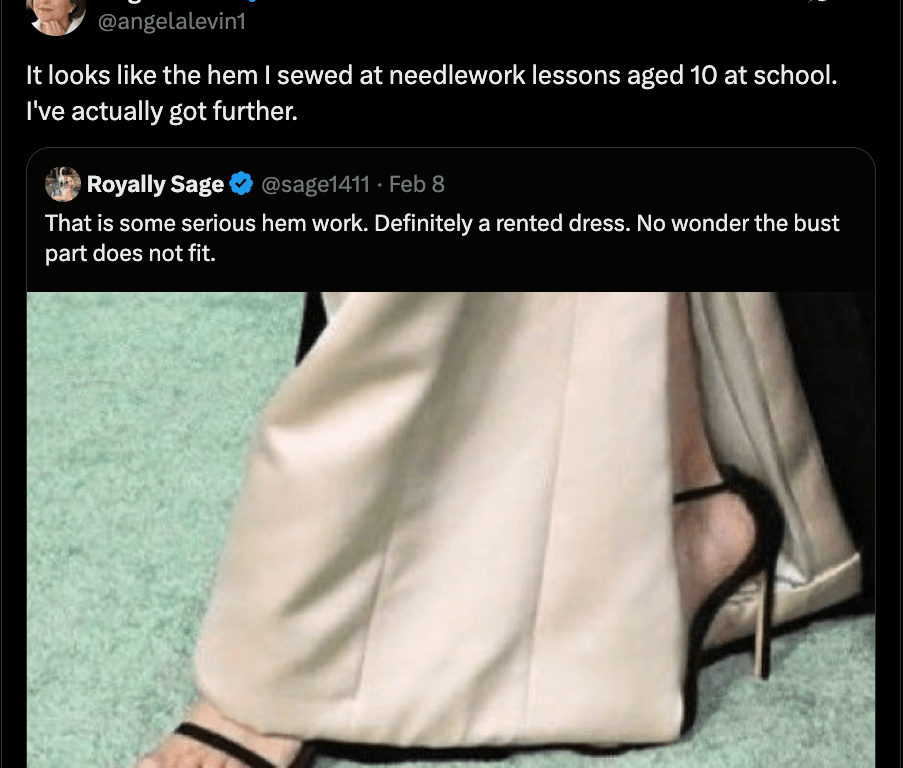
Angela Levin wants you to know she was good at sewing when she was ten.
That’s the takeaway from her latest contribution to British public discourse, a quote tweet zooming in on the hemline of a gown at a green carpet event, declaring it inferior to her childhood needlework. “It looks like the hem I sewed at needlework lessons aged 10 at school,” she wrote. “I’ve actually got further.”
Let that sit for a moment. A biographer. A journalist. A woman with a verified account and a platform reaching tens of thousands. And this is what she chose to do with her Sunday evening: inspect fabric at someone’s ankles and announce that her prepubescent self could have done better.
It would be laughable if it weren’t so calculated.
The Anatomy of a Crop
Before Levin even typed a word, the image had already done the heavy lifting. The photo is cropped tight. Just feet, fabric, and carpet. No face. No context. No human being. Just a specimen laid out for inspection.
This is not accidental. When you reduce a person to a close-up of their hemline, you are making a visual argument before the text even begins: this is not a person, this is a collection of flaws to be catalogued. The audience isn’t being invited to see someone at an event. They’re being handed a magnifying glass and told to find fault.
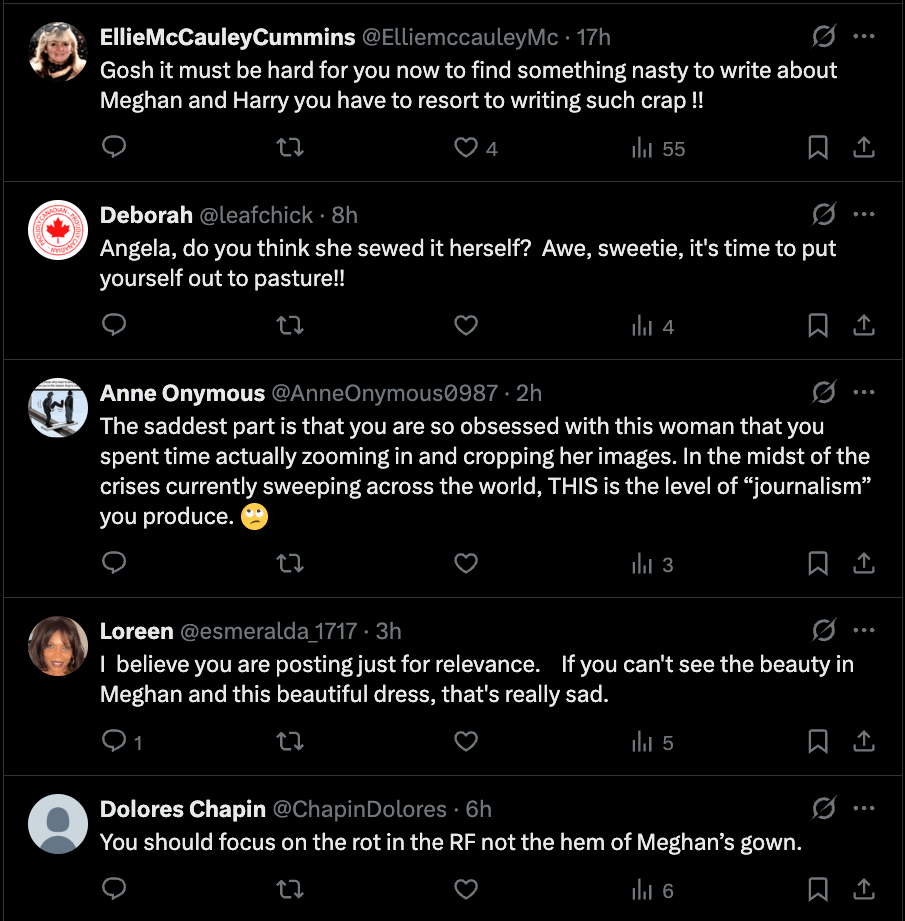
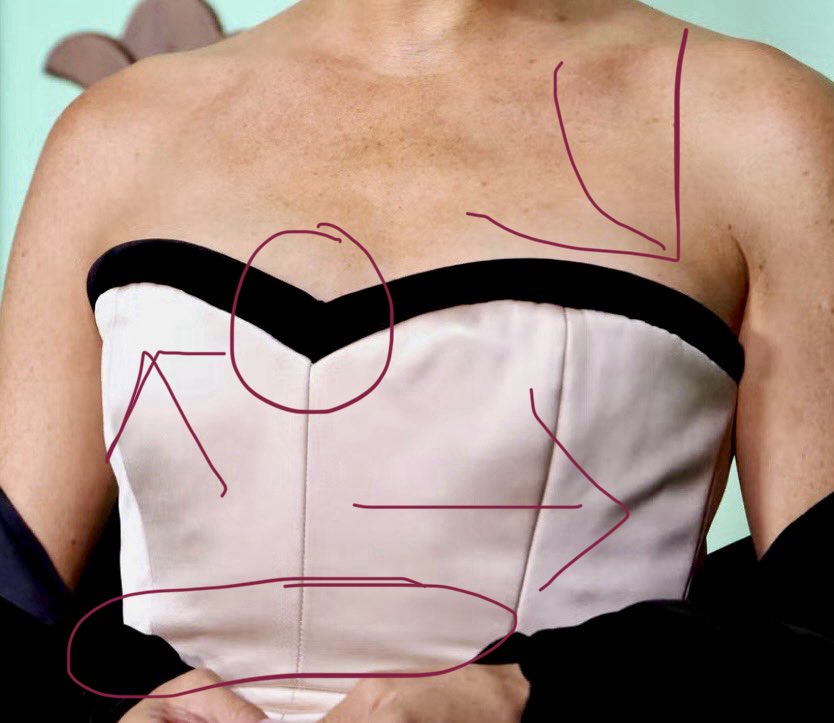
And find fault they did. Within hours, the replies had escalated from hem critiques to “her toes are heinous,” to speculation about whether the dress was rented, to commentary on bust fit. Each reply peeled away another layer of humanity. By the time the thread had run its course, there was no person left. Just a patchwork of body parts deemed insufficient by a jury of strangers.

The Real Stitch Being Sewn
Here’s what Levin’s little sewing anecdote is actually saying, once you strip away the twee nostalgia: This person does not have the infrastructure to be where they are.
A “proper” member of this world would never appear with an imperfect hem. They would have couture. They would have a stylist, a fitter, a team of people ensuring every seam was invisible. They would have resources. The bad hem isn’t a fashion observation. It’s an accusation of illegitimacy. The dress is rented. The fit is wrong. The toes are wrong. The body is wrong. The person is wrong.
Every single one of these micro-critiques draws the same invisible line: between those who belong in elite spaces and those who are trespassing. Levin isn’t doing fashion commentary. She’s doing border patrol.
And she has plausible deniability sewn right into it, if you’ll pardon the pun. Object to this, and you’ll be told you’re overreacting. It’s just a hemline! It’s just an observation! Can’t anyone take a joke?
But stack these “observations” up. Week after week, event after event, outfit after outfit, expression after expression. The hair. The posture. The dress. The shoes. The way she stands, walks, breathes, exists in space. No single instance looks like a campaign. But cumulatively? It is a systematic project to teach an audience that someone is fundamentally inadequate. That they will never, ever be enough.
That is not criticism. That is demolition by a thousand cuts.
The Replies Tell the Real Story
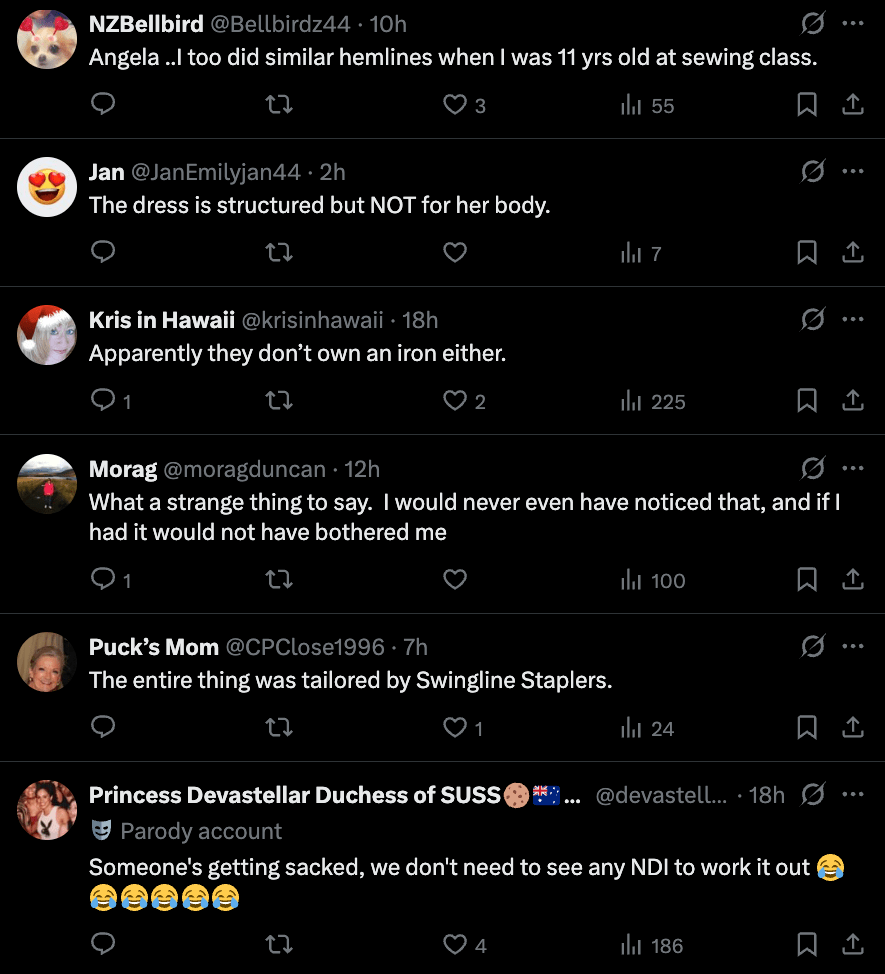
What’s most revealing isn’t Levin’s tweet. It’s what happened underneath it. The replies split into factions that expose the entire machinery at work.
There were the enthusiastic participants, people who took Levin’s invitation and ran with it, adding their own anatomical critiques like offerings at an altar of contempt. Each one a little audition: See? I can be cruel too. Let me in.
And then there were the ones who saw straight through it. “Let’s talk about anything but a real royal scandal, aye Ange,” wrote one reply, before pointedly referencing Jimmy Savile. Others invoked Mandelson. The message was consistent and damning: You are using a hemline to fill the space where accountability journalism should be.
This is the displacement function that these posts serve. Every column inch spent on a hem is a column inch not spent on institutional scandals, on questions of real consequence, on the stories that actually matter. It’s not a coincidence that the loudest appearance police are the most loyal institutional defenders. The hemline isn’t a distraction from the project. It is the project. Keep the audience focused on whether someone’s dress fits, and they won’t ask whether the institution does.
The Needlework of Cruelty
There is something particularly grotesque about Levin’s framing. She didn’t just say the hem was bad. She constructed a little narrative: I was ten, I was learning, and even I did better than this. It’s a masterclass in condescension dressed as self-deprecation. She makes herself the relatable everywoman (we all had sewing lessons!) while positioning her target as someone who can’t even clear the bar set by a child.
It’s the kind of cruelty that wears a cardigan. Cozy, nostalgic, very English, and utterly vicious underneath.
And let’s be honest about the selectivity at play here. The same accounts that will dissect a hemline at 400% zoom will extend infinite grace to others in the same orbit. Wrinkled suits, ill-fitting jackets, questionable sartorial choices. All forgiven, all unscrutinised, all simply not worth mentioning. The magnifying glass only comes out for one person. The standards are only “universal” in one direction.
That selectivity is the tell. It reveals that this was never about fashion standards, tailoring quality, or hemlines. It’s about who is granted the presumption of belonging and who must earn it anew every single time they step outside, only to be told, again and again, that they have failed.
The Bottom Line
Angela Levin sat down, looked at a photograph of a human being at a public event, cropped it to their ankles, and invited the internet to join her in picking that person apart stitch by stitch.
She wants us to think this is about sewing.
It’s about power. It’s about who gets to decide who belongs. And it’s about a woman with a platform who has chosen, consistently and deliberately, to use it as a weapon of small, sustained, soul-grinding cruelty, and then hide behind a thimble.
The hem is fine, Angela. It’s your moral fabric that’s unravelling.

 celebchai.com