In this powerful interview, Senator Raphael Warnock (D-GA) addresses critical issues facing the nation, from holding controversial nominees accountable to calling out dangerous political rhetoric. Warnock emphasizes the importance of leadership rooted in moral courage, faith, and a commitment to the well-being of the American people. Key highlights include: Confronting RFK Jr.’s controversial statements about the CDC. Responding to claims that his Senate seat was “purchased” by donors. Critiquing Trump’s use of a tragic plane crash to advance a political agenda. Advocating for policies that align with Christian values of justice, mercy, and compassion. Defending democracy and urging Americans to stand up for the republic.

Senator Raphael Warnock Calls for Moral Courage, Accountability, and Faith-Informed Leadership

In a powerful interview, Senator Raphael Warnock (D-GA) addressed critical issues facing the nation, from the confirmation of controversial nominees to the role of faith in politics and the recent tragic plane crash in Washington, D.C. His remarks underscored the need for moral courage, accountability, and leadership that prioritizes the American people over partisan agendas.

Key Moments from the Interview

1. Confronting RFK Jr.’s Controversial Statements
During RFK Jr.’s confirmation hearing, Warnock pressed him on past statements comparing the CDC to Nazi death camps and sexual abusers in the Catholic Church. Despite RFK Jr.’s denial, Warnock presented transcripts proving the remarks were made. Warnock emphasized the gravity of leading agencies like the CDC, stating:

“The selection of the Secretary for Health and Human Services is serious business. It’s literally a matter of life and death. We can’t play around with this kind of thing.”
## Political Discourse Heats Up Following DCA Aviation Incident

In the wake of a recent aviation incident near Washington DC's Reagan National Airport (DCA), political discourse has intensified around issues of transportation safety, leadership accountability, and federal policy. The incident has sparked heated debate about aviation safety protocols and administrative oversight, while highlighting stark differences in how political figures approach crisis response.

### Competing Narratives Emerge

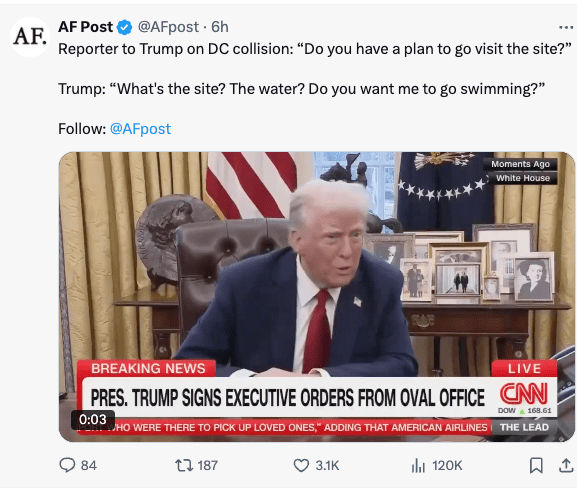
Former President Trump has made several public statements attributing the incident to multiple factors, including DEI (Diversity, Equity & Inclusion) policies, the current administration, and previous administrative decisions. These claims, made without supporting evidence according to observers, have drawn sharp criticism from various quarters.

Senator Raphael Warnock emerged as one of the most vocal critics of this response, characterizing it as "shameful" and "dangerous," particularly given the timing of such statements while families were still being notified. "That he would use this moment to advance his agenda of attacking DEI and Democrats speaks volumes," Warnock stated in a recent interview.

### Policy Context and Administrative Changes

The incident has drawn attention to several relevant administrative and policy changes in federal aviation:
- Recent changes to the Aviation Safety Committee
- The departure of the FAA administrator
- Staffing levels among air traffic controllers
- Implementation and subsequent changes to federal hiring policies

### Media Coverage and Political Messaging

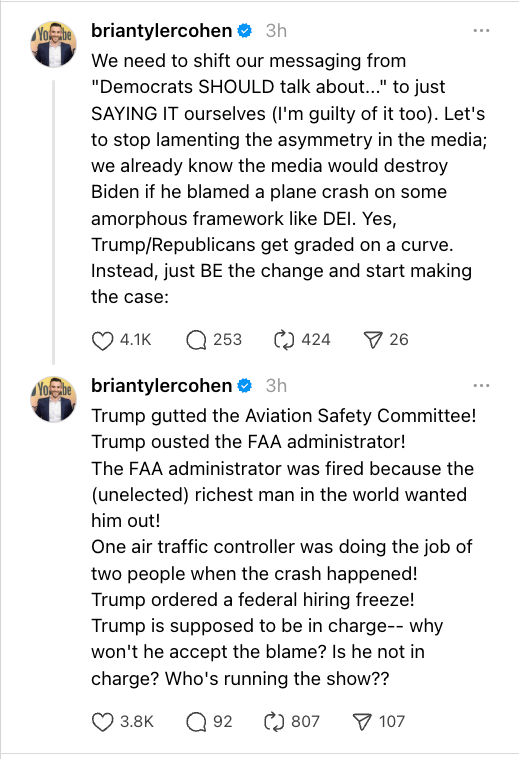
The incident has also sparked discussion about asymmetry in media coverage of political responses to crises. Some commentators, including Brian Tyler Cohen, have called for a shift in Democratic messaging strategy. Rather than discussing how Democrats "should" message about issues, they argue for more direct communication about specific policy decisions and their consequences.

### Broader Political Implications

The discourse surrounding this incident has expanded beyond aviation safety to touch on broader themes of political accountability and leadership. Questions have been raised about responsibility during crises, the role of federal oversight in transportation safety, and the impact of administrative decisions on public safety infrastructure.

### Looking Forward

As investigations into the incident continue, the political discourse shows no signs of cooling. The event has become a flashpoint for debates about federal administration, safety protocols, and crisis response, while highlighting fundamental differences in how political leaders approach both policy and public communication during critical moments.

---

*Note: This summary reflects ongoing discussions of recent events. Readers are encouraged to consult official sources for the most current information about the incident and subsequent investigations.

2. Responding to Nicole Shanahan’s Claims
Warnock also addressed a tweet from Nicole Shanahan, RFK Jr.’s former running mate, who claimed she helped fund his campaign. Warnock firmly rejected the notion that his seat was “purchased,” stating:

“The people of Georgia elected me in a historic election. I represent the people of Georgia and their interests.”

3. Concerns About Trump’s Nominees
Warnock expressed deep concern about nominees who are hostile to the agencies they are tasked to lead. He stressed the importance of qualified leadership, especially in roles that impact public safety and health:

“We need leaders who are not conspiracy theorists, but who are focused on the well-being of the American people.”

4. Trump’s Response to the Plane Crash
Warnock criticized former President Trump for using the tragic plane crash to advance his political agenda, particularly by blaming diversity and DEI initiatives. He called Trump’s response “shameful” and “dangerous,” especially given the timing when families were still grieving:

“To use this moment, when bodies are still literally on the bottom of the Potomac and families are being notified, to attack DEI and Democrats speaks volumes. It’s not only shameful, it’s dangerous.”

5. Faith and Leadership
As a pastor, Warnock spoke about the importance of aligning policy with Christian values, such as caring for the poor, marginalized, and immigrants. He criticized politicians who claim to be Christian but whose policies contradict the teachings of Jesus:

“Their policies bear false witness against the God I know. The litmus test for one’s faith is the depth of your commitment to the poor and marginalized.”

6. Defending Democracy
Warnock warned against the erosion of democratic norms and the concentration of power in the executive branch. He urged Americans to stand up for the republic and resist any attempts to undermine democratic institutions:

“We don’t have a king. This is an attack on democracy itself, and it’s time for every American to stand up and say the republic belongs to the people.”


Watch the Full Interview

For more of Senator Warnock’s powerful insights, watch the full interview here:
MUST-SEE: Senator Warnock Responds to Trump’s Blame Deflection


Why This Matters
Senator Warnock’s words are a reminder of the importance of moral leadership, accountability, and the need to prioritize the well-being of the American people over partisan politics. His call for Republicans to choose “nation over party” and his emphasis on faith-informed values resonate deeply in these challenging times.

Let’s continue to demand leaders who embody these principles and work tirelessly for the people they serve.


One thought on “Senator Raphael Warnock Calls for Moral Courage, Accountability, and Faith-Informed Leadership

Leave a comment