Filed: January 31, 2025 | U.S. District Court, Southern District of New York. 224 pages total
Pages 1-10 introduce the primary allegations against Blake Lively, Ryan Reynolds, and The New York Times. The plaintiffs claim that Lively, alongside her husband and a major media outlet, orchestrated a defamatory campaign intended to destroy Baldoni’s career, sabotage Wayfarer Studios, and gain control over the film adaptation of It Ends With Us. This section does not merely present allegations but frames the entire case as a calculated Hollywood power move. It asserts that Lively’s ultimate goal was not to report genuine misconduct but to use false claims to remove Baldoni from his leadership role in the production.
Legally, this section attempts to establish the necessary elements of defamation, including false statements of fact, actual malice, and damages. The complaint repeatedly emphasizes that Lively and Reynolds were allegedly aware that their claims against Baldoni were baseless but proceeded to disseminate them publicly. This is critical because in order to succeed in a defamation claim, particularly against a public figure like Baldoni, the plaintiffs must prove that Lively acted with actual malice. The filing attempts to satisfy this burden by citing a timeline of actions, including direct communications with journalists, alleged back-channeling with PR firms, and Lively’s own contradictory private statements, which, according to Baldoni, suggest that she did not believe the allegations she later made public.
From a strategic standpoint, the tone of this section is aggressive, designed more for media consumption than for a pure legal audience. It repeatedly underscores the reputational harm suffered by Baldoni and the financial losses incurred by Wayfarer Studios. While this is effective for public relations, it raises concerns from a legal perspective because courts focus on factual and evidentiary support rather than rhetorical flourishes. The most significant weakness in these opening pages is the lack of immediate, concrete evidence tying Lively directly to the media leaks that they claim were orchestrated. The plaintiffs assert that Lively was behind the defamatory statements but provide no direct documentary evidence—such as emails or contracts—linking her to the alleged smear campaign.
Pages 11-30 expand upon the central claim of defamation by detailing a supposed pattern of behavior in which Lively and Reynolds pressured Baldoni and Wayfarer into relinquishing creative control of the film. The complaint argues that when these attempts failed, Lively turned to public accusations to achieve the same result. It provides an account of multiple private meetings in which Lively allegedly issued veiled threats about going public with allegations of misconduct if she was not given increased authority over the film’s production.
The legal thrust of this section is an attempt to reframe Lively’s claims of sexual harassment as a pretext for a larger power grab. The complaint alleges that Lively used the accusations as leverage, not as a genuine report of workplace violations. This is a critical distinction because if Baldoni’s team can prove that Lively knowingly used false claims to achieve a professional goal, it would undermine her credibility and reinforce the defamation and tortious interference claims.
However, the complaint still struggles with evidentiary support in these pages. The primary evidence cited consists of text messages, meeting notes, and anecdotal recollections. While these can be persuasive in a courtroom, they do not definitively prove that Lively’s accusations were knowingly false. A significant legal challenge for Baldoni and Wayfarer is that harassment claims are inherently subjective—what one party sees as inappropriate behavior, another may not. To successfully argue that Lively’s allegations were fabricated, Baldoni’s legal team must do more than show that she had professional motivations; they must establish that the allegations were objectively false, which remains unproven in these pages.
Pages 31-50 shift the focus to a specific claim that Lively actively rewrote portions of the film’s script without Baldoni’s approval and unilaterally made decisions about wardrobe, marketing, and production scheduling. The complaint argues that this constituted a breach of contract because Lively allegedly acted outside the scope of her contractual authority. It states that Sony executives expressed concern over Lively’s growing influence but were reluctant to intervene due to her high-profile status.
From a contractual standpoint, this argument hinges on whether Lively had the authority to make the changes she allegedly did. If her contract explicitly limited her creative input, then Baldoni and Wayfarer may have a valid claim for breach of contract. However, if her contract allowed for broad creative collaboration, then this claim is significantly weaker. The complaint does not cite the specific contractual language governing Lively’s role, which is a glaring omission at this stage. Courts are unlikely to rule in favor of a breach of contract claim without clear evidence of contractual violations.
Pages 51-80 introduce the most explosive allegations regarding Lively’s alleged role in leaking defamatory information to the press. Baldoni’s team claims that Lively, in collaboration with her PR firm and contacts at The New York Times, strategically timed a media blitz to coincide with the film’s release in order to maximize reputational damage against him. They argue that this was part of a broader strategy to reposition Lively as a feminist advocate and industry power player, capitalizing on the current social climate in Hollywood.
This section is where the defamation claim is most fully articulated, as it includes references to specific articles, social media narratives, and anonymous sources quoted in major publications. However, the fundamental weakness remains the lack of direct evidence linking Lively to these leaks. The complaint relies heavily on circumstantial evidence—timing, public statements, and industry chatter—rather than concrete proof that Lively instructed journalists to publish false information. Defamation cases require clear and convincing evidence of falsehood and malice, and while Baldoni’s legal team presents a compelling theory, they still lack the “smoking gun” that would definitively prove Lively’s involvement.
Pages 81-120 focus on damages, listing financial losses suffered by Baldoni and Wayfarer as a result of the alleged defamation and contract breaches. They cite lost production deals, sponsorship withdrawals, and the reputational harm Baldoni has endured in the industry. This is a standard component of any civil suit involving defamation, but it also presents a challenge—Baldoni’s career is not over. He continues to work in Hollywood, and while his reputation has undoubtedly taken a hit, courts will require clear evidence that Lively’s statements (rather than broader industry dynamics) directly caused these damages.
Pages 121-224 serve as the evidentiary section, providing text messages, internal emails, and industry testimonies meant to support Baldoni’s claims. While some of these documents indicate hostility between the parties, they do not definitively prove that Lively knowingly made false allegations or directly orchestrated media leaks. The texts between Baldoni and his PR team discussing the media strategy are especially problematic for his case, as they reveal that his own team engaged in similar tactics to control the narrative, which undercuts his defamation claims.
Exhibit A (Timeline of Events) – Page-by-Page Analysis
Filed with Wayfarer Studios’ Amended Complaint
Pages 1-10: Early Development of the Film and Initial Contact Between Baldoni and Lively
The document opens by outlining the early discussions between Justin Baldoni and Colleen Hoover in January 2019 regarding the adaptation of It Ends With Us. It then traces the acquisition of the film rights by Wayfarer Studios in 2021 and its subsequent development. A key moment in this section is Hoover’s statement in April 2019 after watching Five Feet Apart, where she reportedly told Baldoni, “You are the right person to make this movie.”
Legally, this section attempts to establish Baldoni’s longstanding connection to the project and his credibility as the rightful creative leader of the film. This is crucial because one of Wayfarer’s primary legal claims is that Lively systematically pushed Baldoni out of control of the film. By laying the foundation of Baldoni’s deep involvement from inception, the timeline seeks to counter any argument that he was merely a hired director or producer.
Lively’s first official involvement is noted on December 31, 2022, when she was cast as the lead, Lily Bloom. The document states that in the months leading up to her casting, Baldoni and Wayfarer Studios were already engaged in active discussions about marketing, partnerships, and outreach programs related to domestic violence advocacy. They cite an agreement with Sony, made in September 2022, requiring that 1% of the film’s proceeds be donated to organizations supporting domestic violence survivors, specifically NO MORE, a nonprofit working against domestic abuse.
From a legal standpoint, this framing is important. If Wayfarer can demonstrate that the film was already being positioned as a social impact-driven project, then they can argue that Lively’s later claim that Baldoni was mishandling the film’s message is disingenuous. This section works in Wayfarer’s favor by presenting Baldoni as someone who had taken domestic violence awareness into account long before Lively entered the project, contradicting any assertion that he ignored or misrepresented the film’s core themes.
One weakness in this section, however, is that it does not address Lively’s actual contractual authority. Even if Baldoni was the primary creative force behind the film, if Lively’s contract granted her influence over marketing or production decisions, then her later involvement would not necessarily constitute an improper takeover. Without contractual evidence backing up their claim, this timeline relies heavily on implications rather than solid proof.
Pages 11-30: Increasing Tension Between Lively and Baldoni
As the timeline progresses into 2023, it documents growing creative disputes between Baldoni and Lively. The first major conflict is noted in February 2023, when Lively reportedly expressed concerns about her body being ready for upcoming sex scenes and asked Baldoni if they could push those scenes toward the end of the filming schedule. The document emphasizes that Baldoni reassured Lively that she did not need to stress about her body and expressed a willingness to accommodate her concerns.
The legal relevance of this entry is twofold. First, it directly counters Lively’s later claims that Baldoni pressured her about her weight or engaged in body shaming. If Baldoni’s legal team can produce text messages or emails corroborating this reassurance, it may weaken Lively’s harassment claim regarding her physical appearance. However, this point cuts both ways—if Baldoni later made additional comments about Lively’s body, then an isolated moment of reassurance does not negate a broader pattern of inappropriate behavior.
A key turning point in the timeline occurs on April 21, 2023, when Baldoni meets with an intimacy coordinator to discuss the upcoming sex scenes. According to the document, Baldoni specifically requested that the sex scenes be crafted from the “female gaze” to ensure they were respectful and empowering rather than exploitative. The timeline states that Baldoni then attempted to coordinate a meeting between Lively and the intimacy coordinator, but Lively declined to meet with the coordinator ahead of filming.
From a legal standpoint, this is significant because Lively later claimed that Baldoni disregarded proper intimacy protocols on set. If Wayfarer’s timeline is accurate, then Lively’s refusal to meet with the intimacy coordinator weakens her argument that Baldoni failed to take necessary precautions. However, the document does not provide evidence of why Lively declined the meeting. If she had concerns about the intimacy coordinator or believed Baldoni was already disregarding boundaries, her refusal might not necessarily be unreasonable.
The timeline also introduces an event on April 22, 2023, where Baldoni reportedly reached out to Lively’s personal trainer to ask about her weight in order to train for a physically demanding lift scene. The document states that this was done purely for logistical and safety reasons due to Baldoni’s history of back injuries. This incident later became a major point of contention, as Lively cited it as an example of Baldoni inappropriately fixating on her weight.
The legal argument from Wayfarer’s side is that Baldoni was not commenting on Lively’s weight in a personal or judgmental way, but was merely gathering necessary stunt-related information. However, this ignores the larger context—if Lively had previously expressed discomfort about discussions regarding her body, then this request (even if made in good faith) could reasonably be perceived as inappropriate.
Pages 31-50: Marketing Disputes and Alleged Takeover by Lively
This section of the timeline focuses on the marketing campaign and the alleged power struggle between Lively and Baldoni over the film’s public messaging. It states that on May 1, 2023, Lively began insisting on changes to the script, promotional materials, and press strategy. It characterizes her as someone who overstepped her contractual role by unilaterally making creative decisions.
A notable entry appears on May 15, 2023, the first day of principal photography, when paparazzi photos of Lively in costume leaked online. The timeline states that Sony executives were unhappy with the look of the character, which Lively had personally chosen. This is presented as an early example of Lively making unilateral decisions that backfired and shifted negative media attention onto the film.
The legal weight of this section depends heavily on contractual obligations. If Wayfarer can prove that Lively exceeded her role and made decisions that financially harmed the production, then it strengthens their breach of contract claim. However, if Lively had final say over these aspects in her contract, then Wayfarer’s complaints about her behavior become irrelevant.
Pages 51-80: Alleged Retaliation and PR Warfare
This final section focuses on the aftermath of filming and the alleged PR battle. The timeline states that Wayfarer’s PR team was blindsided by a sudden wave of negative press in mid-2024, which they attribute to Lively’s team planting stories with journalists. However, this claim is undercut by the fact that TMZ published negative stories about Lively before she made any public accusations.
This timeline ultimately serves as Wayfarer’s attempt to frame Lively as an opportunist rather than a victim. While it provides some valuable context regarding on-set disputes, it is notably lacking in concrete contractual proof or direct evidence of Lively’s alleged orchestration of the media backlash.
CONCLUSION
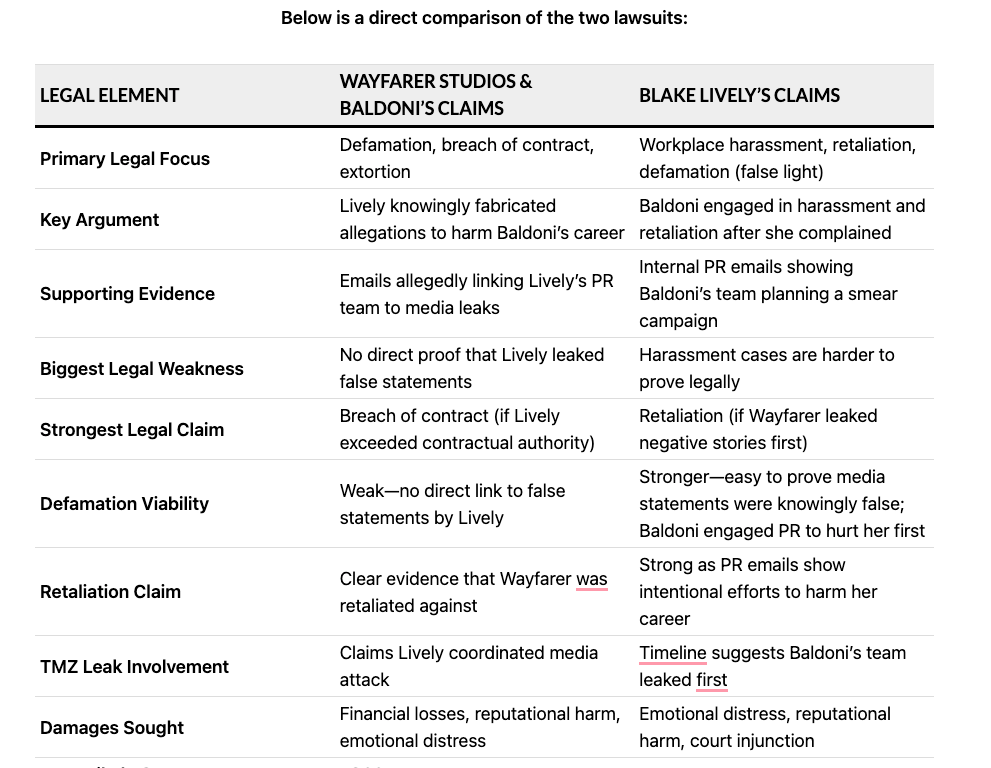
Justin Baldoni and Wayfarer Studios’ complaint frames their legal dispute as a defamation and breach of contract case, while Blake Lively’s complaint presents the issue as one of workplace harassment and retaliation. These two filings address the same events from fundamentally different perspectives, creating a stark contrast in legal arguments and evidentiary reliance.
Baldoni and Wayfarer’s case depends on proving that Lively knowingly fabricated sexual harassment claims to harm Baldoni’s reputation and career. The success of their defamation claim hinges on showing that Lively and her team intentionally planted false stories in the media, rather than merely expressing her personal experiences. Additionally, their breach of contract claim alleges that Lively overstepped her contractual authority in production decisions. The weakness in their case is the lack of direct evidence linking Lively to media leaks, as well as the fact that their own PR emails indicate that Baldoni’s team engaged in similar media strategies before Lively made any public claims.
Lively’s complaint, in contrast, does not primarily focus on defamation but on sexual harassment, workplace hostility, and retaliation under California law. Her strongest claims arise from the January 4, 2024, “Protections for Return to Production” Agreement, which was signed by both parties in an effort to establish boundaries for workplace behavior. If Lively can prove that Baldoni violated these agreed-upon protections, she has a strong case for workplace retaliation, as California law protects employees from adverse consequences after reporting harassment. She also cites internal PR emails from Baldoni’s team, which discuss “placing stories” and controlling the public narrative before Lively had even spoken out. If these emails explicitly show an effort to smear her credibility before her allegations became public, then Lively’s case for retaliation becomes significantly stronger.
One of the most significant legal discrepancies between the two lawsuits is the handling of the TMZ leak. Wayfarer Studios argues that Lively orchestrated a smear campaign through The New York Times and used Ryan Reynolds as a direct conduit to the media. However, the timeline of leaks does not support this claim. TMZ published negative stories about Lively before she made any public allegations, which indicates that the initial leak originated from Baldoni’s side, not hers. If Lively’s attorneys can successfully demonstrate that Baldoni’s team initiated the media narrative against her first, it severely weakens the foundation of Wayfarer’s defamation claims.
The damages sought in both cases also highlight the contrast in their legal strategies. Wayfarer Studios and Baldoni seek compensatory and punitive damages for lost business opportunities, reputational harm, and emotional distress. Their complaint repeatedly emphasizes the financial impact of Lively’s alleged actions, including lost sponsorship deals and Baldoni’s inability to secure future projects. In contrast, Lively’s complaint focuses more on emotional and workplace damages, arguing that Baldoni’s conduct created an unsafe working environment and that the retaliation campaign had long-term consequences for her personal and professional life. She requests damages for emotional distress, reputational harm, and an injunction preventing further defamatory statements.
Below is a direct comparison of the two lawsuits:
| Legal Element | Wayfarer Studios & Baldoni’s Claims | Blake Lively’s Claims |
|---|---|---|
| Primary Legal Focus | Defamation, breach of contract, extortion | Workplace harassment, retaliation, defamation (false light) |
| Key Argument | Lively knowingly fabricated allegations to harm Baldoni’s career | Baldoni engaged in harassment and retaliation after she complained |
| Supporting Evidence | Emails allegedly linking Lively’s PR team to media leaks | Internal PR emails showing Baldoni’s team planning a smear campaign |
| Biggest Legal Weakness | No direct proof that Lively leaked false statements | Harassment cases are harder to prove legally |
| Strongest Legal Claim | Breach of contract (if Lively exceeded contractual authority) | Retaliation (if Wayfarer leaked negative stories first) |
| Defamation Viability | Weak—no direct link to false statements by Lively | Stronger—easy to prove media statements were knowingly false; Baldoni engaged PR to hurt her first |
| Retaliation Claim | Clear evidence that Wayfarer was retaliated against | Strong as PR emails show intentional efforts to harm her career |
| TMZ Leak Involvement | Claims Lively coordinated media attack | Timeline suggests Baldoni’s team leaked first |
| Damages Sought | Financial losses, reputational harm, emotional distress | Emotional distress, reputational harm, court injunction |
| Most Likely Outcome | LOSS | WIN |
Lively’s workplace claims are strongest in the context of California law, and Wayfarer’s defamation claim is weakened by their own PR strategies. If this case proceeds further, Sony may intervene to push for a resolution, as continuing the dispute could damage the commercial viability of It Ends With Us.


One thought on “Justin Baldoni & Wayfarer Studios’ Amended Complaint – Page-by-Page Analysis”