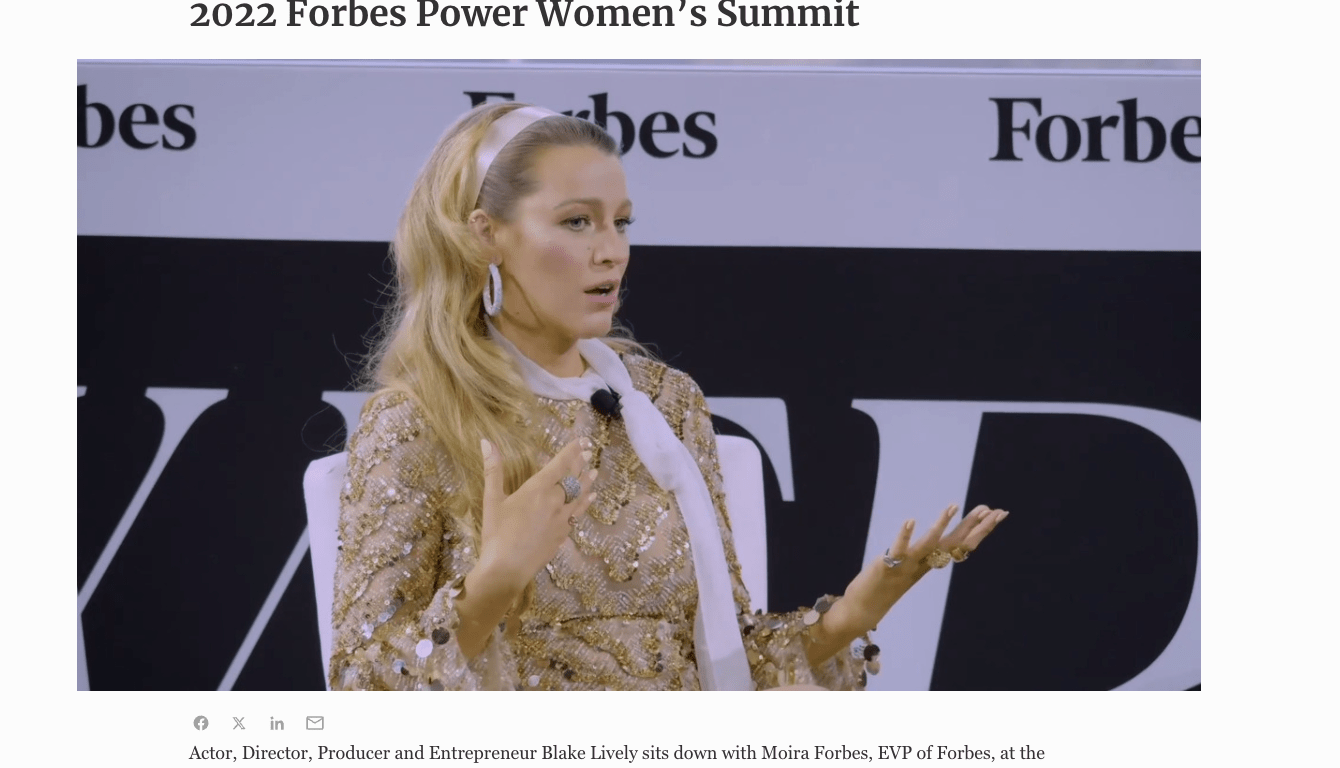
Blake Lively’s 2022 Forbes Summit interview has been brought up as supposed evidence that could harm her legal case against Justin Baldoni. However, when analyzed alongside the facts of the lawsuit, it becomes clear that this video does not undermine her claims but actually reinforces that she was upfront about her expectations and involvement in projects.
The Video and Baldoni’s Contradictory Claims
In the interview, Lively openly discusses her past experiences in Hollywood, explaining that earlier in her career, she would sign onto films as an actress and later assert her need for creative authorship. She acknowledges that this sometimes led to conflicts with directors and producers who did not expect or welcome that level of involvement. However, she also states that she has since learned to be upfront about her creative expectations from the outset.
This statement is critical in assessing the contradictions in Baldoni’s legal claims. His lawsuit argues that Lively manipulated the production process to take control of It Ends With Us, yet at the same time, it claims she did not do enough to earn a producer credit. If Baldoni is arguing that she overstepped her role and took over production, then he is also admitting that she was deeply involved, which meets the PGA (Producers Guild of America) mark criteria for producer recognition. The lawsuit simultaneously claims she was both a passive participant who did not contribute enough and a dominant force who took over. These contradictory claims cannot logically coexist.
The Forbes video actually works against Baldoni’s lawsuit. It suggests that Lively has long recognized the importance of being transparent about her creative ambitions, making it unlikely that she would have entered It Ends With Us without clear expectations. If she was upfront from the beginning about wanting to be meaningfully involved beyond acting, then Baldoni’s claims of a “takeover” start to fall apart.
The Issue of the Producer Credit
A key aspect of the lawsuit revolves around Baldoni blocking Lively from receiving her Producers Mark (p.g.a.), despite acknowledging that she had been promoted from executive producer to full producer. The PGA requires a producer to make substantial and continuous contributions beyond acting, including overseeing production, securing key creative personnel, and influencing the post-production process. Baldoni’s lawsuit spends over 100 pages arguing that Lively took control of the film but then claims she did not qualify for the producer mark. If she was as involved as he claims, then withholding the credit appears to be a strategic move rather than a fair assessment of her contributions.
The PGA has clear guidelines about what qualifies an actor for producer recognition. If Baldoni encouraged Lively’s involvement, praised her ideas, and sought her input throughout the process, then he cannot reasonably argue that she did not contribute. His texts, as well as her executive producer promotion, suggest that she was doing the work of a producer. His argument appears designed to discredit her contributions rather than provide a fair account of production dynamics.
The Role of Media Manipulation
The timeline of events also raises questions about Baldoni’s true motives. Reports indicate that Sony asked Lively to remain quiet on the situation, yet Baldoni was actively crafting a media narrative through leaks. He submitted his lawsuit to TMZ before filing it in court, suggesting that he prioritized public perception over a legal resolution. If he truly had evidence disproving Lively’s claims, he would not need to rely on PR tactics.
Additionally, his legal team has not presented evidence of Lively issuing threats or ultimatums to gain control. Released communications show professional and cordial interactions, rather than the coercive behavior that Baldoni describes. The lack of any documentation supporting his allegations of manipulation further weakens his case.
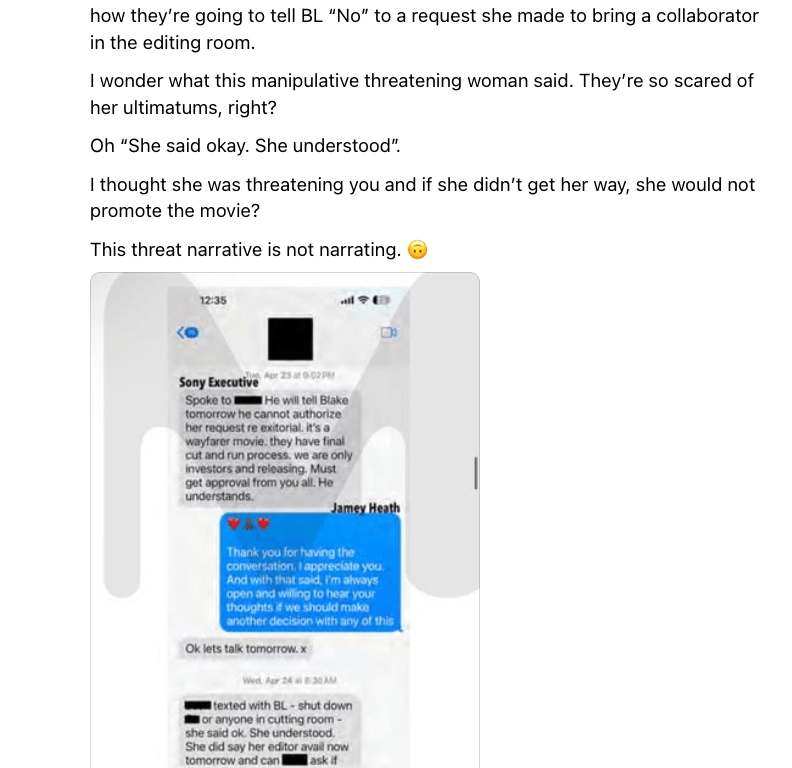
The screenshot appears to contain a conversation involving a Sony executive and Jamey Heath discussing Blake Lively’s request to have a collaborator in the editing room. The text confirms that the executive informed Lively that her request could not be authorized because Wayfarer had final control over the editing process. The message further states that she “said okay. She understood.”
This contradicts Baldoni’s lawsuit narrative, which claims Lively threatened and coerced the production team to take control of the film. If she had truly been issuing ultimatums, there should be evidence of pushback or resistance from her, yet the conversation suggests she accepted the decision without issue.
The claim that she would refuse to promote the film unless she got her way also seems unsupported. If she had used threats to gain control, it would be expected that the response from the production team would reflect tension or reluctance, yet the tone of the messages is calm and professional.
This further weakens Baldoni’s argument that Lively was manipulative or engaged in bad faith. Instead, it appears she made a request, received a denial, and moved on without protest—which does not align with the power-hungry persona that Baldoni’s lawsuit tries to paint. This is yet another example of how the evidence does not support the narrative being pushed against Lively.
This analysis further highlights the inconsistencies in Justin Baldoni’s claims against Blake Lively, particularly regarding control over the film and the alleged threats he attributes to her. Let’s break down how these findings reinforce Lively’s position and expose contradictions in Baldoni’s lawsuit.
The Narrative Shift: Apologies Turned to Gaslighting
On June 1, 2023, Baldoni’s team initially acknowledged Lively’s concerns and even apologized for certain behaviors. However, by the following day, they shifted the narrative, calling her concerns an “overanalysis.” This is a classic example of backtracking—where an initial recognition of wrongdoing is later reframed as the victim simply “misinterpreting” events. If Baldoni and his team truly believed she was “overanalyzing,” why did they initially agree to adjust and apologize?
The Firing of an Assistant Director – Lack of Evidence
Baldoni’s complaint alleges that Sony and Lively pressured them to fire an Assistant Director they wanted to keep. However, the documents fail to provide any communications or a specific reason as to why this person was fired. If this was a major claim against Lively, why is there no documentation showing her direct involvement? The omission suggests that this firing may not have been her decision or that it is being exaggerated for narrative purposes.
Cold Exchanges and the Absence of Direct Communication
There is a noticeable gap in long, informal text exchanges between Baldoni and Lively as time progresses. If their previous interactions involved detailed conversations and long texts, a sudden shift to short, logistical replies could indicate that Lively intentionally distanced herself following concerning behavior. Instead of proving manipulation, this suggests professional disengagement—likely due to discomfort, which aligns with her harassment claims.
The WGA Strike – Crossing Picket Lines?
A June 5, 2023, incident involving WGA picketers raises further ethical concerns about Baldoni’s decisions. Lively reportedly refused to cross picket lines, leading the production to rent a boat to film away from the protests. Meanwhile, Baldoni’s position on the issue remains vague. If he indeed crossed picket lines, it would explain tensions between him and his crew, shifting blame away from Lively.
Seven Pages of Notes – Overstated Criticism
On March 13, 2024, Lively reportedly provided seven pages of notes on the film’s edit. This was presented as extreme or unreasonable by Baldoni, but in the industry, seven pages for a full-length film is a minimal amount of feedback. Baldoni’s dismissive comment—“She doesn’t get it. Someone needs to tell her.”—not only downplays her role but also suggests he didn’t want to communicate directly with her anymore. If he was truly her boss, why wouldn’t he handle the discussion himself?
Vague Threat Allegations Without Evidence
On April 3, 2024, Baldoni’s complaint again references an alleged threat from Lively but fails to specify when, where, or how this occurred. No direct quotes, emails, or texts are provided. If these threats were real and damaging, why is the evidence so vague? The repeated reliance on paraphrasing rather than direct proof makes this claim weak.
Lively’s Editing Involvement – Was It About Nude Scenes?
Baldoni continuously frames Lively’s desire for input on the film’s edit as an overreach, but nowhere does he address why she wanted involvement. If her concerns related to nude or intimate scenes, this would be a valid reason for her insistence on oversight. The failure to clarify what specifically she wanted changed makes his claim appear misleading.
The “Threatening” Request to Bring an Editing Collaborator
On April 23, 2024, Lively requested to bring a collaborator into the editing room. The response from Sony was straightforward: they told her no because Wayfarer had final editorial control. She accepted the decision without protest, replying, “She said okay. She understood.”
This directly contradicts Baldoni’s lawsuit, which suggests that Lively issued ultimatums and refused to promote the film unless she had control. If she were truly manipulative, her response would have involved pushback or refusal to comply—but the texts show none of that.
This single exchange completely undermines the narrative that Lively was coercive or unreasonable.
Movie Cut Screenings – Whose Version Was Better?
On May 30, 2024, screenings for two versions of the film were held—one edited by Baldoni, the other by Lively. The results showed:
- Baldoni’s cut scored 85% with women under 35 (his “key demographic”)
- Lively’s cut scored 83% in total audience approval
While Baldoni’s cut performed slightly better in his preferred demographic, Sony still chose Lively’s version. This decision suggests that overall audience response—not just a narrow demographic—was the deciding factor. His frustration over this choice appears to be a personal issue rather than a professional one.
The Book Bonanza Stream – Mischaracterization of Events
Baldoni’s lawsuit alleges that the studio begged Lively not to showcase the film at the Book Bonanza event, claiming they had no choice but to allow it. However, video footage from the event paints an entirely different picture. If Baldoni’s allegations were accurate, the footage should have reflected reluctance or tension. Instead, it appears the event proceeded smoothly, again undermining his claims.
The Movie Poster Dispute – Where’s the Proof?
Baldoni alleges that Lively refused to approve the phrase “A film by Justin Baldoni” on the movie poster, which ultimately led to Sony removing the credit. However, no communication from Lively confirming this is provided. Instead, the only available messages show Sony making the request, which suggests this was a studio decision, not Lively’s demand. If Baldoni had proof that she directly blocked the credit, why wouldn’t he include it?
The PGA Mark – Private Praise, Public Denial
On June 25, 2024, Lively requested a letter of recommendation for a PGA Mark (Producers Guild of America accreditation for notable producer contributions). Jamey Heath, a Wayfarer executive, expressed hesitation, claiming he feared what Lively was capable of. Yet in his text directly to her, he stated, “You added a great deal to the movie beyond the acting role itself.”
Privately, they acknowledged her work. Publicly, they denied it. If Lively’s contributions were genuinely insufficient, why did Heath say otherwise to her face? This discrepancy suggests the attempt to block her producer credit was personal, not professional.
Conclusion: The Evidence Does Not Support Baldoni’s Claims
- The documents reveal multiple contradictions in Baldoni’s allegations.
- Lively’s concerns were acknowledged and apologized for before being reframed as overreactions.
- Allegations of her issuing threats are vague and unsupported by direct evidence.
- When told “no” regarding editorial involvement, she accepted it without resistance.
- The film’s final cut was chosen based on audience response, not personal favoritism.
- The PGA mark dispute reflects an intentional attempt to downplay Lively’s contributions rather than a fair judgment of her role.
Baldoni’s lawsuit appears to be an effort to control the narrative rather than a response to legitimate professional concerns. The gaps in evidence, reliance on paraphrased threats, and selective framing of events all suggest that his claims against Lively are strategically exaggerated rather than factually grounded.
If anything, the evidence paints a picture of a woman advocating for herself in an industry that often resists powerful female voices—and being retaliated against for doing so.
The Bigger Picture
Ultimately, the Forbes video does not harm Lively’s case. Instead, it highlights that she has been clear about her approach to creative projects, making Baldoni’s claims of an unexpected takeover less credible. His contradictions—arguing both that she was too uninvolved to deserve a producer credit and that she was controlling production—suggest that his real issue is not her level of contribution but rather the loss of power he experienced during the process.
If Baldoni had genuine concerns about Lively’s producer status, those should have been handled within industry standards rather than through a lawsuit that appears more focused on damaging her reputation. The real question is not whether Lively met the producer criteria—his own lawsuit suggests she did—but whether Baldoni deliberately blocked her credit as an attempt to control the film’s legacy.
Lively’s transparency about her creative ambitions, the contradictions in Baldoni’s lawsuit, and the PR tactics surrounding his legal actions all point to an effort to discredit her rather than resolve a legitimate dispute. The Forbes video does not undermine her claims but instead reinforces that she approached It Ends With Us as an engaged creative partner, not someone looking to manipulate the process for personal gain. Baldoni also buried another person through Wayfarer too.
 celebchai.com