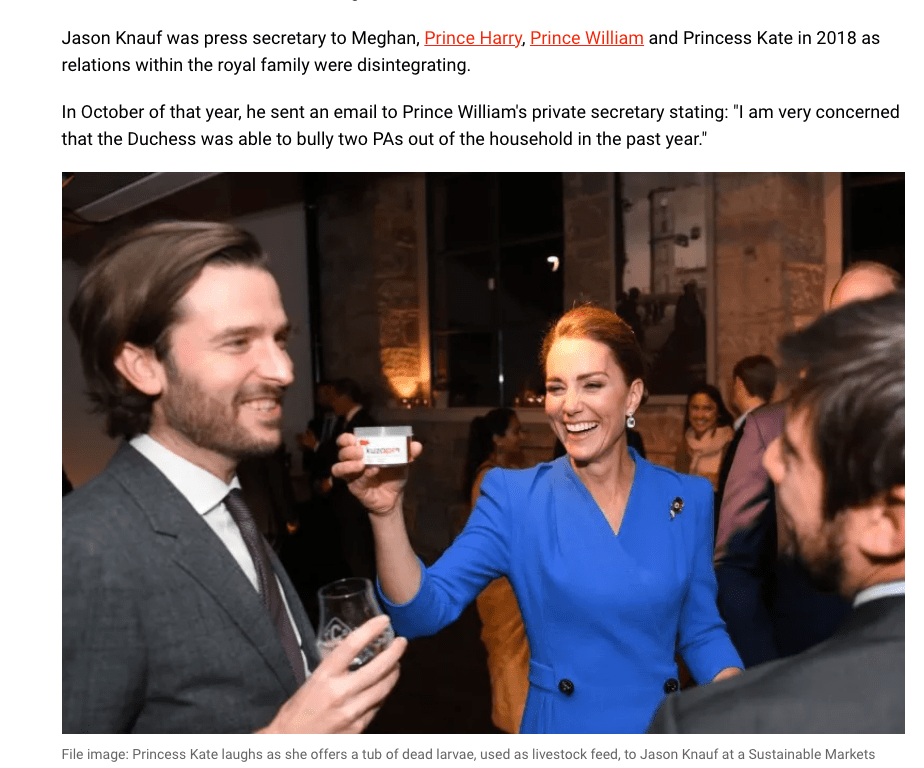
Jason Knauf:
Jason Knauf’s interview on 60 Minutes Australia attempts to reinforce an old narrative about Meghan Markle—one that relies on selective information, conveniently timed leaks, and unsupported accusations that never led to a publicized formal finding. However, when examined critically, his statements do little to prove Meghan engaged in wrongdoing. Instead, they highlight the broader power struggle within the royal family, the willingness of certain aides to act against her, and the way Meghan has been held to a different standard than other royals. Kate is on another rebrand.
1. The “Finding Freedom” Emails Prove Nothing Substantial
One of the key points that Knauf has been used to attack Meghan is his claim that she instructed him to provide background information to the authors of Finding Freedom, despite her legal team originally stating she had not cooperated with the book. When his emails surfaced during Meghan’s lawsuit against The Mail on Sunday, she apologized to the court, explaining she had forgotten about the correspondence.
Why is this not a major revelation?
- Forgetting an email exchange from years ago is not evidence of dishonesty—especially given the sheer volume of communications Meghan was handling at the time.
- If Meghan had intended to lie about this, she would have deliberately concealed it—but the emails surfaced in legal discovery, which is a routine process in lawsuits. There was no indication she attempted to suppress them.
- Providing background information to journalists or authors is common practice, even among royals. Prince William, for example, was reported to have discreetly authorized aides to provide information for Robert Lacey’s books about the monarchy.
The fact that Knauf’s emails emerged does not mean Meghan was engaged in deception. It simply means she did not initially recall a minor interaction that, in the grand scheme of things, had little bearing on her lawsuit against the Mail on Sunday.
2. The Bullying Allegations Were Unsubstantiated and Never Officially Proven
The more damaging claim Knauf made was that Meghan “bullied” palace staff, an accusation he first raised in an internal 2018 email that only became public in 2021. However, this claim collapses under scrutiny:
- No formal complaint was ever pursued. Knauf’s email expressing “concern” was not followed by any official HR action at the time. If his allegations had been as serious as they were later portrayed, why didn’t the palace take immediate steps to address them?
- The Buckingham Palace investigation into the bullying claims never released its findings. The palace launched an internal inquiry after the media firestorm in 2021, yet ultimately decided to keep its conclusions private. This raises a crucial question: if there were clear evidence of wrongdoing, why not release the results?
- Some former staff publicly defended Meghan. Meghan’s former aide, Melissa Toubati, allegedly resigned due to the pressures of working in the royal household, but other staff members later contradicted Knauf’s portrayal of Meghan as a bully. Some suggested the claims were exaggerated or misrepresented.
It is also telling that Knauf waited until after stepping away from working directly with Meghan and Harry before making his allegations known to the media. If he truly believed staff were being mistreated, why not act at the time?
The bullying allegations seem to be part of a broader effort to tarnish Meghan’s reputation rather than genuine concerns about workplace conduct. Meghan’s defenders argue that she faced resistance from a royal institution that was never fully welcoming of her presence. The allegations, conveniently leaked right before the Sussexes’ Oprah interview, appear to be part of a strategic effort to undermine her credibility at a critical moment.
3. Jason Knauf’s Close Ties to Prince William and the Palace’s Power Plays
Knauf’s role in this entire saga raises serious questions about his motivations. He was not just a neutral royal aide—he remained in close proximity to Prince William long after stepping away from his role with Harry and Meghan. At the time of the leaked allegations, Knauf was still working for the Royal Foundation, which is tied directly to William and Kate. He continues to be connected to William’s Earthshot Prize, indicating a strong loyalty to the future king.
This suggests a conflict of interest—Knauf’s decision to provide evidence in Meghan’s court case and to make his bullying claims public may have been influenced by palace politics rather than a genuine desire for accountability.
If there were truly an interest in transparency, why hasn’t Knauf spoken about other internal issues within the royal household? Why does he remain selective in what he discusses publicly? His comments in the 60 Minutes Australia interview were carefully worded, showing that while he was willing to discuss Meghan’s supposed failings, he refused to speculate too much on Prince William’s rift with Harry—another indication of where his loyalties lie.
4. The Broader Context of Royal Staff and Their Treatment of Meghan
Meghan has long been painted as a difficult and demanding boss, but it is worth asking: was she really any more demanding than other royals?
- Past accounts of royal life suggest a culture of demanding behavior from senior members of the family. Prince Charles (now King Charles III) has been known for his high expectations of staff, with some reports suggesting he has made unusual demands over the years. Stories of tense working environments within the palace are nothing new.
- Kate Middleton also faced staff turnover early on. When William and Kate first married, there were reports that multiple staff members left after struggling with the pressures of their roles. Yet, no allegations of bullying ever surfaced.
- The racial and gender dynamics cannot be ignored. Meghan was the first mixed-race woman to marry into the royal family. As a biracial American woman, she faced heightened scrutiny compared to other royal wives. The same behavior that might be seen as “assertive” in a white woman was portrayed as “bullying” in Meghan.
The idea that Meghan was uniquely difficult is not supported by a consistent standard applied to other royals. Instead, the selective framing of her behavior as problematic suggests a targeted effort to discredit her.
Conclusion: Jason Knauf’s Interview Proves Nothing New
At its core, Knauf’s interview does not introduce new information—it simply regurgitates old allegations in a way that benefits those who remain inside the palace system. Meghan’s supposed dishonesty regarding Finding Freedom is easily explained as a simple oversight, not a deliberate lie. The bullying allegations remain unproven, never led to any formal accountability, and are undermined by the fact that Buckingham Palace refused to release the results of its own investigation.
Knauf’s continued association with Prince William suggests that his involvement in these matters is not neutral. His selective decision to speak out about Meghan while being careful not to say too much about William and Kate reflects a pattern of media management that protects the royal institution’s image while scapegoating those who have left it.
In the end, this interview is less about uncovering new truths and more about reinforcing a well-worn narrative. It does not change the fact that Meghan faced an institution resistant to her presence, that she was subjected to intense public and media scrutiny, and that she ultimately made the decision to step away rather than continue fighting an uphill battle. Knauf may believe he was acting with integrity, but the broader context suggests his words serve a different purpose: protecting the palace at Meghan’s expense.
 celebchai.com