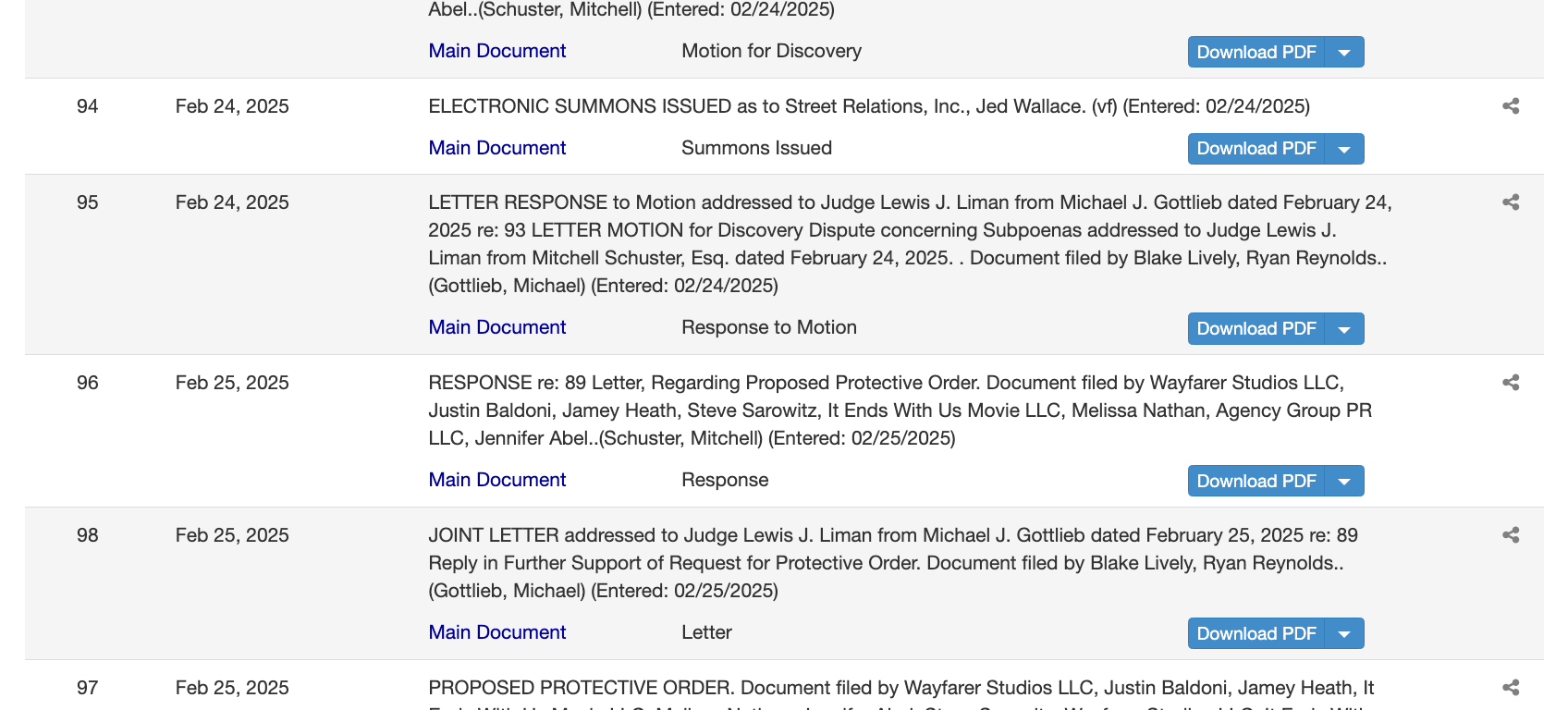
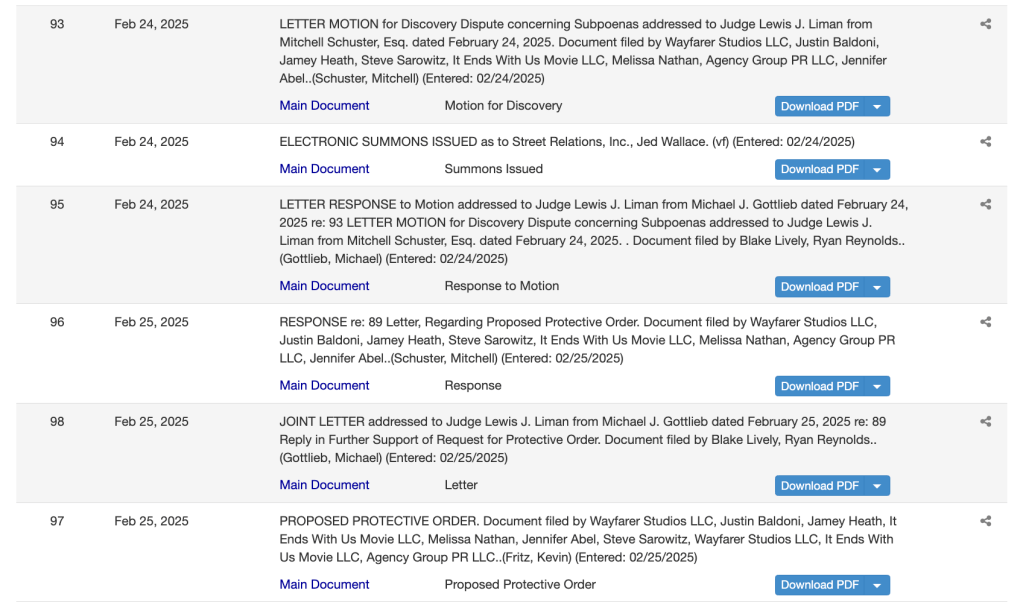
Document Chronology:
- February 24, 2025, Dkt #93: Wayfarer’s objection to Lively’s subpoenas to cell providers
- February 24, 2025, Dkt #95: Lively’s response defending the modified subpoenas
- February 25, 2025, Dkt #96: Wayfarer opposing Lively’s request for “Attorney’s Eyes Only” designation
- February 25, 2025, Dkt #97: Wayfarer’s proposed standard protective order
- February 25, 2025, Dkt #98: Lively’s reply supporting stronger protections for witnesses
Case Summary
This is a high-profile lawsuit between actress Blake Lively and the producers of the film “It Ends With Us.” The case involves sexual harassment allegations by Lively against director/actor Justin Baldoni and other defendants. Lively claims she was harassed and later became the target of a retaliatory “smear campaign” when she raised concerns. The documents show Wayfarer has filed a countersuit against Lively.
The current legal filings reveal two main discovery disputes:
- Subpoenas to cellular providers: Lively seeks non-content call and text logs from AT&T, Verizon, and T-Mobile to establish communication patterns during the alleged harassment and retaliation. Wayfarer objects, claiming these requests would reveal private communications unrelated to the case.
- Protective order scope: Both sides agree confidential information needs protection, but disagree on the extent. Lively wants an “Attorney’s Eyes Only” designation to protect sensitive materials, particularly for third-party witnesses who reportedly fear retaliation. Wayfarer argues Lively waived privacy by publicly discussing her allegations.
The case has garnered significant media attention, with Wayfarer’s counsel highlighting that Lively provided materials to The New York Times and made public statements about her allegations.
In a series of filings last week, Blake Lively and the producers of “It Ends With Us” squared off over critical discovery issues in their increasingly contentious legal battle.
This Week’s Legal Maneuvering
Two key battlegrounds emerged in court filings dated February 24-25, 2025:
Phone Records Fight
Lively’s legal team has subpoenaed major cellular carriers (AT&T, Verizon, and T-Mobile) seeking call and text logs—not content—to establish communication patterns during the alleged harassment and “untraceable” retaliatory campaign.
Wayfarer’s attorneys fired back in Document 93, claiming these requests are “overbroad” and would enable Lively to use “reverse phone lookup” to identify “every doctor, medical practitioner, lawyer, relative, friend” with whom Wayfarer employees communicated.
Lively’s counsel (Document 95) defended the subpoenas as standard discovery practice, noting they’ve already narrowed the requests by removing location data and limiting timeframes.
Protective Order Battle
Both sides agree confidential information needs protection during discovery, but disagree sharply on the extent.
Justin Baldoni literally set up a website for his papers:
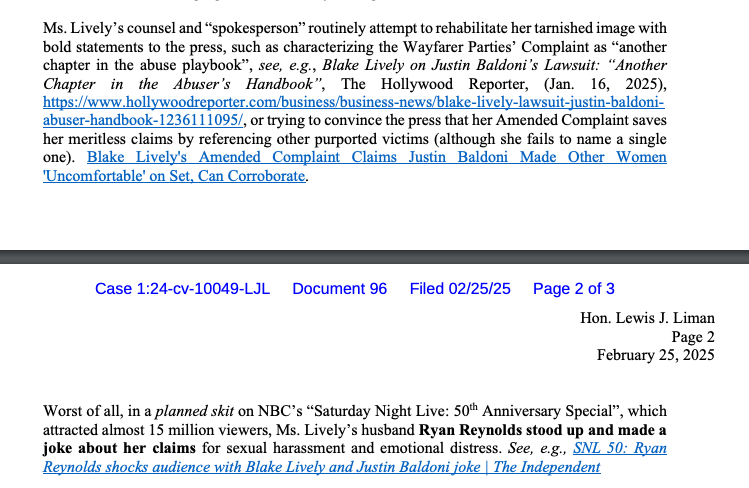
In a particularly pointed passage, Wayfarer’s counsel noted that Lively’s husband Ryan Reynolds “stood up and made a joke about her claims for sexual harassment” during NBC’s “Saturday Night Live: 50th Anniversary Special.”
Blake’s response:
First: Blake’s team replied at Docket 98 that they want third parties to have AEO (Attorney’s eyes only) to protect them.
Second: Paragraph 9 of the Model PO requires that the
Parties confer about the use of the AEO designation and, if they cannot reach agreement, seek relief from
the Court. The prospect of reaching future agreements on AEO designations would appear to be a fait
accompli given the Wayfarer Parties’ position that “Ms. Lively lacks a ‘good faith’ belief that there is
any information” that would violate her privacy rights because she has chosen to file a lawsuit detailing
her “so-called ‘harassment.’” Opposition at 2. Ms. Lively attempted to resolve her concerns about an
unsafe work environment privately and directly with Mr. Baldoni, Mr. Heath, Wayfarer, and others, and
only filed a legal complaint after the defendants launched the retaliatory smear campaign detailed in Ms.
Lively’s Amended Complaint. Leaving aside the callous disregard and disrespect for a woman
advocating for the most basic workplace protections against sexual harassment, the Wayfarer Parties’
position that a woman who speaks up against sexual harassment has somehow waived any and all privacy
interests shows the futility of future conferral.
Lively’s lawyers are saying there’s a problem with how the protective order process would work in practice. Here’s why:
- The standard court process (Paragraph 9) says that if you want to mark something as “Attorney’s Eyes Only,” you need to try to work it out with the other side first.
- But Wayfarer has already taken the extreme position that Lively has zero privacy rights left because she went public with her harassment claims.
- Lively’s team is saying: “What’s the point of trying to negotiate with them on this? They’ve already said they think Lively has no privacy rights at all. Any future discussions would be a waste of time.”
- They argue Wayfarer’s position is basically that any woman who speaks up about sexual harassment automatically gives up all privacy rights – which they say has no legal support.
- If the judge doesn’t allow “Attorney’s Eyes Only” designation now, they’ll have to keep coming back to court every time they need to protect sensitive information, wasting everyone’s time and the court’s resources.
In essence, Lively’s team is saying that normal negotiation won’t work here because Wayfarer has taken such an extreme position, so the judge should just establish stronger protections from the start.
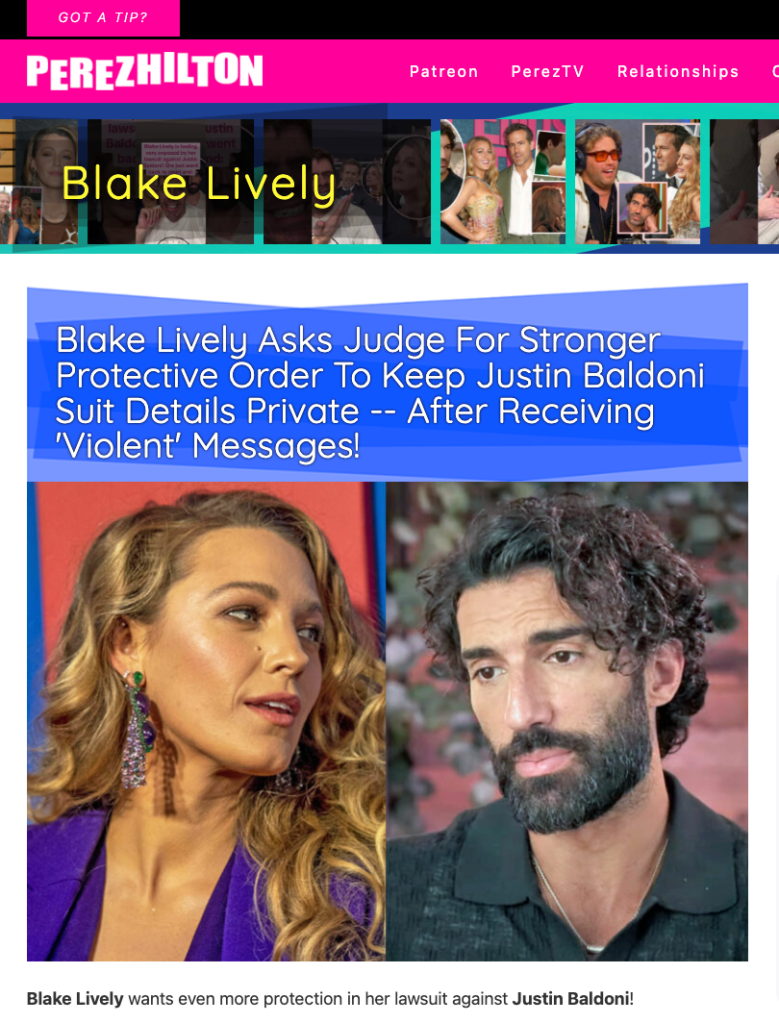
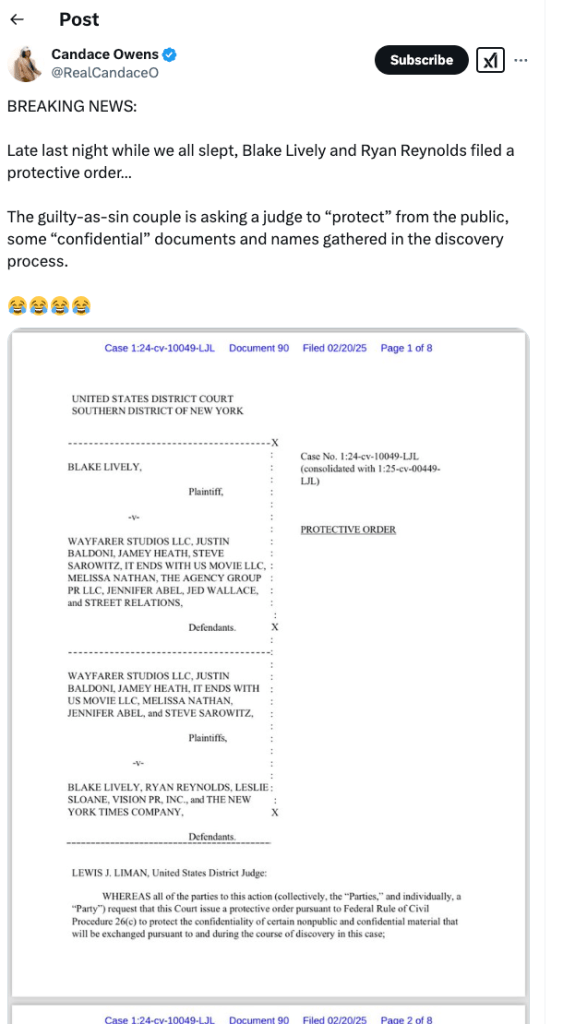
Third: Blake points to negative coverage of her at Perez Hilton, Candace Owens, and Mirror that uses the PO fight to suggest Blake is hiding something.

What’s Next
Judge Lewis J. Liman must now decide whether to allow Lively’s phone record subpoenas and which version of the protective order to adopt. The resolution of these procedural battles will shape how evidence is gathered and protected as this Hollywood drama moves closer to trial.
Protective Orders in Federal Litigation
Protective orders serve as crucial tools in the litigation process, especially in cases involving sensitive information like sexual harassment claims. They establish rules for how confidential information can be used, who can access it, and how it must be protected.
Types of Protective Order Designations
- Standard “Confidential” designation: Allows parties and their counsel to view materials but prevents public disclosure. This is the most common level of protection.
- “Attorney’s Eyes Only” (AEO): A higher level of protection where even the parties themselves cannot view certain materials—only their attorneys can. This is typically reserved for extremely sensitive information like trade secrets or, in cases like Lively’s, potentially sensitive personal information about witnesses or victims.
- Custom designations: Courts sometimes create specialized designations tailored to specific case needs.
Judicial Approach to Protective Orders
Judges typically balance several factors when deciding on protective order disputes:
- Presumption of public access: Courts generally favor transparency in judicial proceedings.
- Specificity of harm: Parties seeking protection must demonstrate specific harms, not just general privacy concerns.
- Proportionality: Protection should be narrowly tailored to protect legitimate interests without impeding the discovery process.
- Industry standards: In cases like sexual harassment, courts may consider established practices for protecting victim and witness identities.
Discovery Scope and Limitations
Federal Rule of Civil Procedure 26(b) permits discovery of any non-privileged material relevant to claims or defenses, provided it’s proportional to the needs of the case.
Phone Records Discovery
In cases involving communication patterns (like Lively’s allegations of a coordinated smear campaign), judges typically consider:
- Relevance threshold: How central are the communications to proving claims?
- Temporal scope: Are the timeframes reasonably limited?
- Privacy intrusion: Do the requests unnecessarily invade third-party privacy?
- Alternative means: Are there less intrusive ways to obtain similar information?
Burden of Proof
The party seeking to restrict discovery typically bears the burden of demonstrating why limitations are necessary. This is why Wayfarer’s arguments focus on overbreadth and privacy concerns rather than denying relevance entirely.
Judicial Decision-Making Patterns
Judges handling high-profile cases like Lively v. Wayfarer typically follow several principles:
- Incremental approach: Often starting with less restrictive measures before considering more stringent protections.
- Compromise solutions: Judges frequently craft middle-ground approaches, such as allowing phone records but with narrowed timeframes or limiting AEO designation to specific categories of documents.
- In camera review: For particularly sensitive materials, judges may review them privately before deciding on appropriate protections.
- Consideration of precedent: Courts look to similar cases, particularly those involving public figures and harassment allegations, to maintain consistency.
- Special attention to third parties: Judges tend to provide stronger protections for non-parties, recognizing they didn’t voluntarily subject themselves to litigation.
In the Lively case, Judge Liman will likely weigh Wayfarer’s privacy concerns against Lively’s legitimate need for evidence and the potential chilling effect on third-party witnesses if their information isn’t adequately protected. The judge may also consider the unusual public dimension of this case when crafting an appropriate protective order that balances all interests involved. One interesting note is that the judge has adopted Rule 3.6 of the New York Rules of Professional Conduct as a court order, which limits what attorneys can say publicly about the case. This suggests the judge is concerned about public statements affecting the proceedings.
 celebchai.com