It wasn’t a photo-op that fractured Sentebale. It was power without process, spending without accountability, and governance without transparency. While Dr. Sophie Chandauka continues to frame her fallout with Prince Harry and the board of Sentebale as racialized “harassment and bullying at scale,” the legal and operational realities tell a different story—one involving unauthorized spending, legal overreach, and governance breakdown at one of the UK’s most beloved royal charities.
The Viral Photo: Distraction or Deflection?
In April 2024, footage from the Royal Salute Polo Challenge showed Meghan Markle directing Dr. Chandauka to reposition herself during a staged photo. The moment sparked a minor buzz—but it wasn’t the photo that ignited an institutional collapse.

What followed in March 2025 was far more significant: Prince Harry and Prince Seeiso resigned as patrons of Sentebale, along with the charity’s entire board of trustees. Their statement was unequivocal. “These trustees acted in the best interest of the charity in asking the chair to step down. In turn, she sued the charity to remain… further underscoring the broken relationship.”

What Dr. Chandauka Claims Now
In a high-profile Sky News interview with Sir Trevor Phillips, Dr. Chandauka doubled down, accusing Prince Harry of:
- “Harassment and bullying at scale”
- Orchestrating an unannounced media release without her knowledge
- “Unleashing the Sussex machine” to damage her and harm the 540 Sentebale staff
She added, “That is an example of harassment and bullying at scale.”
But legal sources and former trustees immediately pushed back.

“Her claims are completely baseless,” a source close to the ex-trustees told Sky News, calling the interview a “publicity stunt.”
Dr. Kelello Lerotholi, one of Sentebale’s original trustees, told Sky’s royal correspondent Rhiannon Mills: “I had never witnessed these issues… The board always treated each other with respect. So this all came as a shock to me.”
The Legal Red Flags: Did Chandauka Act Alone?
One of the most serious concerns is whether Dr. Chandauka had the legal authority to appoint new trustees after the board’s mass resignation. UK charity law is clear: such appointments must follow the charity’s constitution and cannot be made unilaterally. If a board loses quorum, governance decisions are suspended unless approved by the Charity Commission.
Yet, the day before resignations were made public, Chandauka installed a new board—sparking accusations of a “power grab.”
Follow the Money: £500K in Consultants, No Results
While media headlines swirl, financial governance remains the heart of this scandal. According to reporting from People, The Times, and GB News:
- Chandauka authorized over £500,000 in consultant spending
- No major deliverables followed
- She requested a £300,000 salary for a traditionally unpaid chair role
- Former trustees accused her of altering minutes and operating without approval
When asked to resign, she filed a legal case to prevent her removal—forcing the trustees to vacate their roles entirely.
Public Outrage Is Growing
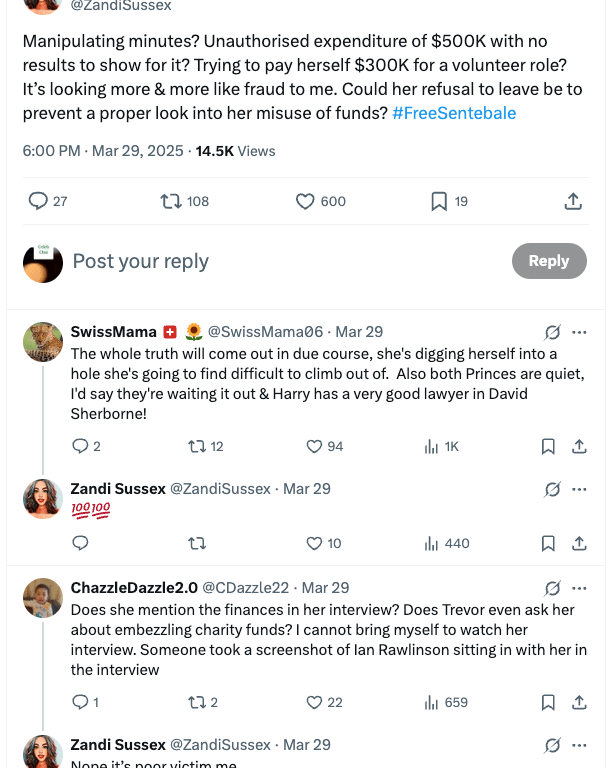
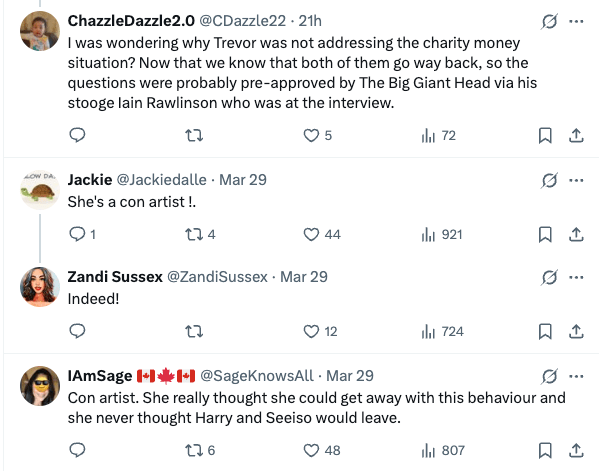
Across social media, public frustration is building—not toward Prince Harry, but toward Chandauka’s alleged misuse of funds and her refusal to step down.
“Trying to pay herself £300K for a volunteer role? It’s looking more & more like fraud to me.” —@ZandiSussex
“If all board & founders align against you, it’s time 2 go, quietly.” —@diannekhawkins
“She is trying to cover her misuse of funds and misdeeds.” —@Babca123
“Don’t people go to jail for embezzlement?” —@ThatFamilyBS
Even a Sky News source confirmed: no injunction was granted by the High Court to block her removal, contradicting her repeated public claims. Despite Dr. Chandauka’s repeated public assertions that the High Court of England and Wales had issued an injunction to block her removal as chair of Sentebale, GB News has now confirmed this was not true. According to their reporting, while she did file a legal challenge to prevent a board vote, the court did not grant an injunction, and no formal ruling was issued in her favor. In fact, the board meeting in question was simply canceled, making further judicial intervention unnecessary. This revelation significantly undercuts Chandauka’s narrative of legal vindication and raises questions about her public statements, credibility, and ongoing claim to leadership at the charity.
The Real Casualty: Sentebale’s Mission
Founded in 2006 in memory of Princess Diana and Queen ‘Mamohato, Sentebale’s mission was simple and vital: help young people affected by HIV/AIDS in Lesotho and Botswana. Under Dr. Chandauka’s leadership, that mission was diluted—rebranded into a vague “transformation agenda” emphasizing climate resilience, U.S. corporate partnerships, and ambiguous growth strategies.
Donors lost confidence. Income dropped. The charity that had once saved lives now risks becoming a cautionary tale.
Conclusion: No One Is Above Accountability—Not Even the Chair
Dr. Chandauka’s public narrative invokes powerful rhetoric: misogynoir, systemic bias, whistleblowing. But when weighed against the facts—unauthorized spending, board collapse, legal maneuvering, and a lack of transparency—her leadership raises more questions than answers.
Sentebale is not a personal brand. It is a charitable trust that deserves ethical leadership, not legal entrenchment.
The Charity Commission must act swiftly to investigate, restore governance, and protect the vulnerable children this charity was built to serve.
 celebchai.com