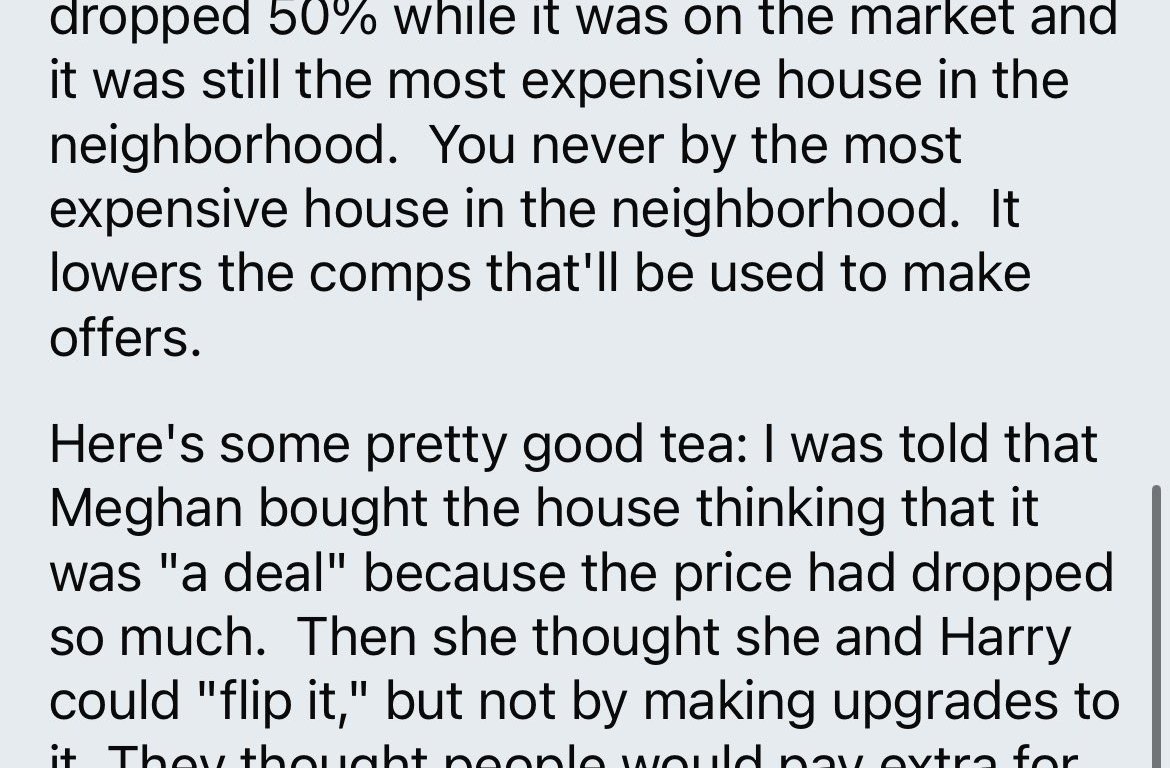
When Prince Harry and Meghan Markle purchased their Montecito estate in 2020, headlines painted it as a luxurious fresh start. Four years later, the same property has become a flashpoint for ridicule, real estate gossip, and online vitriol. A viral tweet alleging the couple made a “stupid investment” by buying the most expensive house in the neighborhood has triggered a wave of online mockery. But beneath the surface-level snark lies a deeper question: Is the criticism rooted in fact—or in a media narrative desperate to see them fail?
The original tweet claimed that the property sat unsold for years, dropped 50% in price, and was still overpriced when Harry and Meghan bought it. It went on to suggest that Meghan believed she could “flip” the home not through upgrades but by leveraging her celebrity status, assuming wealthy buyers would pay a premium simply to live in “Meghan Markle’s house.” This theory quickly became social media fodder, prompting thousands of replies mocking her as “delusional,” “narcissistic,” and “clueless.” Some even suggested putting the property on the National Register of Historic Places—likely sarcastically—while others declared the house “tired” and “raggedy.”
What’s telling is the tone and content of the replies. Many aren’t really about real estate. Instead, they reflect a cultural obsession with tearing down celebrity women, particularly those who are ambitious, visible, and polarizing. Meghan, who has become a lightning rod for criticism since stepping back from royal duties, is a convenient target. In one reply, she’s accused of not having the “real-world skills” to maintain a home. Another called her an “ex-yacht girl” and “grifter,” echoing smear campaigns that have long been discredited but continue to thrive in fringe internet spaces.
The joy with which users pile on—even over an unverified rumor—illustrates how easily misinformation spreads when it confirms preexisting biases. There’s little effort to verify whether the house did indeed drop 50%, whether comparable properties in Montecito have seen similar slowdowns, or whether celebrity homes often carry a premium (they sometimes do). Context is lost in the rush to mock.
Celebrity real estate is often misunderstood. The idea of “flipping” a home for profit is not unique to Meghan Markle. Many wealthy individuals buy during dips and hope to sell during booms. Sometimes they succeed. Sometimes they don’t. But assuming she expected people to enter a bidding war simply to have “bragging rights” of living in her house is pure speculation, likely designed to caricature her as self-obsessed.
Even the real estate wisdom in the viral tweet—“never buy the most expensive house in the neighborhood”—isn’t universally true. In exclusive enclaves like Montecito, where each property is distinct and comparables are limited, that rule doesn’t always apply. High-end real estate markets are often driven by factors beyond square footage and comp sets: privacy, provenance, architectural uniqueness, and yes, sometimes celebrity.
That said, the house has reportedly been difficult to sell. But in a broader sense, so have many luxury homes post-pandemic, as interest rates rise and buyers reassess priorities. To attribute every market fluctuation to Meghan’s decision-making is neither fair nor accurate. It’s a selective judgment cloaked in snide humor.
Ultimately, what the viral reaction reveals is not just skepticism about a real estate purchase—it’s a collective eagerness to see a powerful woman fall. Meghan Markle isn’t the first woman to be mocked for her ambition, and she won’t be the last. But when the conversation masquerades as real estate analysis while recycling misogynistic tropes, it’s worth asking: are we really talking about property, or are we indulging in something uglier?
Summary of the Replies
1. Tone and Sentiment Most of these replies are:
- Mocking and derisive (e.g., “raggedy kitchen,” “delusional,” “needs a straight jacket”)
- Personal attacks veiled as real estate criticism
- Echo-chamber reinforcement, where like-minded users build off each other’s disdain
2. Recurrent Themes
- Misjudgment and arrogance: Many claim Meghan and Harry lacked real-world experience or real estate savvy.
- Narcissism accusations: Frequent use of terms like “delusional,” “narc,” and “ego” to cast Meghan as out of touch.
- Schadenfreude: Users appear gleeful about the house allegedly depreciating and being unsellable, which is framed as karmic justice or proof of incompetence.
- Questionable real estate logic: Some users suggest the home should be on the National Register of Historic Places—an unlikely outcome for a relatively new celebrity-owned property, showing a mix of sarcasm and misunderstanding.
3. Fringe and Toxic Narratives A few responses veer into misogynistic or conspiratorial tropes (e.g., “yacht girl,” “grifter,” “mattress actress”)—accusations that stem from long-debunked smear campaigns.
Broader Media Context
This type of pile-on is not unique to this thread—it reflects a persistent media ecosystem where Meghan Markle, in particular, is a lightning rod for scorn, often disproportionate to the facts. A few points to consider:
- Echoes of “celebrity schadenfreude”: The wealthy are easy targets for glee when they stumble.
- Gendered narratives: Criticism of Meghan often focuses on ambition, vanity, or manipulation—traits that get interpreted very differently in men.
- Social media as feedback loop: Once a post like the original “bad investment” tweet goes viral, it reinforces existing biases, drawing in replies that escalate tone rather than question premise.
 celebchai.com