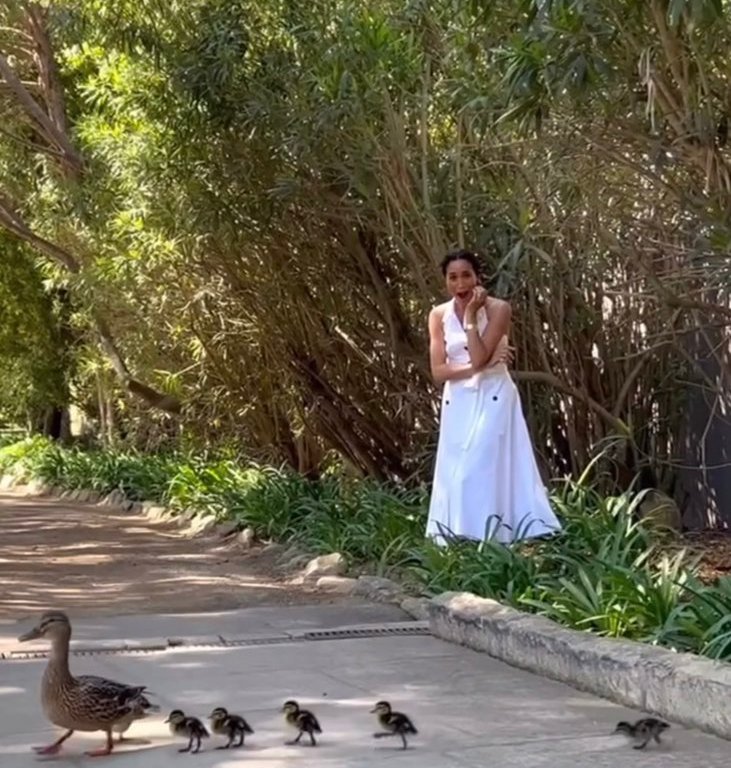
When did watching ducks become controversial? Apparently, the moment Meghan Markle did it. A short clip of Meghan gleefully pointing out ducks during a nature walk—an entirely innocuous and sweet moment—has become the latest battleground in the never-ending war waged by her critics. The disproportionate outrage over a few seconds of unscripted joy tells us far more about her detractors than it ever will about Meghan herself.
The backlash began, predictably, with social media users accusing Meghan of “performative joy” and “camera baiting,” ignoring the fact that the entire scene was filmed for her own show. She wasn’t interrupting a funeral. She wasn’t shouting over someone’s tragedy. She was smiling at ducks.
Yet, somehow, this has triggered a wave of fury, much of it from older white women who seem deeply offended by Meghan’s peace. To them, joy is something she’s not allowed to possess. They can’t accept that she’s moved on, built a life in California, and continues to find delight in small things. Meghan is, in their minds, supposed to be miserable—and more importantly, visible in that misery.
Heather (@HMefford123) put it bluntly: “It’s mortifying and revolting to witness their insane hatred towards a stunning and intelligent black woman that has so many gifts and natural talents.” Indeed, the root of this coordinated vitriol isn’t about birds or smiles—it’s about who is allowed to be happy and under what conditions.
Critics argued that Meghan’s reaction was “over the top,” or somehow staged. But these same critics never raised an eyebrow when Prince Harry marveled at hummingbirds during their Netflix docuseries. Why is his nature-loving awe adorable and hers calculated? Why is her spontaneous laughter performative while his quiet smiles are endearing?
The answer, as usual, lies in a toxic double standard shaped by gender, race, and class. Meghan is a biracial American woman who married into a centuries-old monarchy and dared to step back. For that, she must be perpetually punished in the eyes of those who believe she “got too far.” She is not allowed to enjoy ducks, not because watching ducks is offensive—but because her joy undermines the narrative that she is a pariah.
The irony, of course, is that the people accusing Meghan of being “attention-seeking” are the ones sharing, dissecting, and obsessing over a clip of her doing absolutely nothing scandalous. They’re the ones keeping her in the headlines. They’ve invented a game where the only way for her to “win” is to disappear, and even then, they’d probably say she’s hiding something.
More disturbing still is the overt racial undertone many have pointed out. Some tweets from white women claim that Meghan needs to “apologize to Harry” for showing joy. Others mock her as “emotional” and “desperate.” The fixation on her facial expressions, her body language, her voice, her clothes—none of this scrutiny happens in a vacuum. It’s part of a long history of policing Black women’s emotions, especially when those emotions fall outside of sorrow, anger, or silence.
As one Twitter user, @jhaye76940280, aptly said: “All they end up doing is just publicising their lack of love and joy in their obviously sad lives.” The spectacle isn’t Meghan. It’s the bizarre hysteria that surrounds her happiness.
This moment, ridiculous as it may seem, is a cultural mirror. It reflects how much work we still need to do to normalize women—particularly women of color—expressing joy without suspicion. It shows how easily empathy is weaponized when it’s selective. And it begs the question: who benefits from the media’s continued fixation on demonizing Meghan?
Spoiler: it’s not the public.
 celebchai.com