
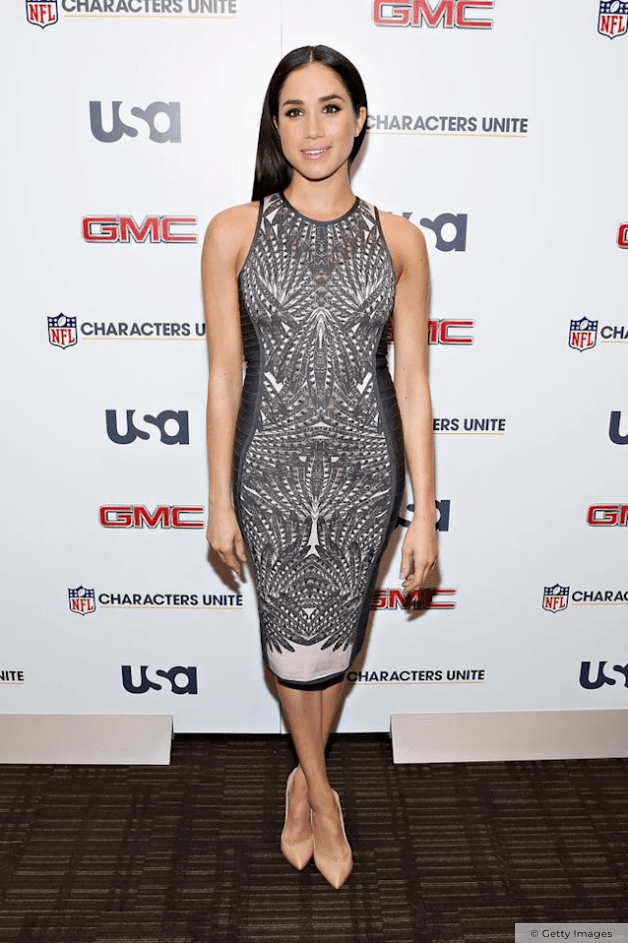
When Meghan stepped out in a snake print Hervé Léger bandage dress back in January 2014, she wasn’t just embracing a fleeting trend. She was tapping into one of the most polarizing pieces of millennial fashion history — and reigniting an old debate: who really gets to wear a bandage dress?
The dress, worn to the 3rd Annual NFL Characters Unite event at Sports Illustrated, was pure early-2000s nostalgia. Hervé Léger’s bodycon designs, famous for their elasticated strips that contour every curve, have long carried a loaded reputation. Some hailed them as a bold celebration of the body; others criticized them as unforgiving, exclusionary, and hypersexualized.
Yet the real tension surrounding the bandage dress has little to do with the fabric or the style itself. It lies in something much harder to admit: the division between those who can carry it off — and those who feel they can’t.
Bandage dresses make no apologies. They don’t camouflage, they don’t flow, they don’t forgive a missed workout. In an era where body positivity movements rightly challenge rigid beauty standards, the unapologetic structure of a Hervé Léger dress can seem almost defiant. It’s no wonder that even today, seeing someone like Meghan Markle in such a dress sparks heated reactions. It’s not really about the dress; it’s about what the dress demands from the wearer — and what it reveals about how we see ourselves.
When Meghan donned that snake print number, she embodied exactly what the bandage dress was designed for: confidence without compromise. It wasn’t a safe choice. It was a declaration. Whether intended or not, she reignited the bandage dress’s essential divide: admiration from those who see it as aspirational, resentment from those who view it as a relic of unattainable standards.
The fashion world loves to call clothes “divisive” when they provoke strong reactions. But in truth, the dress is just a mirror. It’s the audience that’s divided — divided between those who feel celebrated by such styles and those who feel excluded by them.
Meghan’s moment in Hervé Léger wasn’t just a nostalgic throwback. It was a reminder that fashion’s fiercest battles are never just about hemlines or fabrics. They’re about who feels seen, who feels left out, and who dares to wear the dress anyway.
 celebchai.com